Bitcoin transactions are public by design. Anyone can inspect the blockchain and see transaction details such as inputs, outputs, amounts, and the addresses or scripts involved.
That transparency is useful, but it also creates privacy challenges.
One of the most important examples is Bitcoin address reuse. If someone repeatedly receives Bitcoin using the same address, observers can often connect those payments together and potentially learn more about the person’s financial activity.
The usual solution is simple: generate a new Bitcoin address for every payment.
But what if you want to publish one permanent payment address on your website, donation page, or social media profile without publicly linking every payment you receive to the same on-chain address?
This is where Bitcoin Silent Payments come in.
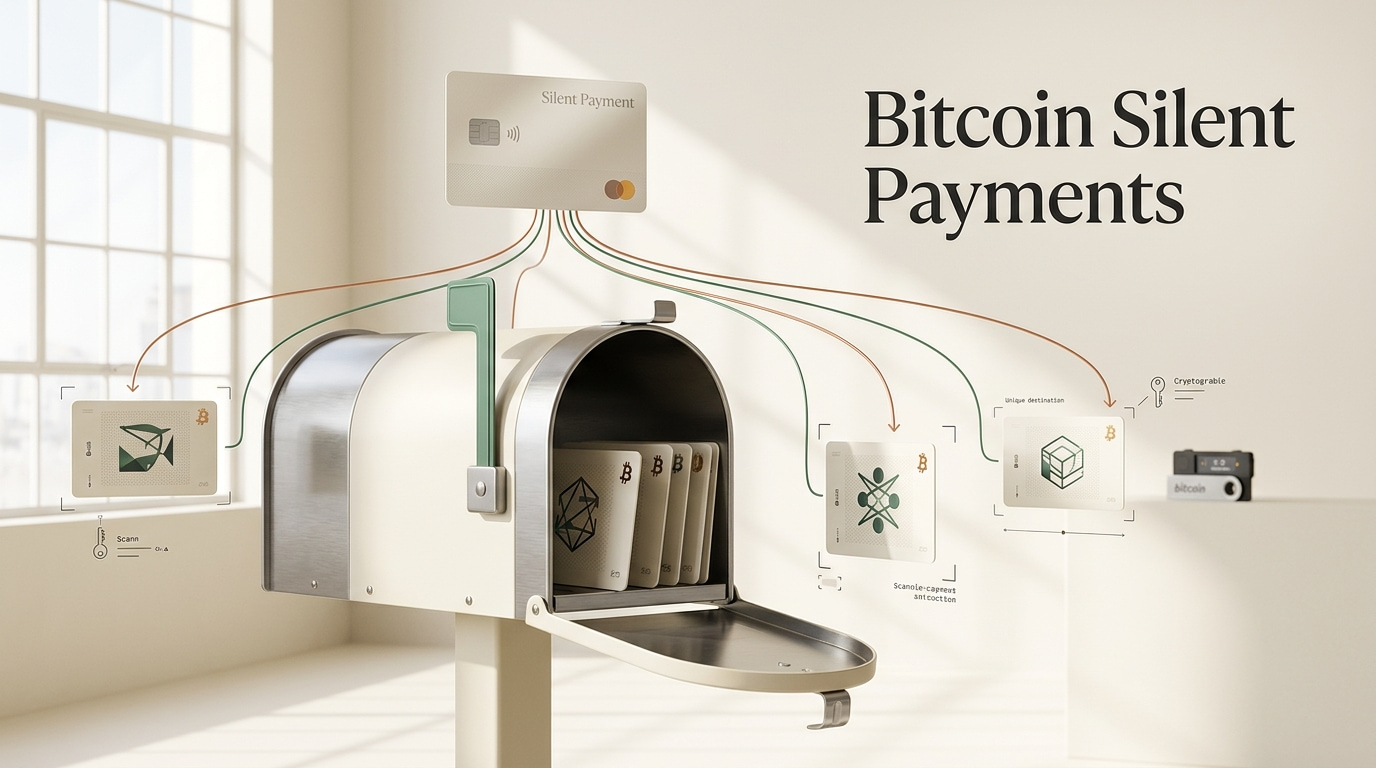
Silent Payments are a Bitcoin protocol that allows a recipient to publish a reusable payment instruction while each payment can still create a unique on-chain output. The recipient does not need to communicate with the sender to generate a fresh address for every payment.
In this guide, we will explain what Silent Payments are, why they were created, how they differ from ordinary Bitcoin addresses, and how the basic system works.
What Are Bitcoin Silent Payments?
Bitcoin Silent Payments are a protocol for receiving Bitcoin using a reusable payment address without requiring every payment to reuse the same on-chain address.
The concept is defined by BIP 352.
The basic idea is surprisingly elegant.
Instead of giving someone an ordinary Bitcoin address that directly identifies a particular output script, the recipient provides a special Silent Payment address.
The sender uses information from their transaction and the recipient’s Silent Payment information to derive a unique destination for that particular payment.
The recipient can then scan the blockchain and recognize the payment as belonging to them.
As a result, the same Silent Payment address can be shared repeatedly while the actual on-chain outputs associated with different payments can be different.
This solves an important problem:
How can someone publish one reusable payment instruction without publicly linking all of their payments together?
Why Is Bitcoin Address Reuse a Problem?
To understand Silent Payments, we first need to understand address reuse.
Imagine that you run a website and publish this Bitcoin address:
bc1qexample...
You tell everyone:
“Send Bitcoin donations to this address.”
Now imagine that 100 different people send Bitcoin to that same address.
All 100 payments appear on the blockchain as payments to the same destination.
Anyone examining the blockchain can potentially determine:
- how many payments arrived;
- when they arrived;
- how much Bitcoin was received;
- which transactions funded the address;
- how the received coins were later spent.
The problem becomes even greater if the address is publicly associated with your identity.
For example, suppose a business publishes one Bitcoin address on its website.
An observer can associate that address with the business and then monitor transactions involving it.
This is one reason Bitcoin wallets normally generate a new receiving address for each payment.
Why Not Just Generate a New Address Every Time?
You might reasonably ask:
“If address reuse is bad, why not simply generate a new address for every payment?”
For many situations, that is exactly what Bitcoin wallets do.
However, there is a practical problem.
Suppose you want to publish a permanent Bitcoin donation address on your website.
You could generate a new address whenever someone wants to donate, but then the donor and recipient need some way to communicate.
For a normal payment, the recipient might provide:
Address #1
Then another payment requires:
Address #2
Then another requires:
Address #3
This works well when there is direct communication between the sender and recipient.
But it becomes inconvenient when the payment information is published publicly.
Think about:
- donation pages;
- public websites;
- social media profiles;
- physical signs;
- business information;
- content creators;
- long-term payment instructions.
You may want to publish one payment instruction and leave it there.
Silent Payments are designed to address this problem.
The Main Idea Behind Silent Payments
The easiest way to understand Silent Payments is to compare them with ordinary Bitcoin addresses.
With a traditional Bitcoin address, the address corresponds to information that can be used to construct a specific output script.
The sender uses that information to create the transaction output.
With Silent Payments, the recipient’s payment information does not directly represent one fixed output script.
Instead, it contains public-key information that allows the sender to derive a unique destination using information from the transaction.
Bitcoin Optech describes this distinction clearly: a Silent Payment address does not encode a specific scriptPubKey; instead, it encodes public keys used to derive the actual output script.
This is the key idea.
Ordinary address
Address → Output script
Silent Payment
Silent Payment address + transaction information → Unique output
That means the same Silent Payment address can be reused without forcing every payment to the same on-chain destination.
A Simple Example
Imagine Alice wants to receive Bitcoin donations.
She publishes one Silent Payment address:
Alice’s Silent Payment address
Bob wants to send Alice 0.01 BTC.
Bob’s wallet uses Alice’s Silent Payment information together with appropriate information from Bob’s transaction to derive a unique destination.
Bob broadcasts the transaction.
Alice’s wallet scans the blockchain and recognizes the output as belonging to her.
Later, Carol sends Alice another 0.01 BTC using the same Silent Payment address.
Carol’s transaction produces a different destination.
Alice scans the blockchain again and recognizes Carol’s payment as hers.
An outside observer does not simply see:
Bob → Alice’s permanent address
and
Carol → Alice’s permanent address
Instead, the payments can appear as separate destinations on-chain.
That is the privacy advantage.
Silent Payments Do Not Require Interaction
One of the most useful properties of Silent Payments is that the sender and recipient do not need to communicate every time a payment is made.
With a normal new-address system, the recipient may need to provide a fresh address to the sender.
With Silent Payments, the recipient can publish a reusable payment instruction.
The sender can use it directly.
This is particularly useful for situations where the recipient cannot conveniently respond to every payer.
For example:
Public donation page
A charity could publish a Silent Payment address.
Content creator
A creator could place a payment instruction on a website.
Business
A company could publish payment information without having to continuously generate and distribute new addresses.
Personal payments
Someone could share their Silent Payment information privately without having to provide a new on-chain address every time.
The protocol is specifically designed to provide a static payment address without requiring on-chain notifications.
How Does a Silent Payment Actually Work?
The technical mechanism uses public-key cryptography.
At a high level, the sender and recipient use information from their respective keys to derive a shared secret.
This concept is related to Elliptic Curve Diffie-Hellman, commonly abbreviated as ECDH.
You do not need to understand the mathematics to understand the basic idea.
Think of it as a way for two parties to independently calculate the same secret using their keys.
The sender uses their relevant private-key information and the recipient’s public information.
The recipient later uses their private scanning key and information from the sender’s transaction.
Both sides can therefore arrive at the information needed to identify the resulting payment.
Bitcoin Optech explains that Silent Payments use the transaction’s input public keys together with the recipient’s Silent Payment information to derive the destination.
The Recipient Has Special Keys
Silent Payments introduce an important concept that differs from ordinary Bitcoin receiving addresses.
A Silent Payment wallet uses key material for two main purposes:
Scanning
The wallet needs to determine whether a particular blockchain transaction contains a payment belonging to it.
Spending
Once the wallet discovers the payment, it needs the appropriate private key material to spend those coins later.
This creates a useful separation between:
Finding payments
and
Spending payments
Current Silent Payment descriptor work formalizes this distinction with separate scanning and spending information. BIP 392 describes formats for exporting and importing Silent Payment wallet information, including watch-only scanning arrangements and full spending wallets.
We will explore these keys in much more detail in Part 2.
Why Does the Recipient Need to Scan the Blockchain?
There is an important trade-off with Silent Payments.
With an ordinary Bitcoin wallet, the wallet can often determine whether an output belongs to it by examining the output script or address.
Silent Payments work differently.
The destination is derived from information involving the transaction itself.
Therefore, the recipient needs to scan blockchain transactions to determine whether they contain payments belonging to the wallet.
Bitcoin Optech describes this as one of the main disadvantages of Silent Payments: scanning is more computationally expensive than simply checking the UTXO set for known output scripts.
This is one of the most important things to understand about Silent Payments:
Better receiving privacy comes with additional scanning work.
Silent Payments vs Traditional Bitcoin Addresses
Let’s compare the two systems.
| Feature | Traditional Address | Silent Payment |
|---|---|---|
| Can be shared publicly | Yes | Yes |
| Can be reused | Technically yes, but poor privacy | Designed for reuse |
| Same address for every payment | Usually same output destination | No |
| Fresh on-chain destination per payment | Requires new address | Yes |
| Requires sender-recipient interaction for every payment | Often needed for fresh addresses | No |
| Recipient scanning complexity | Relatively low | Higher |
| Privacy against address reuse | Limited if reused | Improved |
The biggest difference is the relationship between the published payment information and the actual on-chain destination.
With Silent Payments, one reusable payment instruction can result in different on-chain outputs.
Silent Payments vs Bitcoin Payment Codes
You may have heard of BIP47 reusable payment codes.
Both systems attempt to solve a similar practical problem:
How can someone share reusable payment information without forcing all payments to the same visible Bitcoin destination?
However, they use different mechanisms.
BIP47 uses notification transactions to establish information between the sender and recipient.
Silent Payments were designed specifically to avoid the need for on-chain notification transactions. BIP 352 describes the protocol as providing static payment addresses without on-chain linkability of payments or on-chain notifications.
This makes Silent Payments particularly interesting as a modern Bitcoin privacy technique.
Silent Payments and CoinJoin Are Different
Silent Payments should not be confused with CoinJoin.
CoinJoin changes the structure of a transaction by combining inputs from multiple participants.
Its goal is primarily to make transaction ownership and transaction history harder to analyze.
Silent Payments solve a different problem.
They focus on receiving payments privately without address reuse.
For example:
CoinJoin
“How can multiple users combine transaction activity to improve privacy?”
Silent Payments
“How can I publish reusable payment information without forcing every payment to the same visible destination?”
They can therefore be thought of as different privacy tools.
They address different stages of Bitcoin transactions.
Are Silent Payments Completely Anonymous?
No.
This is an important distinction.
Silent Payments can improve privacy, but they do not make Bitcoin transactions magically anonymous.
The Bitcoin blockchain remains public.
Transaction inputs, outputs, amounts, timing, and other information can still provide clues.
Other privacy leaks can also occur through:
- wallet behavior;
- network metadata;
- exchange records;
- address clustering;
- transaction patterns;
- spending behavior;
- publicly identifying information.
Silent Payments primarily address the problem of receiving payments without repeatedly exposing the same on-chain destination.
They should therefore be viewed as a privacy-enhancing technology rather than a complete anonymity solution.
Why Silent Payments Matter
Bitcoin was designed with transparent transactions.
That transparency is one of its defining characteristics, but privacy often requires users to take additional steps.
Generating a new address for every payment helps, but it creates a practical communication problem when someone wants to publish a permanent payment instruction.
Silent Payments attempt to bridge that gap.
They allow someone to publish a reusable payment address while still generating unique on-chain destinations for individual payments.
That combination is what makes the technology interesting.
How Bitcoin Silent Payments Work
In Part 1, we explained the problem Silent Payments are designed to solve.
A traditional Bitcoin address can be reused, but doing so can make multiple payments easier to link together. Generating a fresh address for every payment improves privacy, but it is inconvenient when someone wants to publish a permanent payment destination.
Silent Payments take a different approach.
A recipient can publish a reusable Silent Payment address, while senders use information from their own transaction to derive a unique destination for each payment.
The result is a system where the recipient does not need to communicate with every sender to create a new address.
But how does this actually happen?
To understand that, we need to look at the keys and cryptographic process behind Silent Payments.
The Two Important Roles: Scanning and Spending
One of the easiest ways to understand Silent Payments is to separate two different jobs:
Finding payments
and
Spending payments
A Silent Payment wallet needs to scan the blockchain and determine whether particular outputs belong to it.
Once the wallet discovers a payment, it also needs the appropriate private key to spend those coins.
This means Silent Payment systems can conceptually separate:
- information used for scanning;
- information used for spending.
This separation is important because it can allow specialized wallet setups, including watch-only arrangements where a device can detect incoming payments without having the ability to spend them.
BIP 352 defines the Silent Payments scheme using separate scan and spend key material. It also specifies how a Silent Payment address contains the information required for senders and recipients to participate in the protocol.
What Is a Scan Key?
The scan key allows a wallet to look for payments belonging to it.
Think of it like a detector.
The wallet examines eligible blockchain transactions and uses the scan key to determine whether a particular output was generated for the recipient.
The scan key itself does not mean that the wallet can spend the discovered Bitcoin.
That distinction is important.
A wallet could potentially give scanning capability to another system while keeping the spending keys offline.
For example, imagine a business that wants its accounting server to detect incoming Bitcoin payments.
The server could have information necessary to identify incoming Silent Payments while the private spending keys remain protected elsewhere.
This creates an interesting separation between:
Monitoring
and
Authorization
What Is a Spend Key?
The spend key is associated with actually controlling the Bitcoin once it has been received.
After the wallet identifies a payment, the corresponding private key material is needed to create a valid Bitcoin signature when those coins are eventually spent.
Think of it like this:
Scan key = Find the payment
Spend key = Spend the payment
The two roles work together, but they have different purposes.
This is similar to the broader idea of watch only Bitcoin wallets, where a system can monitor addresses and balances without holding the private keys required to spend funds.
The Silent Payment Address
A Silent Payment address looks different from a traditional Bitcoin address.
It contains public information associated with the recipient’s Silent Payment keys.
The sender uses that information to derive the actual destination for the payment.
This is an important distinction.
With a normal address, the sender essentially receives a destination that can be directly used to construct the output.
With Silent Payments, the published address acts more like a set of instructions for deriving a destination.
BIP 352 specifies the format and encoding of Silent Payment addresses and defines the public keys used by senders and recipients.
You can therefore think of the Silent Payment address as a reusable payment recipe rather than a single reusable on-chain destination.
The Shared-Secret Idea
Now we reach the cryptographic part.
Silent Payments use an approach based on elliptic-curve Diffie-Hellman, commonly called ECDH.
Don’t worry about the mathematical details.
The basic concept is simple:
Two parties can use their respective key information to independently derive the same secret.
The sender has private-key information.
The recipient has corresponding public and private key information.
Using the appropriate combination, they can derive a shared value that an outside observer cannot simply calculate from the public blockchain information.
That shared value is then used as part of the process that creates the recipient’s unique payment destination.
BIP 352 defines this shared-secret calculation as part of the Silent Payments protocol.
A Simple Analogy for the Shared Secret
Imagine Alice and Bob each have a special mathematical lock.
Alice can give Bob one part of the information publicly.
Bob can combine Alice’s public information with his own secret information.
Alice can do the reverse using Bob’s relevant public information and her own secret information.
Both arrive at the same secret result.
An observer can see the public information but cannot simply reproduce the secret without the necessary private-key material.
Silent Payments use this general cryptographic principle to allow the sender and recipient to derive information that can be used to create and recognize a payment.
The real protocol is more precise than this analogy, but the analogy captures the important idea.
What Happens When Someone Sends a Silent Payment?
Let’s walk through a simplified example.
Suppose Alice publishes her Silent Payment address.
Bob wants to send her Bitcoin.
Step 1: Bob gets Alice’s Silent Payment address
Alice does not need to create a new payment address specifically for Bob.
She can simply give Bob her reusable Silent Payment information.
Step 2: Bob prepares his Bitcoin transaction
Bob chooses the Bitcoin inputs he wants to spend.
These inputs provide important information for the Silent Payment calculation.
Step 3: Bob derives the payment destination
Bob’s wallet combines relevant transaction input information with Alice’s Silent Payment public keys.
This produces a unique destination for Alice’s payment.
Step 4: Bob creates the transaction
The transaction contains the newly derived output.
An outside observer sees a normal Bitcoin transaction output rather than an obvious statement saying:
“This payment belongs to Alice.”
Step 5: Bob broadcasts the transaction
The transaction enters the Bitcoin network and eventually becomes part of the blockchain.
Step 6: Alice scans the blockchain
Alice’s wallet examines transactions and performs the necessary calculations to determine whether any outputs were created for her.
Step 7: Alice identifies the payment
If the calculation matches her Silent Payment information, the wallet recognizes the output as belonging to her.
Step 8: Alice can spend it later
Her wallet has the necessary key material to construct a valid spending transaction.
This is the basic Silent Payment lifecycle.
Why Do Transaction Inputs Matter?
One unusual aspect of Silent Payments is that information from the sender’s transaction inputs plays an important role in deriving the recipient’s destination.
This is part of what makes each payment different.
Suppose Bob sends Alice a payment today.
The transaction has one set of inputs.
Later, Carol sends Alice another payment.
Carol’s transaction has a different set of inputs.
The resulting derivation can therefore produce a different destination for each payment.
This is how the protocol can avoid simply sending everything to one reusable on-chain destination.
BIP 352 specifies how eligible transaction inputs contribute to the shared-secret calculation and how the resulting output keys are derived.
Why Does Every Payment Get a Different Destination?
This is the heart of Silent Payments.
Imagine Alice publishes one Silent Payment address.
Bob pays her.
The resulting output might correspond to:
Destination A
Later, Carol pays her.
The resulting output might correspond to:
Destination B
Later, David pays her.
The resulting output might correspond to:
Destination C
All three payments were made using the same published Silent Payment information.
Yet the on-chain destinations can be different.
This makes it substantially harder for an outside observer to simply identify all incoming payments by looking for one reused address.
How Does Alice Know Which Output Belongs to Her?
This is where the scanning process becomes important.
Alice’s wallet cannot simply search the blockchain for her published Silent Payment address.
That address is not the actual destination appearing in each transaction.
Instead, the wallet needs to perform the Silent Payment derivation process.
At a high level, it:
- Examines eligible transactions.
- Extracts the required public information.
- Uses Alice’s scanning key.
- Recreates the relevant shared-secret calculation.
- Derives candidate output information.
- Compares the derived result with transaction outputs.
- Identifies outputs belonging to Alice.
If there is a match, the wallet knows that the payment belongs to it.
This is why Silent Payment wallets have a greater scanning workload than ordinary wallets.
Why Scanning Is More Expensive
A traditional wallet can often monitor the blockchain for outputs associated with known scripts or addresses.
Silent Payments are different.
The wallet needs to perform additional calculations to determine whether a transaction created a payment for it.
Bitcoin Optech identifies this increased scanning requirement as an important trade-off of Silent Payments. The recipient may need to scan transactions rather than simply monitoring a known set of output scripts.
This creates an interesting privacy trade-off:
More privacy at the receiving-address level
in exchange for
More work for the recipient’s wallet.
Modern hardware and software can make this practical, but wallet developers still need to design efficient scanning systems.
What Does a Silent Payment Look Like on the Blockchain?
One of the interesting characteristics of Silent Payments is that the resulting outputs do not necessarily advertise:
“This is a Silent Payment.”
The output can use standard Bitcoin output types.
BIP 352 currently specifies Silent Payments using Taproot outputs.
This means an observer looking at the blockchain may see a normal-looking Taproot output rather than a special visible “Silent Payment” marker.
That is important for privacy.
The protocol is designed so the recipient can recognize the payment while an outside observer does not automatically receive the same information.
Does the Sender Know the Recipient’s Private Key?
No.
The sender does not learn Alice’s private spending key.
The sender only uses the public information contained in Alice’s Silent Payment address together with information from the sender’s own transaction.
The cryptographic construction allows the destination to be derived without revealing the recipient’s private key.
Likewise, Alice does not need Bob’s private keys.
Both sides use their own secret information and the appropriate public information from the other side.
This is a fundamental property of public-key cryptography.
What Happens if Alice Receives Multiple Payments?
Suppose Alice publishes one Silent Payment address.
Over several days, she receives payments from five different people.
Each sender uses the same published Silent Payment information.
However, each transaction can result in a different destination.
Alice’s wallet scans the blockchain and identifies each payment.
From Alice’s perspective, all five payments belong to the same wallet.
From the blockchain’s perspective, the payments can appear as outputs to different destinations.
This is one of the primary privacy improvements Silent Payments are designed to provide.
Can Someone See That Alice Received Bitcoin?
Silent Payments do not make blockchain activity invisible.
An observer can still see that Bitcoin moved.
They can inspect:
- transaction inputs;
- transaction outputs;
- amounts;
- block times;
- transaction structure;
- subsequent spending activity.
The privacy benefit comes from making it harder to directly connect those outputs to Alice’s published Silent Payment information.
If Alice publicly reveals that a particular transaction belongs to her, that information can obviously reduce the privacy benefit.
Likewise, other transaction-analysis techniques may still reveal relationships.
Silent Payments should therefore be understood as privacy-enhancing, not as a complete anonymity system.
Silent Payments and Watch-Only Wallets
The separation between scanning and spending creates another interesting possibility.
Imagine a wallet that needs to monitor incoming payments but should not have the ability to spend them.
A watch-only system could potentially perform the scanning process while the spending keys remain offline or on a separate secure device.
This can be useful for businesses, treasury systems, and other setups where monitoring and spending responsibilities are deliberately separated.
However, the exact capabilities depend on the wallet software and implementation.
Users should not assume that every Silent Payment wallet supports every watch-only configuration.
Silent Payments and Existing Bitcoin Knowledge
At this point, several of the concepts from our previous Bitcoin articles come together.
Bitcoin Addresses
Silent Payments provide a different approach to reusable payment information.
Bitcoin Private and Public Keys
Public information can be shared, while private keys remain secret.
Bitcoin Taproot
Silent Payment outputs use Taproot output structures.
HD Wallets
Wallet key derivation can be used to organize and manage key material.
Output Descriptors
Descriptors can provide structured information about wallet outputs and key derivation.
PSBTs
PSBTs can help move transaction information between signing devices and wallet components.
CoinJoin
CoinJoin and Silent Payments both improve Bitcoin privacy, but they solve different problems.
Understanding these concepts makes Silent Payments much easier to understand.
Silent Payments Have a Trade-Off
No privacy technology is completely free.
Silent Payments provide an important benefit:
A reusable payment address without requiring the recipient to reuse one visible on-chain destination.
But they also introduce additional complexity.
The recipient’s wallet needs to scan blockchain transactions and perform cryptographic calculations.
Wallet software therefore needs to optimize the scanning process.
There can also be compatibility limitations because Silent Payments require wallet software that understands the protocol.
So the trade-off can be summarized as:
Better receiving privacy → More wallet complexity and scanning work
What Happens if a Wallet Goes Offline?
Suppose Alice’s wallet is offline for several months.
Bob sends Alice a Silent Payment while her wallet is unavailable.
The transaction can still be confirmed on the blockchain.
When Alice’s wallet eventually comes back online, it can scan the relevant blockchain history and attempt to identify the payment.
This is another important difference from systems that rely on the recipient being online to acknowledge a payment.
However, the wallet needs access to the relevant blockchain information and must perform the required scanning process.
Why Silent Payments Are Technically Interesting
Silent Payments solve a problem that is easy to describe but difficult to solve elegantly.
The goal is:
Allow a recipient to publish reusable payment information while avoiding the privacy problems of repeatedly paying the same visible address.
To achieve this, the protocol combines:
- public-key cryptography;
- transaction input information;
- shared-secret derivation;
- unique output generation;
- recipient-side scanning.
The result is a system that can make receiving Bitcoin more private without requiring the sender and recipient to exchange a new address for every payment.
Bitcoin Silent Payments: Privacy Benefits, Limitations, Security, and FAQs
Silent Payments offer an interesting solution to one of Bitcoin’s long-standing privacy challenges: how to receive payments without repeatedly exposing the same on-chain destination.
Instead of asking every sender to use a different address, a recipient can publish one reusable Silent Payment address. Senders use that information to derive unique payment destinations, while the recipient’s wallet scans the blockchain to identify payments belonging to it.
That approach provides meaningful privacy benefits.
However, Silent Payments are not a perfect privacy solution, and they are not completely anonymous. They also introduce additional wallet complexity and scanning requirements.
Understanding both sides is important before deciding whether Silent Payments are useful for you.
What Are the Main Privacy Benefits of Silent Payments?
The primary advantage is straightforward:
Silent Payments can reduce the need for Bitcoin address reuse.
A traditional address can reveal a relationship between multiple payments when the same address receives funds repeatedly.
Silent Payments are designed so that one published payment address can lead to different on-chain destinations.
This can make it more difficult for an observer to connect incoming payments simply by searching for a single reused address.
1. One Published Address
A user can publish one Silent Payment address on a website, profile, donation page, or other public location.
The address does not need to be replaced every time someone wants to make a payment.
This makes Silent Payments particularly convenient for public-facing payment information.
2. Different On-Chain Destinations
Although the published Silent Payment address remains the same, individual payments can produce different on-chain output keys.
Therefore, an observer cannot simply search for the published Silent Payment address and find every payment associated with it.
This is one of the fundamental privacy properties described by BIP 352.
3. No Notification Transaction
Some reusable payment systems require an additional notification transaction so that the sender and recipient can establish the information needed for payments.
Silent Payments were specifically designed to avoid this requirement.
The sender can derive the payment destination directly using information available from the transaction and the recipient’s published Silent Payment information.
BIP 352 describes this as a static payment mechanism that does not require on-chain notifications.
This can make the system more efficient and less publicly linkable than approaches that require notification transactions.
Silent Payments vs Normal Bitcoin Addresses
The difference becomes clearer when we compare the two approaches.
| Feature | Normal Bitcoin Address | Silent Payment |
|---|---|---|
| Can be published publicly | Yes | Yes |
| Reusable | Yes, but privacy suffers | Designed to be reusable |
| New destination for each payment | Requires new address | Derived automatically |
| Sender needs a fresh address | Usually yes | No |
| Recipient blockchain scanning | Relatively simple | More computationally demanding |
| Payment privacy | Depends heavily on address handling | Improved against address reuse |
This doesn’t mean Silent Payments make all Bitcoin activity private.
They specifically improve the receiving side of Bitcoin privacy.
Silent Payments vs CoinJoin
Silent Payments and CoinJoin are both associated with Bitcoin privacy, but they operate differently.
Silent Payments
Focus on:
How Bitcoin is received.
The goal is to avoid repeatedly exposing the same destination when receiving payments.
CoinJoin
Focuses on:
How transaction inputs and outputs are combined.
Multiple participants contribute inputs to a transaction, making blockchain analysis more difficult.
In simple terms:
Silent Payments help hide the connection between a published payment destination and individual received outputs.
CoinJoin can make transaction ownership and transaction history harder to analyze.
These technologies therefore solve different privacy problems.
They should not be treated as competing versions of the same technology.
Silent Payments vs HD Wallets
HD wallets and Silent Payments also solve different problems.
An HD wallet, or Hierarchical Deterministic wallet, allows a wallet to derive many keys and addresses from a master seed.
This makes it practical to generate a new Bitcoin receiving address for different payments.
Silent Payments take a different approach.
Instead of requiring the recipient to send a new address to every payer, the recipient can publish reusable Silent Payment information.
The two technologies can therefore complement each other.
An HD wallet can provide the key-management structure underneath a wallet, while Silent Payments can provide a private receiving mechanism.
Silent Payments vs BIP47 Payment Codes
BIP47 and Silent Payments address a similar problem: reusable payment information.
However, their mechanisms are different.
BIP47 uses notification transactions to establish information between participants.
Silent Payments were designed to eliminate the need for these on-chain notification transactions.
This distinction matters because notification transactions can themselves create additional blockchain activity.
Silent Payments instead derive payment destinations directly from transaction information and the recipient’s public payment information.
What Are the Limitations of Silent Payments?
Silent Payments are promising, but they come with trade-offs.
Understanding these limitations is just as important as understanding the privacy benefits.
1. Wallet Scanning Is More Complicated
This is probably the biggest practical limitation.
A normal wallet can often monitor a known set of addresses or output scripts.
A Silent Payment wallet needs to perform additional calculations to discover whether transactions contain payments intended for it.
That means scanning can require substantially more work.
Bitcoin Optech identifies blockchain scanning as one of the main challenges associated with Silent Payments.
Wallet developers therefore need efficient scanning techniques.
2. Wallet Support Is Limited
Not every Bitcoin wallet supports Silent Payments.
A recipient cannot simply assume that any Bitcoin wallet will understand a Silent Payment address.
Both sending and receiving software need appropriate support.
As the protocol and related wallet standards continue to develop, compatibility can improve over time.
Before using Silent Payments for important funds, always verify that the wallet you choose actually supports the required functionality.
3. They Do Not Hide Everything
Silent Payments improve privacy around receiving Bitcoin.
They do not hide the entire transaction.
The blockchain still contains public information.
Depending on the transaction, observers may still analyze:
- inputs;
- outputs;
- amounts;
- transaction timing;
- spending patterns;
- relationships between transactions.
Additional information outside the blockchain can also reduce privacy.
For example, if someone publicly announces:
“I received 0.5 BTC in this transaction.”
then observers can associate that transaction with the person regardless of how the payment destination was generated.
4. Transaction Inputs Can Still Reveal Information
Bitcoin privacy is not determined by addresses alone.
Transaction inputs can contain valuable information for blockchain analysis.
If an observer can confidently determine that several inputs belong to the same entity, they may be able to make connections between transactions.
Silent Payments do not eliminate this type of analysis.
This is why Silent Payments should be considered one component of a broader Bitcoin privacy strategy rather than a complete solution.
5. Scanning Infrastructure Matters
Because Silent Payment wallets need to scan blockchain transactions, the software needs access to relevant blockchain data.
A wallet that depends on a third-party server may introduce additional privacy considerations.
For example, if a server performs scanning on behalf of the user, that server could potentially learn information about which wallet is searching for which transactions.
Self-hosted or locally performed scanning can provide a different privacy model, but it may require more technical resources.
This is an important consideration when choosing a wallet.
Are Silent Payments Anonymous?
No.
This is probably the most important misconception to avoid.
Silent Payments provide privacy enhancement, not guaranteed anonymity.
They make it harder to directly link a published payment destination with individual received outputs.
However, Bitcoin remains a transparent public blockchain.
Other information can still create links.
Think of Silent Payments as reducing one particular type of information leakage.
They do not make every aspect of a Bitcoin transaction invisible.
Can Silent Payments Be Used for Donations?
Yes, this is one of the most intuitive use cases.
Imagine a content creator who wants to accept Bitcoin.
They could publish a Silent Payment address on their website.
Visitors can use the same published payment information.
Each payment can still result in a unique on-chain destination.
This avoids the need for the creator to constantly update the payment address displayed on the website.
The same concept can apply to:
- charities;
- businesses;
- developers;
- content creators;
- public fundraising pages;
- personal donation pages.
The exact usefulness depends on wallet support.
Can Businesses Use Silent Payments?
Potentially, yes.
A business that accepts Bitcoin may want a permanent payment instruction without reusing one visible Bitcoin address.
Silent Payments could help separate individual incoming payments at the on-chain destination level.
However, businesses have additional requirements.
They may need:
- accounting systems;
- payment reconciliation;
- wallet monitoring;
- secure key management;
- tax records;
- reliable wallet infrastructure.
Therefore, a business should evaluate Silent Payments as part of its complete payment system rather than simply switching addresses.
Silent Payments and Watch-Only Monitoring
One interesting possibility is separating payment detection from spending authority.
A business could potentially use one system to monitor incoming Silent Payments while keeping the spending keys somewhere more secure.
This follows the broader Bitcoin principle of separating:
Observation
from
Authorization
For example, an online server could monitor payments while the private spending keys remain offline.
However, this depends heavily on wallet implementation and supported standards.
Users should verify the capabilities of their chosen wallet rather than assuming that every Silent Payment implementation supports the same architecture.
Silent Payments and Hardware Wallets
Hardware wallets can provide strong protection for private keys, but they do not automatically solve every Silent Payment challenge.
A complete Silent Payment setup may involve:
- payment scanning;
- key derivation;
- transaction construction;
- transaction signing;
- wallet backups.
A hardware wallet may handle the signing component while another application handles blockchain scanning.
This creates an architecture where:
Scanning software → identifies payment
Hardware wallet → protects spending keys
That separation can be useful, but it also makes wallet compatibility and backup procedures more important.
Silent Payments and PSBTs
PSBTs can help move transaction information between wallet software and signing devices.
This can be useful when Silent Payments are combined with advanced custody arrangements.
For example:
- Wallet software identifies a Silent Payment output.
- The wallet prepares a transaction.
- Transaction information is placed into a PSBT.
- A hardware wallet receives the necessary information.
- The device signs the transaction.
- The completed transaction is broadcast.
The exact workflow depends on the wallet and signing software.
Silent Payments therefore fit naturally into the broader ecosystem of modern Bitcoin wallet infrastructure rather than operating as an isolated technology.
How Secure Are Silent Payments?
The underlying cryptographic design is intended to allow senders and recipients to derive payment information without revealing the recipient’s private keys.
However, the security of a real-world Silent Payment setup depends on more than the protocol.
Users also need to consider:
- wallet software;
- private-key security;
- seed backups;
- descriptor or policy backups where applicable;
- device security;
- software updates;
- scanning infrastructure;
- recovery procedures.
A secure protocol can still be used insecurely.
For example, if someone stores their private keys in an exposed environment, Silent Payments cannot protect those keys.
Best Practices for Using Silent Payments
If you eventually use a wallet that supports Silent Payments, follow some basic security principles.
Use reputable wallet software
Choose software with a strong security record and active development.
Keep private keys private
Never share seed phrases or private keys with anyone.
Verify payment addresses
When receiving a payment, make sure the sender is using the correct Silent Payment information.
Test with a small amount
Before sending a large amount to an unfamiliar wallet setup, perform a small test transaction.
Maintain reliable backups
Keep the information needed to recover the wallet.
Understand scanning
Know whether your wallet scans locally or relies on an external service.
Keep software updated
Wallet implementations can change as Silent Payment support evolves.
Common Silent Payment Mistakes
Mistake 1: Assuming every wallet supports them
Silent Payments require specific wallet support.
Always verify compatibility.
Mistake 2: Thinking the payment address appears on-chain
The published Silent Payment address is not simply the output destination that appears in every transaction.
The wallet derives the actual payment destination.
Mistake 3: Assuming payments are completely anonymous
Silent Payments improve privacy but do not eliminate blockchain analysis.
Mistake 4: Ignoring scanning costs
The recipient needs to scan transactions to discover payments.
This requires additional wallet resources.
Mistake 5: Forgetting backups
A sophisticated wallet is only useful if you can recover it.
Make sure you understand what information your particular implementation requires.
Frequently Asked Questions
What are Bitcoin Silent Payments?
Silent Payments are a Bitcoin protocol that allows users to publish reusable payment information while allowing individual payments to produce unique on-chain destinations.
Do Silent Payments use normal Bitcoin addresses?
They use a specialized Silent Payment address format rather than an ordinary receiving address. The published information is used to derive actual payment destinations.
Can I reuse a Silent Payment address?
Yes. Reusability is one of the main purposes of the protocol.
Does every payment go to the same address?
No. Individual payments can result in different on-chain destinations.
Does the sender need to contact the recipient?
No. Silent Payments are designed so that the sender can derive the payment destination without requiring an on-chain notification from the recipient.
Are Silent Payments anonymous?
No. They are a privacy-enhancing technology, not a complete anonymity system.
Are Silent Payments better than CoinJoin?
They solve different problems.
Silent Payments primarily improve privacy when receiving Bitcoin, while CoinJoin focuses on transaction privacy by combining participants’ inputs and outputs.
Do Silent Payments require Taproot?
The BIP 352 protocol specifies Silent Payment outputs using Taproot-based output construction.
Why does the recipient need to scan the blockchain?
Because the actual payment destination is derived rather than simply being the published Silent Payment address. The wallet needs to perform calculations to identify outputs belonging to it.
Can Silent Payments work with hardware wallets?
Potentially, depending on the wallet and device. Hardware-wallet support depends on the specific implementation.
Can businesses use Silent Payments?
Yes, they may be useful for businesses that want reusable payment information while avoiding address reuse. However, businesses need to evaluate wallet compatibility, accounting, security, and payment-monitoring requirements.
Can Silent Payments be used for donations?
Yes. Public donation pages are one of the clearest examples of where reusable payment information can be useful.
What happens if my wallet is offline?
Payments can still be recorded on the blockchain. When the wallet comes back online, it can scan the relevant blockchain history to identify payments belonging to it, assuming the wallet implementation supports historical scanning.
Do Silent Payments prevent blockchain analysis?
No. They address a particular privacy problem but do not prevent all forms of blockchain analysis.
Final Thoughts
Bitcoin Silent Payments provide an interesting solution to the problem of reusable payment information and address privacy.
Traditional Bitcoin wallets encourage users to generate a fresh address for every payment. That improves privacy, but it can be inconvenient when someone wants to publish one permanent payment destination.
Silent Payments approach the problem differently.
A recipient can publish one reusable Silent Payment address.
The sender uses that information together with transaction-specific data to derive a unique destination.
The recipient’s wallet then scans the blockchain and identifies the payment.
This creates an important privacy improvement:
One published payment address does not have to mean one reused on-chain destination.
However, Silent Payments are not a magic anonymity tool.
They introduce additional scanning requirements, require compatible wallet software, and do not eliminate other forms of blockchain analysis.
The best way to understand them is therefore not:
“Silent Payments make Bitcoin anonymous.”
Instead:
Silent Payments are a privacy-enhancing way to receive Bitcoin without repeatedly exposing the same on-chain destination.
As Bitcoin wallet technology continues to evolve, mechanisms like Silent Payments could become increasingly useful for people who want the convenience of reusable payment information without sacrificing as much receiving privacy.
For beginners, the most important takeaway is simple:
Bitcoin payments are public, but the way you receive them can be designed with much stronger privacy. Silent Payments are one of the technologies trying to make that possible.


1 thought on “Bitcoin Silent Payments Explained: How to Send Bitcoin Privately Without Revealing Your Address”