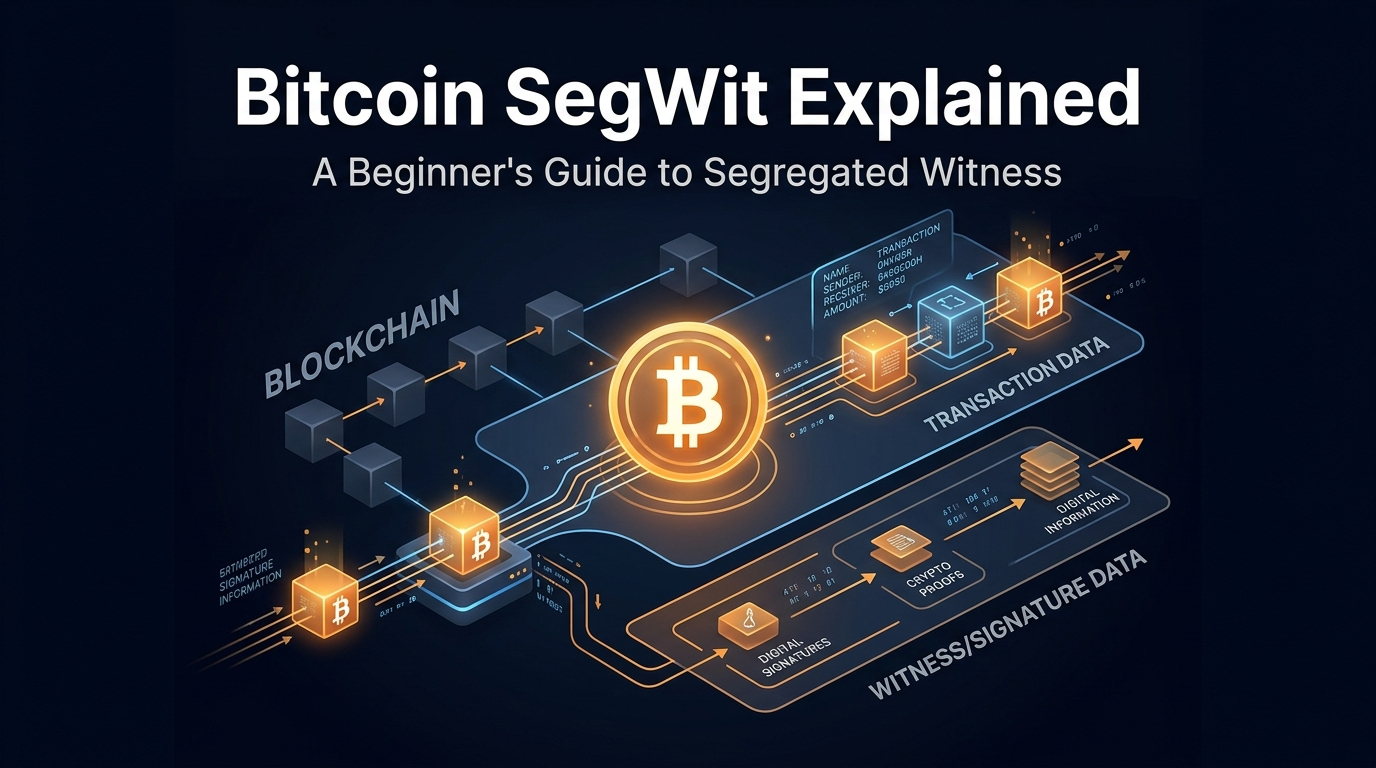
Bitcoin has gone through several important technical upgrades since its launch in 2009. One of the most significant was Segregated Witness, commonly called SegWit.
SegWit changed how certain information is stored inside Bitcoin transactions. The upgrade helped address transaction malleability, increased the effective capacity of Bitcoin blocks, and created a foundation for later developments such as the Lightning Network.
For someone new to Bitcoin, however, the name can sound much more complicated than the idea actually is.
So what exactly is SegWit?
In simple terms, SegWit is a Bitcoin protocol upgrade that separated transaction signature data, known as witness data, from the transaction’s main data structure.
That change had several consequences for Bitcoin’s transaction system, including improved transaction efficiency and lower effective fees for transactions that use the newer format.
In this guide, we’ll explain what SegWit means, why Bitcoin developers introduced it, how it changed transactions, and why it remains important today.
What Does SegWit Mean?
SegWit is short for Segregated Witness.
The two words describe what the upgrade does.
Segregated means separated.
Witness refers to the transaction data used to prove that the person spending a Bitcoin output is authorized to do so. In practical terms, this includes digital signatures and related information.
Before SegWit, signature information was part of the transaction structure that contributed directly to the transaction’s size.
SegWit changed this structure by separating witness data from the transaction’s core data.
This may sound like a small technical modification, but it had important consequences for Bitcoin.
It helped:
- Fix an important transaction malleability issue
- Increase Bitcoin’s effective transaction capacity
- Reduce the effective cost of many transactions
- Improve the efficiency of block space
- Create a better foundation for second-layer technologies
To understand why this mattered, it helps to first understand how Bitcoin transactions work.
A Quick Refresher: How Bitcoin Transactions Work
A Bitcoin transaction transfers control of Bitcoin from previous outputs to new outputs.
For example, imagine Alice wants to send Bitcoin to Bob.
Her wallet creates a transaction that references Bitcoin she already controls.
The transaction contains important information such as:
- Inputs
- Outputs
- Amounts
- Scripts
- Signatures
- Other transaction metadata
The inputs point to previous unspent transaction outputs, commonly called UTXOs.
If you’re unfamiliar with this system, our guide to What Is a Bitcoin UTXO? explains how Bitcoin tracks spendable units without using traditional account balances.
The transaction then gets broadcast to the Bitcoin network.
Nodes validate it, and eventually a miner can include it in a block.
Once confirmed, the transaction becomes part of Bitcoin’s permanent blockchain history.
What Is Transaction Malleability?
One of the major reasons SegWit was developed was a problem called transaction malleability.
The word “malleability” basically means that something can be modified without changing its essential meaning.
In Bitcoin’s case, certain parts of a valid transaction could potentially be modified in a way that changed the transaction’s identifier without changing the fundamental transfer of funds.
This created complications for applications that relied heavily on transaction IDs.
Remember that every Bitcoin transaction has a unique identifier called a transaction ID, or TXID.
A simplified example would be:
Transaction → TXID
If certain transaction data could be modified without invalidating the transaction, the resulting transaction could potentially receive a different TXID.
The underlying payment could remain effectively the same, but the identifier could change.
That distinction mattered.
Why Did Transaction Malleability Matter?
For ordinary Bitcoin payments, transaction malleability wasn’t necessarily obvious to the average user.
However, it could create problems for more advanced applications.
Imagine a system that expects:
Transaction A → TXID ABC123
If transaction A’s identifier could be changed before confirmation, the system might see:
Transaction B → TXID XYZ789
even though the underlying payment was still essentially the same.
This could confuse software that depends on transaction IDs.
The problem became especially important for technologies being developed on top of Bitcoin.
One notable example was the development of the Lightning Network.
Lightning uses Bitcoin transactions in sophisticated ways to create payment channels.
Fixing transaction malleability therefore helped make certain types of Bitcoin applications more practical.
How Did SegWit Address Transaction Malleability?
SegWit changed the way signature information is handled.
Rather than keeping the witness information inside the traditional transaction structure, SegWit separates it from the transaction’s main data.
This means the signature data is handled differently when calculating the transaction identifier.
As a result, the specific form of malleability that affected the traditional transaction ID was addressed for SegWit transactions.
This was one of SegWit’s most important technical achievements.
It wasn’t simply about making transactions smaller.
It changed an underlying property of Bitcoin’s transaction format.
SegWit and Bitcoin Block Capacity
Another major benefit of SegWit was increased transaction capacity.
Bitcoin blocks have limited space.
Before SegWit, the conventional block size limit was generally described as 1 MB.
As Bitcoin became more popular, this created an obvious challenge.
More users meant more transactions competing for limited block space.
When demand for block space increased, transaction fees could also rise because users competed to have their transactions confirmed.
You can learn more about this relationship in our guide to Bitcoin Transaction Fees.
SegWit introduced a different way of measuring transaction data.
Instead of treating every byte identically, Bitcoin’s new accounting system gave witness data a lower weight.
This effectively increased the amount of transaction information that could fit into a block under the new rules.
Did SegWit Increase the Block Size?
This is where terminology can become confusing.
People sometimes say that SegWit increased Bitcoin’s block size from 1 MB to 4 MB.
That’s an oversimplification.
SegWit introduced a new block weight system rather than simply changing the old block-size limit to 4 MB.
The maximum block weight is 4 million weight units.
The actual amount of transaction data that can fit into a block depends on the type and structure of the transactions inside it.
Therefore, saying:
“SegWit made Bitcoin blocks 4 MB”
isn’t technically accurate.
A better explanation is:
SegWit replaced the old size-based accounting with block weight, allowing witness data to receive a discounted weight and increasing Bitcoin’s effective transaction capacity.
That distinction is important when explaining how SegWit actually works.
What Is Block Weight?
Block weight is the measurement introduced with SegWit for determining how much data a Bitcoin block consumes under the consensus rules.
A simplified way to think about it is:
Non-witness data has greater weight than witness data.
This means witness data receives a discount when block weight is calculated.
The maximum block weight is:
4,000,000 weight units
This doesn’t mean every Bitcoin block contains 4 MB of ordinary transaction data.
Instead, the total weight depends on the combination of transaction data and witness data included in the block.
This approach allows Bitcoin to make more efficient use of block space.
Why Does Witness Data Receive a Discount?
The witness portion of a SegWit transaction primarily contains information used to authorize spending.
It is essential for validating the transaction, but treating it differently in the block accounting system allowed Bitcoin to improve its use of limited block space.
The discount also created an incentive for users and wallets to adopt SegWit transaction formats.
As more transactions use SegWit, more transactions can potentially fit into the same block weight limit compared with an equivalent collection of older transaction formats.
SegWit and Bitcoin Transaction Fees
Bitcoin transaction fees are influenced largely by how much block space a transaction consumes and the fee rate users are willing to pay.
SegWit can reduce the effective size of transactions for fee calculation purposes because witness data receives a discount under the weight system.
This means users can potentially pay less in fees compared with an equivalent legacy transaction.
However, SegWit doesn’t mean Bitcoin transactions are automatically free or cheap.
Fees still depend on factors such as:
- Network congestion
- Transaction structure
- Number of inputs
- Number of outputs
- Fee rate
- Wallet behavior
- Available block space
For a deeper explanation, see our guide on How Bitcoin Transaction Fees Work.
A Simple SegWit Example
Imagine two transactions transfer approximately the same amount of Bitcoin.
One uses an older transaction format.
The other uses SegWit.
The SegWit transaction may receive a lower effective weight because its witness data receives a discount.
Therefore, if both transactions are paying the same fee rate, the SegWit transaction can potentially require less money in absolute fees.
The exact difference depends on the transaction’s structure.
This is why simply asking:
“Is SegWit cheaper?”
doesn’t have a universal answer.
A better question is:
“How much block weight does this particular transaction consume?”
What Does a SegWit Bitcoin Address Look Like?
SegWit introduced new Bitcoin address formats.
One of the most recognizable is the Bech32 format.
These addresses typically begin with:
bc1
For example, a Bitcoin mainnet address might look conceptually like:
bc1q…
The complete address would be much longer.
Bech32 addresses were designed to work well with SegWit and offer several practical advantages, including improved error detection and a more efficient representation.
The exact address format depends on the type of SegWit output being used.
SegWit Address Types
There are several Bitcoin address formats that users may encounter.
Legacy Addresses
Older Bitcoin addresses commonly begin with:
1
These are associated with older transaction formats.
P2SH Addresses
These commonly begin with:
3
P2SH can be used for several purposes, including wrapped SegWit arrangements.
Native SegWit Addresses
These commonly begin with:
bc1q
They use the Bech32 encoding format.
Taproot Addresses
A later Bitcoin upgrade introduced another address format beginning with:
bc1p
These are associated with Taproot.
Our guide to What Is Bitcoin Taproot? explains how Taproot builds on Bitcoin’s scripting and transaction capabilities.
What Is Native SegWit?
Native SegWit refers to SegWit outputs that use the SegWit format directly rather than placing SegWit inside an older address structure.
Native SegWit addresses generally begin with:
bc1q
They are commonly associated with Pay-to-Witness-Public-Key-Hash, or P2WPKH, for typical single-signature payments.
There are also native SegWit script types for more complex spending conditions.
For beginners, the most important point is simply that native SegWit uses SegWit’s transaction structure directly.
What Is Wrapped SegWit?
Wrapped SegWit is another approach to using SegWit while maintaining compatibility with older systems.
A common example is P2SH-wrapped SegWit.
The SegWit spending conditions are placed inside a P2SH structure.
This can allow older software that doesn’t fully understand native SegWit to interact with the output.
The trade-off is that wrapped SegWit isn’t as efficient as native SegWit.
So, broadly:
Legacy → Older transaction format
Wrapped SegWit → SegWit with additional compatibility
Native SegWit → Direct SegWit implementation
SegWit and Bitcoin Wallets
Whether you use SegWit often depends on your Bitcoin wallet.
Modern wallets commonly support SegWit addresses.
When receiving Bitcoin, the wallet may provide an address beginning with bc1.
When spending Bitcoin, the wallet can construct a SegWit transaction when the relevant inputs and outputs support it.
This is one reason choosing a wallet matters.
A wallet isn’t simply a place where Bitcoin is “stored.”
As explained in our Bitcoin Wallet Beginner’s Guide, wallets manage the cryptographic keys and construct transactions that allow users to control their Bitcoin.
SegWit is therefore part of the transaction technology that modern Bitcoin wallets interact with.
Is SegWit the Same as Bitcoin 2.0?
No.
SegWit didn’t create a separate version of Bitcoin.
It was a protocol upgrade to Bitcoin’s existing network.
The Bitcoin blockchain continued operating under the same overall monetary system, but nodes that upgraded to SegWit-compatible software could follow the new rules.
This is an important distinction because SegWit is sometimes described as though it created an entirely new cryptocurrency.
It did not.
Was SegWit a Hard Fork?
SegWit was implemented as a soft fork.
A soft fork is a protocol change that tightens or modifies the rules in a way that can maintain compatibility with older nodes under certain conditions.
SegWit activated on Bitcoin’s main network in August 2017.
Its activation was one of the most significant events in Bitcoin’s development history.
It also came after years of debate about Bitcoin’s block capacity and scaling strategy.
Why Was SegWit Controversial?
Bitcoin’s scaling debate involved disagreements about how the network should handle increasing transaction demand.
One side favored increasing the block size more directly.
Another approach focused on improving transaction efficiency and developing additional layers on top of Bitcoin.
SegWit became part of that broader debate.
The disagreement eventually contributed to the creation of Bitcoin Cash (BCH) in 2017 through a hard fork.
The important lesson is that Bitcoin’s technical development isn’t only about writing code.
Protocol changes can involve:
- Economics
- Network security
- Miner incentives
- Developer decisions
- User adoption
- Community governance
- Different views about Bitcoin’s future
Understanding SegWit’s history therefore helps explain some of the most important debates in Bitcoin’s development.
How Does a SegWit Transaction Work?
To understand SegWit properly, it helps to look at what actually changes when a SegWit transaction is created.
A Bitcoin transaction generally contains inputs and outputs.
The inputs identify previously created UTXOs that are being spent, while the outputs specify where the new Bitcoin can be spent.
The transaction also needs proof that the owner of each input has authorized the spending.
With SegWit, this authorization information is placed in a separate witness structure.
A simplified comparison looks like this:
Legacy transaction
Inputs + Outputs + Signature information
SegWit transaction
Inputs + Outputs + Witness information
The witness is still part of the transaction as a whole, but it is treated separately under Bitcoin’s transaction and block-weight rules.
This structural change is the foundation of SegWit’s benefits.
What Is the Witness?
The word witness can sound confusing because it doesn’t refer to a person.
In Bitcoin, witness data contains information needed to prove that a transaction input can be spent.
For many common SegWit transactions, this includes a digital signature and a public key.
The signature demonstrates that the person spending the Bitcoin has access to the appropriate private key.
This connects SegWit to the fundamental cryptography behind Bitcoin.
A private key is used to create a digital signature, while other participants in the network can use the corresponding public information to verify that signature.
If you want to understand the underlying concepts in more detail, see our guide to Bitcoin Private Keys vs. Public Keys.
How SegWit Changes Transaction Identification
One of SegWit’s most important technical changes involves the transaction ID.
For a traditional Bitcoin transaction, the TXID is calculated from the transaction data in the conventional serialization.
Because signatures were part of that data, changes to certain signature-related information could affect the transaction ID.
SegWit separated the witness data from the portion used for the traditional transaction ID.
As a result, changing the witness does not change the traditional TXID.
This was an important part of solving the transaction malleability problem.
SegWit transactions can also have another identifier known as the witness transaction ID, or wtxid, which commits to the witness data.
This distinction is important for developers and advanced Bitcoin users.
For beginners, the simplest takeaway is:
TXID → identifies the transaction without the witness data
wtxid → identifies the transaction including witness data
Why the TXID Change Matters
Imagine a payment system that creates another transaction based on the TXID of an earlier transaction.
If the earlier transaction’s identifier could be changed by modifying its signature data, the later transaction could potentially be affected.
By removing witness data from the traditional TXID calculation, SegWit made transaction IDs more stable in the way that second-layer protocols and other applications needed.
This was particularly important for the Lightning Network.
Lightning payment channels rely on carefully constructed Bitcoin transactions.
Reducing transaction malleability made it easier to build these systems securely.
Our Bitcoin Lightning Network guide explains how Lightning uses Bitcoin’s base layer to support faster payments.
SegWit and Transaction Weight
Another major change introduced by SegWit was the concept of transaction weight.
Instead of measuring every part of a transaction in exactly the same way, Bitcoin assigns different weights to different categories of transaction data.
A commonly used relationship is:
Transaction weight = non-witness data × 4 + witness data
The resulting value is measured in weight units.
This system gives witness data a lower effective cost in terms of block space.
For example, if two transactions contain similar information but one uses SegWit, the SegWit transaction may have a lower effective weight.
That can translate into lower fees when the transaction is constructed appropriately.
What Is Virtual Size?
SegWit also introduced the concept commonly referred to as virtual size, or vbytes.
Virtual size provides a convenient way to express the effective size of a transaction for fee calculation.
A simplified relationship is:
Virtual size = transaction weight ÷ 4
The value is rounded according to Bitcoin’s rules.
This is why Bitcoin wallets and fee estimators often discuss fees in:
sat/vB
or
satoshis per virtual byte.
A satoshi is the smallest unit of Bitcoin.
One Bitcoin equals:
100,000,000 satoshis
Therefore, if a wallet estimates a transaction at 150 vbytes and the selected fee rate is 20 sat/vB, the approximate fee would be:
150 × 20 = 3,000 satoshis
The exact transaction size depends on the inputs, outputs, and transaction type.
Why SegWit Can Reduce Fees
SegWit’s fee advantage comes from how witness data is weighted.
Because witness data receives a discount, transactions that use SegWit can have a lower virtual size than comparable legacy transactions.
Suppose two transactions require roughly the same number of inputs and outputs.
The legacy transaction may have a larger effective size because its signatures are treated differently.
The SegWit transaction can have a smaller effective size.
At the same fee rate, the smaller virtual size means a lower absolute fee.
This is particularly useful when Bitcoin’s block space is in high demand.
However, SegWit doesn’t guarantee a specific percentage of savings.
The difference depends on the transaction structure.
Why Inputs Can Make Bitcoin Transactions Expensive
Bitcoin transaction size isn’t determined only by the amount of Bitcoin being sent.
The number of inputs can have a major effect.
Suppose you receive ten small Bitcoin payments.
Your wallet might control ten separate UTXOs.
If you later spend all ten UTXOs in a single transaction, the transaction has ten inputs.
Each input requires information and, depending on the script type, authorization data.
That can make the transaction significantly larger.
This is why the number of UTXOs you control can affect future transaction fees.
Our guide to Bitcoin UTXOs goes into this concept in more detail.
SegWit and Bitcoin Block Space
SegWit didn’t eliminate Bitcoin’s block-space limitation.
Blocks still have a maximum weight.
Instead, SegWit changed how that limited resource is measured.
This allowed Bitcoin to fit more effective transaction data into blocks without simply making every part of the block four times larger.
The result was a more nuanced approach:
Traditional transaction data → higher weight
Witness data → lower weight
Total block → maximum 4,000,000 weight units
This helped increase Bitcoin’s effective capacity while retaining a constrained block resource.
Why SegWit Was Important for Scaling
Bitcoin’s scaling problem is essentially a question of how much transaction activity the network can process while maintaining its decentralized characteristics.
If blocks become too large, running a fully validating node can require more resources.
If blocks remain very small, transaction demand can exceed available capacity.
SegWit addressed part of this problem through greater efficiency.
It didn’t attempt to solve every scaling challenge on the Bitcoin base layer.
Instead, it improved the transaction format and helped create a foundation for additional scaling approaches.
This distinction is important.
SegWit was an important scaling improvement, not a complete scaling solution.
SegWit and the Lightning Network
One of SegWit’s most important consequences was its role in enabling the development of the Lightning Network.
Lightning uses payment channels that rely on Bitcoin’s base layer.
Before SegWit, transaction malleability created technical complications for these types of systems.
By addressing transaction malleability, SegWit made the construction of Lightning payment channels more practical.
Lightning can then allow users to conduct multiple payments without putting every individual payment directly onto the Bitcoin blockchain.
The base layer is still used for opening and closing channels, while many intermediate transactions can happen off-chain.
This creates a relationship between the technologies:
SegWit
↓
Improved Bitcoin transaction structure
↓
Foundation for technologies such as Lightning
This doesn’t mean Lightning is part of SegWit itself.
They are separate technologies that work together.
SegWit and Taproot
SegWit also helped establish a foundation for later Bitcoin upgrades.
One of the most important later upgrades was Taproot, which activated in 2021.
Taproot introduced improvements to Bitcoin’s scripting, privacy characteristics, and efficiency for certain complex transactions.
Taproot uses a newer witness version known as SegWit version 1.
This means SegWit isn’t an isolated historical upgrade.
It became part of the framework through which Bitcoin could continue introducing new transaction capabilities.
Our article on Bitcoin Taproot provides a deeper explanation of that upgrade.
SegWit Versions Explained
Bitcoin’s SegWit design allows different witness versions.
Two important versions are:
SegWit Version 0
This includes common native SegWit outputs such as:
P2WPKH
and
P2WSH
These commonly use Bech32 addresses beginning with:
bc1q
SegWit Version 1
Taproot uses SegWit version 1.
Taproot addresses commonly begin with:
bc1p
This distinction explains why both bc1q and bc1p addresses exist.
They belong to different witness versions.
What Is P2WPKH?
P2WPKH stands for:
Pay-to-Witness-Public-Key-Hash
It is one of the most common native SegWit output types for ordinary single-signature Bitcoin payments.
The recipient’s wallet provides a SegWit address.
The sender creates an output that commits to the recipient’s public-key hash.
When the recipient later spends that output, the relevant signature and public key are included in the witness.
For beginners, the important point is simply:
P2WPKH is a standard native SegWit format commonly used for ordinary Bitcoin payments.
What Is P2WSH?
P2WSH stands for:
Pay-to-Witness-Script-Hash
It allows more complex spending conditions to be represented using SegWit’s witness structure.
This can be useful for scripts involving multiple conditions or multiple signatures.
For example, a more complex wallet arrangement might require several keys to authorize a transaction.
That connects SegWit to advanced Bitcoin wallet structures such as multisig.
You can learn the basics of multisignature Bitcoin wallets in our article on Bitcoin Multisig Wallets.
Legacy vs. Wrapped SegWit vs. Native SegWit
For beginners, the differences can be summarized like this.
| Feature | Legacy | Wrapped SegWit | Native SegWit |
|---|---|---|---|
| Older transaction structure | Yes | Partly | No |
| SegWit benefits | No | Yes | Yes |
| Typical address prefix | 1 | 3 | bc1q |
| Fee efficiency | Lower | Better | Generally better |
| Compatibility | Very broad | Broad | Requires SegWit support |
The table is simplified because Bitcoin supports multiple script types and transaction constructions.
Still, it provides a useful starting point.
Why Some Exchanges May Show Different Bitcoin Address Formats
If you use a cryptocurrency exchange, you may notice that its Bitcoin deposit page provides an address beginning with:
1
3
or
bc1
This doesn’t necessarily mean something is wrong.
It simply indicates that the service supports or has selected a particular Bitcoin output format.
Modern services commonly support SegWit, but compatibility can vary between platforms.
Before sending Bitcoin, always verify:
- The network
- The address
- The asset
- The amount
- Any applicable fees
Sending Bitcoin to an incompatible network or incorrect destination can result in permanent loss.
For a broader explanation of Bitcoin addresses, see What Is a Bitcoin Address?.
Does Sending Bitcoin to a SegWit Address Change Bitcoin?
No.
SegWit doesn’t create a different version of Bitcoin.
If someone sends BTC to a SegWit address, they’re still sending ordinary Bitcoin on the Bitcoin network.
The difference is the transaction and output format being used.
You don’t receive “SegWit Bitcoin.”
You receive Bitcoin.
SegWit simply determines how certain transaction information is represented and processed.
Can Old Bitcoin Wallets Send to SegWit Addresses?
It depends on the wallet.
Older software may not understand newer address formats.
Modern Bitcoin wallets generally support common SegWit formats, but compatibility can still vary.
This is why Bitcoin address support matters when transferring funds between wallets.
If a wallet doesn’t support a particular address type, it may not be able to create or interpret the corresponding transaction correctly.
SegWit Adoption
SegWit wasn’t adopted by every Bitcoin user immediately after activation.
Wallets, exchanges, payment processors, and other services had to update their software.
As support increased, more transactions began using SegWit formats.
This gradual adoption is typical for changes to widely used infrastructure.
A protocol upgrade can be technically available while practical adoption takes considerably longer.
SegWit’s adoption also demonstrated that changes to Bitcoin’s transaction format involve more than changing the Bitcoin Core software.
The broader ecosystem needs to support the new format.
What SegWit Did Not Change
It’s just as important to understand what SegWit didn’t do.
SegWit did not:
- Increase Bitcoin’s maximum supply
- Create a new cryptocurrency
- Eliminate transaction fees
- Make Bitcoin completely private
- Make transactions instant
- Remove the need for miners
- Replace Bitcoin’s proof-of-work consensus
- Eliminate block limits
- Make private keys unnecessary
SegWit was a targeted protocol upgrade.
Its primary effects were related to transaction structure, malleability, block-weight accounting, and the efficiency of Bitcoin transactions.
What Are the Main Benefits of SegWit?
SegWit introduced several improvements to Bitcoin’s transaction system.
Some are highly technical, while others directly affect everyday users.
Let’s break down the most important benefits.
1. SegWit Helps Reduce Transaction Malleability
One of SegWit’s most important achievements was addressing the transaction malleability issue discussed earlier in this guide.
By separating witness information from the traditional transaction ID calculation, SegWit made it much harder for the relevant transaction identifier to be modified through changes to signature data.
This was especially important for applications that rely on predictable transaction IDs.
The improvement helped make advanced Bitcoin protocols more practical and reliable.
2. SegWit Can Reduce Transaction Fees
SegWit transactions can have a lower effective virtual size because witness data receives a discount in Bitcoin’s block-weight system.
For users, that can translate into lower transaction fees compared with an otherwise similar legacy transaction.
However, the savings aren’t identical for every transaction.
A transaction with many inputs can still be expensive even when using SegWit.
Likewise, network congestion can cause fee rates to rise.
So it’s more accurate to say:
SegWit improves fee efficiency.
It doesn’t guarantee cheap transactions under every network condition.
3. SegWit Increases Effective Block Capacity
Bitcoin still has a limited amount of block space.
SegWit’s block-weight system allows that space to be used more efficiently by assigning witness data a lower weight.
This increases the effective number of transactions that can fit into blocks under many transaction mixes.
That was an important scaling improvement without simply removing Bitcoin’s constraints on block resources.
4. SegWit Supports More Efficient Transaction Formats
SegWit provides a more flexible foundation for Bitcoin transaction development.
It separates witness data from the transaction’s core information, allowing future upgrades to introduce new witness versions.
This architecture later became important for Taproot and other developments.
In other words, SegWit wasn’t only a solution to problems that existed in 2017.
It also helped create a framework for future Bitcoin upgrades.
5. SegWit Helped Enable the Lightning Network
The Lightning Network was one of the most important technologies to benefit from SegWit’s improvements.
Lightning payment channels rely on Bitcoin transactions and require certain transaction properties to work correctly.
SegWit’s handling of transaction malleability helped remove an important obstacle.
This made it easier to develop payment-channel systems on top of Bitcoin.
You can learn more about Lightning in our article on What Is the Bitcoin Lightning Network?.
6. SegWit Encourages Better Use of Block Space
Bitcoin’s block space is a scarce resource.
SegWit introduced an incentive structure that makes certain transaction formats more efficient.
As wallets and services adopted SegWit, users could make transactions that use block space more efficiently.
This matters because Bitcoin’s blockchain isn’t infinitely large.
Every transaction consumes resources that nodes must process, validate, store, and relay.
What Are the Disadvantages of SegWit?
SegWit has significant benefits, but it isn’t perfect.
There are also practical considerations users should understand.
1. Compatibility Can Vary
Some older Bitcoin software may not fully support newer address formats.
Although modern wallets generally support SegWit, users can still encounter compatibility issues with outdated services.
This is one reason Bitcoin addresses should always be checked carefully before sending funds.
2. SegWit Doesn’t Eliminate Fees
A common misunderstanding is that SegWit somehow makes Bitcoin transactions free.
It doesn’t.
Bitcoin still has limited block space.
When demand is high, users may need to pay higher fee rates to have transactions confirmed promptly.
SegWit improves efficiency but doesn’t eliminate Bitcoin’s fee market.
3. Users May Find the Different Address Formats Confusing
Bitcoin users can encounter addresses beginning with:
1
3
bc1q
bc1p
For a beginner, this can look intimidating.
The formats represent different types of Bitcoin outputs and spending conditions.
Understanding the differences is useful, but users don’t need to memorize every technical detail to use Bitcoin safely.
4. SegWit Doesn’t Automatically Make Transactions Private
This is an especially important distinction.
SegWit is not a privacy upgrade in the same sense as a dedicated transaction privacy technique.
Bitcoin transactions remain publicly visible.
Anyone can examine the blockchain and see transaction information.
SegWit can improve transaction efficiency and change how transaction data is structured, but it doesn’t make your Bitcoin transactions anonymous.
If you’re interested in Bitcoin privacy, our guide to Bitcoin CoinJoin explains a separate technique designed to make certain transaction relationships harder to determine.
Should You Use a SegWit Bitcoin Address?
For most users, using a modern Bitcoin wallet that supports native SegWit is generally a sensible choice.
Native SegWit provides the benefits of the newer transaction structure while being widely supported throughout the modern Bitcoin ecosystem.
However, the exact choice can depend on:
- Wallet compatibility
- Exchange support
- Transaction requirements
- The type of Bitcoin script being used
- Whether you need compatibility with older software
If you’re simply receiving Bitcoin from another modern wallet, a native SegWit address beginning with bc1q is a common option.
Is SegWit Safer Than Legacy Bitcoin?
It’s better not to describe SegWit simply as “more secure” in every possible sense.
SegWit solved specific technical problems and changed Bitcoin’s transaction structure.
It also introduced improvements related to transaction malleability and block-space efficiency.
But the fundamental security of Bitcoin still depends on many components, including:
- Private-key security
- Wallet software
- Network consensus
- Cryptographic assumptions
- Node validation
- Mining
- User practices
SegWit isn’t a replacement for good wallet security.
You should still protect your recovery phrase and private keys carefully.
Our guide on How to Store Bitcoin Safely covers the security practices that matter most to everyday users.
Does SegWit Make Bitcoin Transactions Faster?
Not directly in the way people often imagine.
SegWit can increase Bitcoin’s effective transaction capacity by improving block-space efficiency.
That can help the network process more transactions over time.
However, it doesn’t change the fundamental block production process into something like an instant payment network.
Bitcoin blocks continue to be produced according to the network’s consensus rules.
If the network is congested, a SegWit transaction may still wait for confirmation.
So:
SegWit → improved transaction efficiency
doesn’t mean:
SegWit → instant Bitcoin transactions
Can You Send Bitcoin From Legacy to SegWit?
Yes, assuming the wallet and destination support the relevant transaction formats.
Bitcoin doesn’t require both sides of a payment to use identical address types.
For example, a user with a legacy address can generally send Bitcoin to a native SegWit address.
The transaction simply spends the sender’s existing UTXOs and creates an output using the recipient’s chosen script type.
The important thing is that the sender’s wallet must correctly construct the transaction and the destination address must be valid.
Can You Send Bitcoin From SegWit to Legacy?
Yes.
A SegWit wallet can generally spend its UTXOs and create an output paying to a legacy Bitcoin address, assuming the wallet supports that destination format.
However, sending to an older address doesn’t turn the original SegWit UTXO into a legacy UTXO in some permanent sense.
Each transaction creates new outputs with their own spending conditions.
This is one reason it helps to think in terms of UTXOs and scripts rather than thinking of Bitcoin as coins physically moving between accounts.
Does SegWit Change Bitcoin’s Supply?
No.
SegWit did not change Bitcoin’s maximum supply.
Bitcoin’s monetary policy remains separate from the transaction-format improvements introduced by SegWit.
The number of bitcoins that can ultimately exist is governed by Bitcoin’s consensus rules and issuance schedule.
SegWit primarily changed transaction structure and block-space accounting.
Does SegWit Change Bitcoin Mining?
SegWit changed how miners and nodes account for transaction data within blocks.
However, it did not replace Bitcoin’s proof-of-work consensus mechanism.
Miners still compete to produce valid blocks using proof of work.
They also select transactions from the mempool based on factors such as fee rates and transaction policies.
Our Bitcoin Mining Beginner’s Guide explains the mining process in greater detail.
SegWit and Bitcoin Nodes
Bitcoin nodes validate transactions and blocks according to Bitcoin’s consensus rules.
A SegWit-aware node understands the witness data and the rules associated with SegWit transactions.
This is important because Bitcoin’s decentralized security depends on independent participants verifying the rules themselves.
A user running a full Bitcoin node isn’t simply trusting a website to tell them whether a transaction is valid.
The node can independently verify the transaction against Bitcoin’s protocol rules.
This is one of the fundamental principles behind Bitcoin’s decentralized design.
Why SegWit Still Matters Today
SegWit activated in 2017, but its importance didn’t end there.
Many modern Bitcoin transactions use SegWit-related formats.
The upgrade also established technical concepts that became important for later improvements.
Its influence can be seen in:
- Modern Bitcoin wallets
- Transaction fee calculation
- Block-weight accounting
- Lightning Network development
- Taproot
- New witness versions
- More efficient transaction construction
In that sense, SegWit was both a solution and a foundation.
It solved specific problems while also giving Bitcoin developers a better framework for future upgrades.
Common SegWit Misconceptions
Myth 1: SegWit created a new Bitcoin
False.
SegWit is a Bitcoin protocol upgrade. It didn’t create a separate cryptocurrency.
Myth 2: SegWit means 4 MB blocks
Not exactly.
SegWit introduced a block-weight limit of 4 million weight units.
The actual amount of transaction data in a block depends on the transactions and their witness data.
Myth 3: Every SegWit address starts with bc1q
False.
Common native SegWit version 0 addresses use bc1q, while Taproot’s SegWit version 1 addresses commonly use bc1p.
Myth 4: SegWit makes Bitcoin anonymous
False.
SegWit isn’t designed to make Bitcoin transactions completely private or anonymous.
Myth 5: SegWit removes Bitcoin transaction fees
False.
SegWit can improve fee efficiency, but transactions still compete for limited block space.
Myth 6: SegWit made Bitcoin transactions instant
False.
Bitcoin still requires transactions to be confirmed under its normal consensus process.
Myth 7: SegWit replaced Bitcoin mining
False.
Bitcoin continues to use proof-of-work mining.
Frequently Asked Questions
What is SegWit in simple terms?
SegWit, short for Segregated Witness, is a Bitcoin protocol upgrade that separated transaction signature information from the transaction’s traditional data structure.
Why was SegWit created?
One major goal was to address transaction malleability. It also improved the efficiency of Bitcoin’s block space and transaction fee structure.
When did SegWit activate?
SegWit activated on the Bitcoin mainnet in August 2017.
Is SegWit a separate cryptocurrency?
No. SegWit is part of Bitcoin’s protocol.
Are SegWit addresses safer?
SegWit addresses are associated with a newer transaction format that provides important technical improvements. However, address format alone doesn’t determine whether your Bitcoin is secure. Private-key protection remains essential.
Are SegWit transactions cheaper?
They can be more fee-efficient because witness data receives a discount in Bitcoin’s block-weight system. The actual fee depends on the transaction and current network conditions.
What does a SegWit address look like?
Common native SegWit version 0 addresses begin with bc1q. Taproot addresses, which use SegWit version 1, commonly begin with bc1p.
Can I send Bitcoin from a legacy address to a SegWit address?
Yes, provided the wallet supports the destination format and the transaction is constructed correctly.
Can I send Bitcoin from SegWit to a legacy address?
Yes. Modern wallets can generally create transactions paying to supported legacy addresses.
Does SegWit make Bitcoin private?
No. Bitcoin’s blockchain remains publicly auditable.
Does SegWit increase Bitcoin’s supply?
No. SegWit did not change Bitcoin’s monetary supply rules.
Does SegWit make Bitcoin faster?
It improves transaction efficiency and effective capacity, but it doesn’t turn Bitcoin into an instant payment network.
Is SegWit still relevant?
Yes. SegWit remains an important part of Bitcoin’s modern transaction architecture and provided a foundation for later developments such as Taproot and Lightning.
SegWit vs. Legacy: Quick Comparison
| Feature | Legacy | SegWit |
|---|---|---|
| Witness data separated | No | Yes |
| Addresses can begin with | 1 | bc1q for common native v0 |
| Transaction malleability improvements | No | Yes |
| Block-weight accounting | No | Yes |
| Fee efficiency | Generally lower | Generally better |
| Effective block capacity | Lower | Higher |
| Support for later witness versions | No | Yes |
| Compatible with modern Bitcoin ecosystem | Yes | Yes |
This comparison is intentionally simplified because Bitcoin supports several script and address types.
A Simple Way to Remember SegWit
If all the technical terminology feels overwhelming, remember these four ideas:
1. Separate
SegWit separates witness data from the transaction’s traditional structure.
2. Stabilize
This helps address transaction malleability.
3. Save
The new block-weight system can make compatible transactions more efficient in terms of fee-paying block space.
4. Support
SegWit provided a foundation for technologies such as Lightning and later Bitcoin upgrades.
These four ideas capture much of SegWit’s practical importance.
Final Thoughts
SegWit may sound like an extremely technical Bitcoin feature, but its core idea is relatively straightforward.
It changed how Bitcoin handles transaction authorization data by separating the witness information from the transaction’s traditional structure.
That change solved an important transaction malleability problem and introduced a new way of measuring block space through block weight.
For everyday users, the practical benefits can include more efficient transactions and potentially lower fees.
For developers, SegWit provided an important foundation for building more advanced Bitcoin technologies.
And for the Bitcoin network itself, it represented a major step in the evolution of transaction formats and scaling.
SegWit also demonstrates something important about Bitcoin development.
Major improvements don’t necessarily require replacing the entire system.
Sometimes a carefully designed change to the transaction structure can solve multiple problems at once.
Today, users may interact with SegWit without even realizing it. A wallet displaying a bc1q address, a transaction using witness data, or a fee estimate expressed in virtual bytes can all be connected to the changes introduced by SegWit.
Understanding those details makes it easier to understand other parts of Bitcoin as well, from UTXOs and transaction fees to Taproot and the Lightning Network.
The most important takeaway is simple:
SegWit didn’t create a new Bitcoin. It improved how Bitcoin transactions work.
It addressed transaction malleability, improved block-space efficiency, reduced the effective cost of many transactions, and established a foundation for future Bitcoin development.
For anyone learning how Bitcoin works under the hood, SegWit is one of the key upgrades worth understanding.
