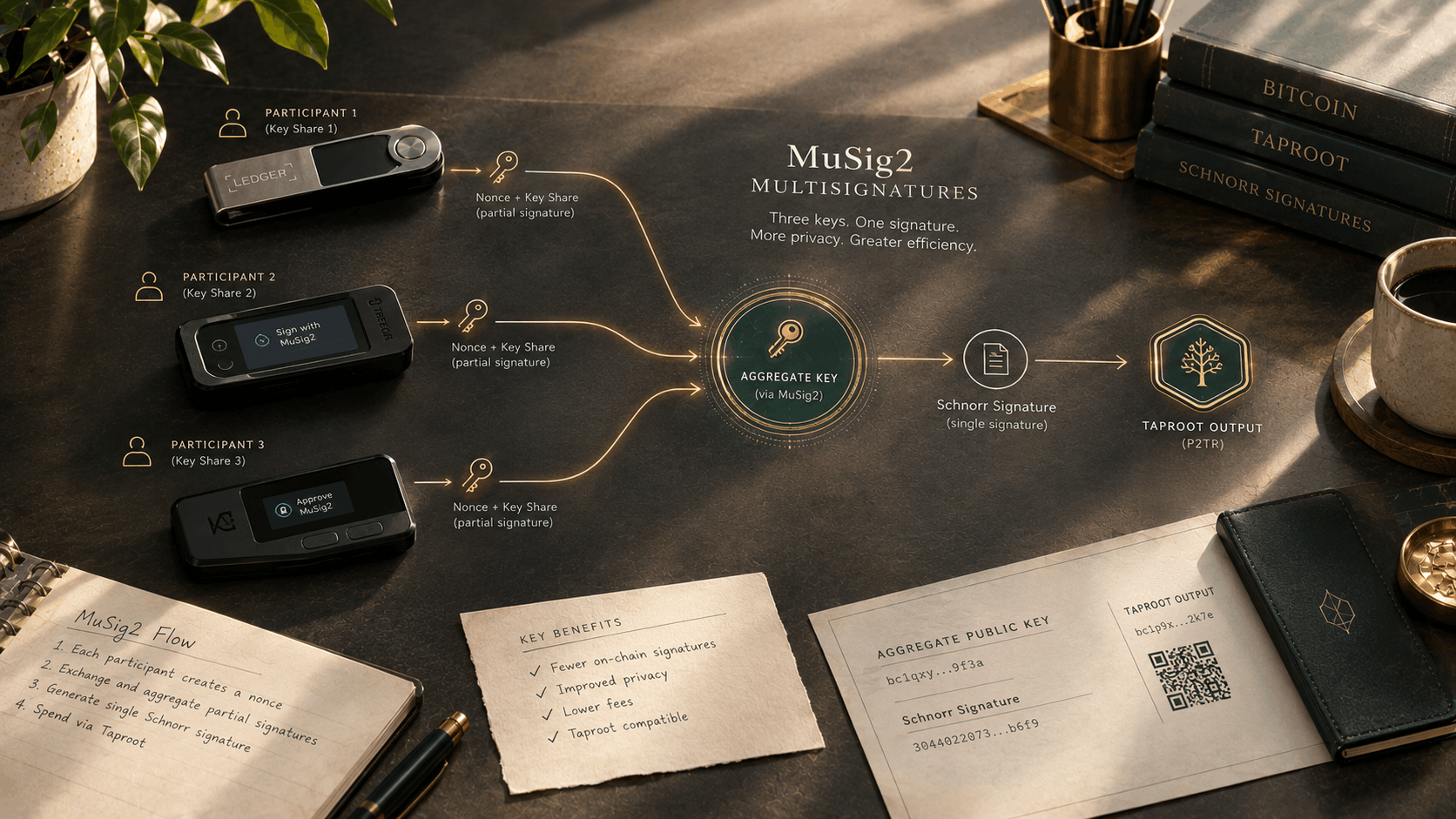
Bitcoin multisignature wallets have traditionally required multiple public keys and multiple signatures to spend coins.
That works, but Bitcoin’s Taproot upgrade opened the door to a more compact approach.
BIP-327 introduces MuSig2, a multisignature scheme that allows multiple signers to collaboratively create a single Schnorr signature under one aggregate public key.
Instead of putting several independent signatures on the blockchain, the participants can cooperate to produce one ordinary-looking BIP-340 Schnorr signature.
This can make certain multisignature arrangements more compact and can provide different privacy characteristics from traditional multisig constructions.
But how does MuSig2 actually work?
And how is it different from the Bitcoin multisig wallets most people already know?
Let’s start with the basics.
What Is BIP-327?
BIP-327 stands for Bitcoin Improvement Proposal 327.
Its official title is:
“MuSig2 for BIP340-compatible Multi-Signatures.”
The proposal was authored by Jonas Nick, Tim Ruffing, and Elliott Jin.
BIP-327 is currently marked Deployed and is an informational BIP. The current specification is version 1.0.4.
Its purpose is to standardize MuSig2, a multi-signature scheme compatible with the Schnorr public keys and signatures defined by BIP-340.
The important idea is simple:
Multiple people can jointly control one aggregate public key and collaboratively produce one valid Schnorr signature.
The blockchain does not need to see each participant’s individual signature.
Instead, the participants cooperate before broadcasting the transaction.
What Is MuSig2?
MuSig2 is a cryptographic protocol that allows multiple signers to create a single aggregate public key and then collaboratively produce a standard Schnorr signature.
Imagine three people:
- Alice
- Bob
- Charlie
Each person has their own private key and public key.
With traditional multisig, Bitcoin can require signatures from multiple individual keys.
With MuSig2, those public keys can be combined into an aggregate public key.
The result looks conceptually like this:
Alice’s key + Bob’s key + Charlie’s key → One aggregate public key
When the group later wants to spend Bitcoin, the participants cooperate to create one Schnorr signature.
The final signature can then be verified against the aggregate public key.
So the blockchain sees:
One public key
and
One Schnorr signature
rather than necessarily seeing a separate signature from every participant.
Why Was MuSig2 Needed?
Bitcoin already had multisignature functionality before MuSig2.
So why create another system?
The answer comes down to efficiency, privacy, and Taproot.
Traditional multisig can expose multiple public keys and signatures in the spending transaction.
For example, imagine a simple n-of-n policy involving three participants.
The transaction may need to reveal information associated with:
- Public key A
- Public key B
- Public key C
- Signature A
- Signature B
- Signature C
MuSig2 takes a different approach.
The participants first combine their keys into one aggregate key.
Then they cooperate to produce a single Schnorr signature.
The resulting Taproot output can therefore have an on-chain footprint similar to a single-key Taproot output.
BIP-327 specifically notes that a MuSig2 Taproot output is essentially represented by one BIP-340 public key and that spending it requires one cooperatively produced signature.
MuSig2 and Schnorr Signatures
To understand MuSig2, you need to understand Schnorr signatures.
Schnorr signatures are defined for Bitcoin by BIP-340.
You can think of a digital signature as proof that someone controlling a particular private key authorized a message or transaction.
Traditional Bitcoin signatures historically used ECDSA.
Taproot introduced Schnorr signatures for its key-path and Tapscript signature operations.
MuSig2 builds on this Schnorr foundation.
The relationship looks like this:
BIP-340
Schnorr signatures
↓
BIP-327
MuSig2 multi-signatures
↓
BIP-341
Taproot outputs can use the resulting aggregate key
This is one reason BIP-327 fits naturally into the Taproot ecosystem.
Traditional Multisig vs MuSig2
The easiest way to understand MuSig2 is to compare it with a traditional multisignature policy.
Suppose three people control a Bitcoin wallet.
With a traditional 3-of-3 multisig arrangement, the spending condition can require all three signatures.
The transaction can reveal that multiple keys participated.
With MuSig2, the three participants can instead combine their keys into one aggregate public key.
They then cooperate to create a single Schnorr signature.
The simplified comparison is:
| Traditional Multisig | MuSig2 |
|---|---|
| Multiple individual keys | Aggregate public key |
| Multiple signatures may appear | One final Schnorr signature |
| Script-based construction commonly used | Key aggregation |
| More information can be exposed on-chain | Can resemble single-key Taproot spending |
| Individual signatures are verified | One aggregate signature is verified |
| Can support threshold policies such as 2-of-3 | BIP-327 itself is n-of-n |
That last point is extremely important.
MuSig2 Is Not 2-of-3 Multisig
A common misunderstanding is that MuSig2 automatically replaces every type of multisignature wallet.
It doesn’t.
MuSig2 is an n-of-n multisignature scheme.
That means every signer participating in the aggregate key is required to participate in the signing process.
For example:
2 participants → both must sign
3 participants → all three must sign
5 participants → all five must sign
It is not, by itself, a general t-of-n threshold signature system.
For example, a 2-of-3 policy means that any two of three participants can authorize the transaction.
MuSig2 does not directly provide that policy.
This distinction is explicitly stated in BIP-327.
Why the Distinction Matters
Imagine a company with three executives:
- Alice
- Bob
- Charlie
Suppose the company’s policy says:
Any 2 of the 3 executives can spend the funds.
That is a 2-of-3 threshold policy.
If Alice is unavailable, Bob and Charlie can still authorize the transaction.
A standard MuSig2 n-of-n arrangement would not provide that same flexibility.
All participants involved in the aggregate key need to participate.
Therefore, MuSig2 is particularly useful when the intended policy is:
Everyone must cooperate.
It should not automatically be described as a replacement for every traditional multisig or threshold-signature design.
What Is an Aggregate Public Key?
The term aggregate public key is central to MuSig2.
Normally, each Bitcoin user has a private key and corresponding public key.
For example:
Alice → Public Key A
Bob → Public Key B
Charlie → Public Key C
MuSig2 combines these individual public keys into an aggregate key.
Conceptually:
Public Key A + Public Key B + Public Key C → Aggregate Public Key
The actual cryptographic process is more sophisticated than simple addition.
MuSig2 calculates key aggregation coefficients from the participants’ public keys before producing the aggregate key.
This prevents certain attacks that could arise from naively combining keys.
The important beginner-level idea is:
The participants’ individual keys become components of one shared public key.
Why Can’t We Just Add the Public Keys?
This is an important technical question.
A beginner might think:
“If Schnorr signatures are linear, why not simply add everyone’s public keys together?”
The problem is security.
Naively adding public keys can allow attacks in which a malicious participant chooses a key that interacts with another participant’s key in a harmful way.
MuSig2 therefore does not simply perform:
P = P₁ + P₂ + P₃
without additional processing.
Instead, each participant’s key receives a cryptographic coefficient derived from the collection of public keys.
Conceptually:
Aggregate Key = a₁P₁ + a₂P₂ + a₃P₃
where the coefficients are derived from the participant keys.
This key-aggregation process is one of the important security features of MuSig2.
The exact algorithm is specified by BIP-327.
Why Public-Key Sorting Matters
MuSig2 needs participants to agree on the same collection of public keys.
The order matters because the aggregation process produces an aggregate result from the complete key set.
BIP-327 specifies a canonical ordering for the individual public keys.
Applications can therefore ensure that the same group of keys produces the same aggregate result regardless of the order in which participants initially provide them.
This becomes particularly important when different wallet applications need to independently reconstruct the same wallet policy.
MuSig2 and Taproot
This is where MuSig2 becomes especially interesting for Bitcoin.
Taproot allows Bitcoin outputs to use a public key for key-path spending while also optionally committing to hidden script paths.
MuSig2 can be used to create an aggregate key for the Taproot key path.
Imagine three participants jointly controlling a Taproot output.
Instead of creating a traditional multisig script that requires three individual signatures, the participants can create an aggregate MuSig2 public key.
That aggregate key becomes the Taproot internal key.
The resulting output can look like an ordinary Taproot output to someone examining the blockchain.
BIP-327 specifically describes this as one of its primary motivations: allowing multiple users to jointly control Taproot outputs using MuSig2.
Why This Can Improve Privacy
MuSig2 can provide an important privacy advantage.
Suppose a blockchain observer sees a normal Taproot output.
From the output alone, the observer generally cannot determine whether that key belongs to:
- One person
- Two MuSig2 participants
- Five MuSig2 participants
- Another arrangement using an appropriate aggregate key
When the MuSig2 participants cooperatively spend through the key path, the resulting signature is a standard BIP-340 Schnorr signature under the aggregate public key.
BIP-327 notes that MuSig2 Taproot outputs can be indistinguishable to a blockchain observer from regular single-signer Taproot outputs.
However, this should not be interpreted as complete Bitcoin anonymity.
Blockchain transaction patterns, funding history, timing, wallet behavior, and other information can still reveal relationships.
MuSig2 improves the on-chain appearance of certain multisignature arrangements; it does not make the entire Bitcoin transaction history private.
MuSig2 vs OP_CHECKSIGADD
This is another important connection to your previous BIP-342 article.
BIP-342 introduced OP_CHECKSIGADD for Tapscript.
Developers can use it to build threshold policies by checking individual Schnorr signatures and counting them.
For example, a 2-of-3 policy could conceptually check three signatures and require the counter to reach two.
MuSig2 takes a different approach.
Instead of putting each participant’s signature into the script, the participants cooperate before the transaction is finalized to create one aggregate signature.
The result is a fundamental difference:
OP_CHECKSIGADD
Multiple keys and signature checks are represented in the script.
MuSig2
Multiple signers cooperate to produce one signature under one aggregate key.
BIP-327 specifically notes that MuSig2 can have a smaller on-chain footprint and lower verification cost than an n-of-n policy implemented with OP_CHECKSIGADD.
Does MuSig2 Hide the Number of Signers?
In an appropriate Taproot key-path construction, the blockchain does not directly reveal how many participants created the aggregate key.
For example, an observer might see:
Taproot output → one public key
They cannot simply look at that public key and conclude:
“This is controlled by three people.”
The same type of on-chain appearance could come from a single signer.
This is one of the most interesting properties of MuSig2.
However, the privacy benefit depends on the wallet construction and spending behavior.
If participants use a script path or otherwise reveal additional information, observers may learn more.
Is MuSig2 the Same as Multisig?
MuSig2 is a multisignature scheme, but it works differently from the traditional script-based multisig construction many Bitcoin users know.
Traditional multisig generally expresses the spending policy directly through Bitcoin Script.
MuSig2 instead aggregates the participants’ public keys and combines their signing contributions into a single Schnorr signature.
So both approaches can involve multiple people controlling funds.
But they represent that control differently.
Think of it this way:
Traditional multisig:
“Bitcoin, check these multiple keys and signatures.”
MuSig2:
“Bitcoin, verify this one Schnorr signature under this aggregate key.”
The second approach shifts much of the coordination from the blockchain to the participants before the transaction is broadcast.
What Does the “2” Mean in MuSig2?
The name MuSig2 refers to the second-generation MuSig protocol.
One important improvement is the signing process.
MuSig2 uses two communication rounds during signing.
That means the participants exchange information in two main rounds before they can produce the final signature.
This is more efficient than the earlier MuSig1 construction, which required three rounds.
BIP-327 highlights the reduced communication requirement as one of MuSig2’s advantages.
A Simple MuSig2 Example
Imagine Alice, Bob, and Charlie jointly control a Bitcoin treasury.
Each person has:
Private key → Public key
The three public keys are combined using MuSig2.
The result is:
One aggregate public key
The aggregate key is used as the Taproot key.
Later, the treasury needs to spend Bitcoin.
Alice, Bob, and Charlie each participate in the signing protocol.
They exchange the required signing information.
Each produces a partial signature.
The partial signatures are combined.
The result is:
One valid Schnorr signature
The Bitcoin network verifies that signature against the aggregate public key.
The network does not need three separate signatures in the final transaction.
This is the basic idea behind MuSig2.
The Most Important Idea
MuSig2 moves much of the complexity of multisignature authorization off-chain and produces a single Schnorr signature for the blockchain to verify.
The participants still need to cooperate.
They don’t magically become one person.
Instead, their individual keys contribute to a shared aggregate key, and their signing contributions combine into one final signature.
That is what makes MuSig2 different from traditional script-based multisig.
Step 1: The Participants Share Their Public Keys
Before anyone signs, the participants need to establish who is part of the MuSig2 group.
Imagine Alice, Bob, and Charlie.
Each participant has:
- A private key
- A corresponding public key
Their public keys are shared with the other participants.
The group then runs the MuSig2 key-aggregation process.
Conceptually:
Alice’s public key
Bob’s public key
Charlie’s public key
↓
Aggregate public key
The aggregate key becomes the public identity of the group for the purpose of signing.
The individual private keys never need to be revealed to the other participants.
Step 2: Calculate Key-Aggregation Coefficients
MuSig2 does not simply add public keys together.
Instead, the protocol calculates a coefficient for each participant’s public key.
Conceptually:
Aggregate key = a₁P₁ + a₂P₂ + a₃P₃
where:
P₁,P₂, andP₃are the individual public keys.a₁,a₂, anda₃are cryptographic coefficients.
These coefficients are derived from the set of public keys.
This is an important security feature.
If users could simply add public keys together without additional protection, certain malicious-key attacks could become possible.
MuSig2’s key-aggregation algorithm prevents this class of problem by binding each participant’s contribution to the complete key set.
Step 3: Create a Signing Session
When the group actually wants to spend Bitcoin, the participants create a signing session.
The session includes information such as:
- The message being signed
- The participating public keys
- The aggregate public key
- Any applicable tweaks
- Nonce information
For a Bitcoin transaction, the message ultimately corresponds to the data required by the BIP-340 signing process.
The participants must agree on the transaction they intend to authorize.
They are not simply signing arbitrary pieces of information independently.
They are participating in one coordinated signing session.
Step 4: Generate Nonces
This is one of the most important parts of MuSig2.
Each signer generates a secret nonce.
A nonce is temporary cryptographic information used during the signing process.
In BIP-327’s MuSig2 construction, each signer’s nonce consists of two secret values, which correspond to two elliptic-curve points in the public nonce.
You can think of it as:
Signer → Secret nonce → Public nonce
The secret nonce stays with the signer.
The public nonce can be shared with the other participants.
Why Does MuSig2 Need Nonces?
Schnorr signatures use a temporary random value during signing.
This temporary value prevents the private key from appearing directly in the signature.
MuSig2 needs a coordinated version of this process because several people are contributing to the same final signature.
Each signer therefore creates their own nonce contribution.
Those contributions are later combined into the session’s aggregate nonce.
MuSig2 Uses Two Nonce Components
A MuSig2 signer doesn’t create just one public nonce point.
Instead, BIP-327 uses two.
Conceptually:
Nonce 1 → R₁
Nonce 2 → R₂
The signer sends both public nonce points to the other participants.
The corresponding secret values remain private.
This two-point nonce construction is part of the optimized MuSig2 scheme specified by BIP-327.
You don’t need to understand the elliptic-curve mathematics to understand the important principle:
Public nonce information is shared; the secret nonce values are not.
Step 5: First Communication Round
Now we reach the first of MuSig2’s two communication rounds.
Each participant generates their nonce and broadcasts the corresponding public nonce.
For our example:
Alice → Public nonce
Bob → Public nonce
Charlie → Public nonce
Everyone now has the nonce contributions needed to continue the session.
The participants then aggregate those public nonces.
Conceptually:
R₁ + R₂ + R₃ → Aggregate nonce
The exact BIP-327 algorithm is more sophisticated because each signer contributes two nonce points, but this simplified picture captures the basic idea.
Why Is This Called the First Round?
Because the signers have not produced their signatures yet.
They have only exchanged the temporary information needed to safely construct the signature.
This is why MuSig2 is described as a two-round multisignature protocol.
The first round exchanges nonces.
The second round exchanges partial signatures.
That is one of the main improvements over earlier MuSig designs.
Step 6: Build the Session Context
Once the nonce information has been exchanged and aggregated, each signer can construct the information needed for signing.
BIP-327 refers to this as the Session Context.
It contains the information needed to ensure that every participant is signing the same session.
The context can include:
- Aggregate nonce
- Individual public keys
- Aggregate public key
- Tweaks
- Message
- Other session-specific information
The purpose is to bind the partial signatures to the correct signing session.
This prevents a signer from accidentally producing a signature contribution for the wrong transaction or wrong set of participants.
Step 7: Calculate the Challenge
Schnorr signatures use a cryptographic challenge.
At a simplified level, the challenge is calculated from information such as:
- The aggregate nonce
- The aggregate public key
- The message
Conceptually:
Challenge = Hash(aggregate nonce + aggregate public key + message)
BIP-340 defines the corresponding Schnorr challenge mechanism, while MuSig2 incorporates it into its multi-party signing process.
The challenge connects the signature to the exact message being signed.
If the transaction changes, the resulting challenge changes as well.
Step 8: Each Signer Creates a Partial Signature
Now the participants can finally create their individual signing contributions.
Alice uses:
- Her private key
- Her secret nonce
- The session context
to create a partial signature.
Bob does the same.
Charlie does the same.
Conceptually:
Alice → Partial Signature A
Bob → Partial Signature B
Charlie → Partial Signature C
These are not yet the final Bitcoin signature.
They are contributions that can be combined into the final Schnorr signature.
BIP-327 specifies a dedicated signing algorithm for producing these partial signatures.
Step 9: Second Communication Round
Now comes the second communication round.
Each signer broadcasts their partial signature.
For example:
Alice → Partial Signature A
Bob → Partial Signature B
Charlie → Partial Signature C
Every participant can now collect the contributions.
Once all valid contributions are available, they can be combined.
Step 10: Verify the Partial Signatures
BIP-327 includes a partial signature verification algorithm.
This is important because one participant could potentially send an invalid contribution.
If that happened, the final signature would fail.
Partial signature verification allows participants to identify invalid contributions before simply accepting the final result.
This can provide what is called an identifiable abort.
In other words, under the conditions specified by BIP-327, honest participants can determine which signer supplied the invalid contribution that caused the signing session to fail.
This is useful in real-world multi-party signing.
What Happens If One Signer Acts Maliciously?
Suppose Alice, Bob, and Charlie are supposed to sign.
Alice behaves honestly.
Bob behaves honestly.
Charlie deliberately sends an invalid partial signature.
Without a way to identify the problem, the other participants might simply know:
“The final signature doesn’t work.”
That isn’t very helpful.
MuSig2’s partial-signature verification can allow the honest participants to identify the disruptive signer under the conditions specified by the protocol.
This doesn’t magically prevent malicious behavior.
Instead, it makes certain failures easier to diagnose.
Step 11: Combine the Partial Signatures
Once the partial signatures have been verified, they can be aggregated.
Conceptually:
Partial Signature A
Partial Signature B
Partial Signature C
↓
Final Schnorr Signature
The resulting signature has the normal BIP-340 format.
The Bitcoin network doesn’t need to know that three separate people participated in creating it.
It verifies the final signature against the aggregate public key.
If verification succeeds, the transaction can satisfy the MuSig2-controlled Taproot key path.
The Amazing Part: One Signature
This is the key result of the entire protocol.
Three people can participate in signing.
Yet the blockchain can see:
One aggregate public key
and
One Schnorr signature
The participants haven’t shared their private keys.
They haven’t turned their private keys into one common private key.
Instead, they cooperatively produced a valid signature corresponding to the aggregate public key.
That distinction is fundamental.
What Is the Role of the Nonce in the Final Signature?
The nonce contributes to the first component of the Schnorr signature.
A simplified Schnorr signature can be represented as:
Signature = (R, s)
where:
Ris derived from the signing nonce.scontains the mathematical combination of the nonce and secret-key contribution.
MuSig2 has to coordinate the nonce contributions from all participants so that the final (R, s) pair is a valid BIP-340 signature.
This is why nonce handling is such an important part of the protocol.
The Most Important Security Rule: Never Reuse a Secret Nonce
This is probably the single most important practical warning in MuSig2.
A signer must never reuse the same secret nonce in two signing sessions.
BIP-327 explicitly warns that executing the signing algorithm twice with the same secret nonce can allow an attacker to extract the signer’s secret signing key from the resulting partial signatures.
That is a catastrophic failure.
The reason is related to the mathematics of Schnorr signatures.
If the same temporary nonce is reused while the signed messages differ, an attacker can compare the resulting signatures.
The difference can reveal information about the private key.
In a multi-party scheme, the same basic danger applies to the signer’s secret nonce contribution.
Therefore:
Fresh session → Fresh nonce
This isn’t an optional best practice.
It is a critical security requirement.
Why MuSig2 Cannot Simply Use BIP-340’s Deterministic Nonce Method
This is a subtle but important difference.
BIP-340’s single-signer Schnorr signing algorithm can derive its nonce deterministically from signing information and auxiliary randomness.
MuSig2 cannot simply use that same approach for its normal nonce-generation procedure.
BIP-327 explains that its nonce generation requires high-quality randomness because deterministic derivation from session parameters could allow an active adversary to manipulate conditions and trick a signer into reusing a nonce.
Therefore, MuSig2’s standard NonceGen procedure uses fresh randomness.
This is one of the reasons secure implementation matters so much.
What Is a Secret Nonce?
It helps to distinguish two related concepts.
Secret Nonce
The private temporary values generated by the signer.
These must remain secret.
Public Nonce
The elliptic-curve points derived from the secret nonce.
These are shared with the other participants.
So the process is:
Secret nonce
↓
Elliptic-curve calculation
↓
Public nonce
The public nonce can travel between participants.
The secret nonce must remain protected.
Can a Third Party Coordinate MuSig2?
Yes.
BIP-327 allows an untrusted third-party aggregator to coordinate the communication.
Without an aggregator, every signer may need to exchange information with the other participants.
As the number of participants grows, that can create more communication.
An aggregator can collect:
- Public nonces during round one
- Partial signatures during round two
It then combines the contributions and sends the aggregated result back to the signers.
The important point is that the aggregator does not need to know the private keys.
Is the Aggregator Trusted?
Not necessarily.
BIP-327 specifically allows an untrusted aggregator.
A malicious aggregator can disrupt a signing session and cause it to fail.
However, according to the specification, it cannot use that role to forge a valid signature, even when colluding with all but one signer.
This creates an important distinction:
Can the aggregator stop the signing process?
Potentially yes.
Can the aggregator steal the private keys or forge a valid signature simply because it coordinates the session?
The protocol is designed to prevent that.
Why Use an Aggregator?
Imagine a MuSig2 group containing ten participants.
If every participant communicates directly with every other participant, the amount of communication can grow quickly.
An aggregator can simplify the network pattern.
Instead of:
Everyone ↔ Everyone
the process can look more like:
Signer → Aggregator
and:
Aggregator → Signers
BIP-327 describes this as reducing communication complexity from quadratic to linear in the number of signers.
The trade-off is that the aggregator becomes capable of disrupting the session.
Partial Signatures Are Not Final Signatures
Another important distinction:
A partial signature is not a valid Bitcoin signature.
A partial signature represents one participant’s contribution to the MuSig2 signing process.
It becomes useful only when combined with the other required contributions.
BIP-327 even notes that an adversary can forge a partial signature under certain circumstances, which is why partial-signature verification exists as a mechanism for identifying disruptive contributions.
So you should never think of:
Alice’s partial signature
as equivalent to:
Alice’s complete Bitcoin signature.
They serve different purposes.
What If a Signer Goes Offline?
Because MuSig2 is an n-of-n scheme, every signer involved in the aggregate key needs to participate in the signing session.
Suppose a three-person MuSig2 wallet contains:
- Alice
- Bob
- Charlie
If Charlie loses internet access, Alice and Bob cannot simply sign without him.
The signing session cannot produce the required final signature unless all required signers participate.
This is one of the major operational differences between MuSig2 and a 2-of-3 threshold arrangement.
A 2-of-3 multisig could potentially continue if one participant is unavailable.
A 3-of-3 MuSig2 arrangement cannot.
MuSig2 Is About Coordination, Not Shared Private Keys
A common misconception is that the participants somehow combine their private keys into one private key.
They do not.
Alice keeps:
Private Key A
Bob keeps:
Private Key B
Charlie keeps:
Private Key C
None of these private keys needs to be revealed to the others.
Instead, their keys contribute to a cryptographic signing protocol.
The final result is a signature that corresponds to the aggregate public key.
This distinction is important for security.
What About Hardware Wallets?
MuSig2 can also be relevant to hardware-wallet-based custody.
Imagine a treasury controlled by several independent hardware devices.
Each device can protect its own private key.
The devices can participate in the signing protocol without exposing those private keys to the other participants.
This can create a powerful separation of responsibilities.
For example:
Device A → protects Key A
Device B → protects Key B
Device C → protects Key C
The devices cooperate only when a transaction needs authorization.
However, implementing MuSig2 securely inside wallet software or hardware requires careful handling of:
- Secret nonces
- Signing state
- Session information
- Key derivation
- Participant identities
- Communication
- Transaction verification
The cryptographic protocol can be secure while a poorly implemented wallet can still introduce vulnerabilities.
Why Signing State Matters
MuSig2 is described as a stateful signing protocol.
A signer generates secret nonce information and needs to keep it available until the signing process reaches the appropriate stage.
That means the implementation must safely manage temporary signing state.
If the state is:
- Lost
- Reused
- Corrupted
- Exposed
- Associated with the wrong session
the signing process can fail or, in serious cases, create security problems.
This is one reason MuSig2 implementations must follow the specification carefully.
BIP-327 even recommends securely erasing secret nonce data after it has been consumed by the signing algorithm to help prevent accidental reuse.
Can MuSig2 Work With Taproot Tweaks?
Yes.
This is another important feature of BIP-327.
MuSig2 supports key tweaking, which allows aggregate public keys to be modified for purposes such as:
- BIP-32-derived child keys
- Taproot outputs
- Taproot script-path commitments
This means MuSig2 isn’t limited to a basic aggregate public key.
It can be integrated into more advanced Bitcoin wallet structures.
For example, a group can use a MuSig2 aggregate key as the internal key for a Taproot output and add a hidden script path.
That creates a flexible combination of:
MuSig2
Taproot
Tapscript
The details become more advanced, but the architecture is powerful.
A Complete Simplified MuSig2 Flow
Let’s put everything together.
Before Signing
1. Share public keys
↓
2. Calculate aggregation coefficients
↓
3. Create aggregate public key
Round 1
4. Each signer generates fresh secret nonce values
↓
5. Each signer creates public nonce
↓
6. Public nonces are exchanged
↓
7. Nonces are aggregated
Round 2
8. Session context is created
↓
9. Each signer creates a partial signature
↓
10. Partial signatures are exchanged
↓
11. Partial signatures can be verified
↓
12. Valid partial signatures are aggregated
Final Result
13. One BIP-340 Schnorr signature
↓
14. Bitcoin verifies it against the aggregate public key
That’s MuSig2 at a high level.
Why MuSig2 Is More Than “Multisig With Fewer Signatures”
That description is useful, but incomplete.
MuSig2 changes where the coordination happens.
Traditional Script-based multisig can ask Bitcoin’s Script interpreter to verify multiple signatures against multiple public keys.
MuSig2 instead has the participants perform a collaborative cryptographic protocol before the transaction reaches the blockchain.
The blockchain then verifies one ordinary Schnorr signature.
This creates a different architecture:
Traditional multisig
Participants → Multiple signatures → Bitcoin Script → Verification
MuSig2
Participants → Interactive signing protocol → One Schnorr signature → Bitcoin verification
The complexity hasn’t disappeared.
It has moved largely from the blockchain into the signing process.
MuSig2 vs Traditional Bitcoin Multisig
Both systems allow multiple people to control Bitcoin.
The difference is how they represent that control.
Traditional multisig commonly uses Bitcoin Script to specify multiple public keys and a signature requirement.
For example, a wallet might use a:
2-of-3 multisig
This means any two of three authorized keys can spend the funds.
MuSig2 works differently.
BIP-327 creates an aggregate public key from multiple participants and allows those participants to collaboratively produce one Schnorr signature.
That makes MuSig2 an n-of-n scheme.
So:
Traditional multisig
Multiple keys + spending policy + multiple signature checks
MuSig2
Multiple keys → aggregate key → collaborative Schnorr signature
Neither approach is universally suitable for every wallet.
The correct design depends on the spending policy.
MuSig2 vs 2-of-3 Multisig
This is perhaps the most important comparison.
Imagine three people control company funds.
The company wants:
Any 2 of 3 people can spend.
Traditional multisig can directly express this requirement.
MuSig2, as standardized by BIP-327, cannot simply turn three participants into a 2-of-3 policy.
Why?
Because MuSig2 is n-of-n.
If three participants form the aggregate key, all three must participate in the signing protocol.
Therefore:
2-of-3 requirement → traditional threshold multisig or another threshold-signature construction
3-of-3 requirement → MuSig2 can be appropriate
This distinction should always be made before choosing a signing system.
MuSig2 vs OP_CHECKSIGADD
BIP-342 introduced OP_CHECKSIGADD as a way to build multisignature and threshold policies inside Tapscript.
For example, a script could check three Schnorr signatures and require a counter to reach two.
That can implement a 2-of-3 policy.
MuSig2 approaches the problem differently.
With MuSig2, participants collaborate before broadcasting the transaction.
They produce one aggregate Schnorr signature.
The blockchain then verifies that one signature against the aggregate public key.
This creates two different architectures:
OP_CHECKSIGADD
Multiple participants → multiple signatures → Tapscript → Bitcoin verifies them
MuSig2
Multiple participants → collaborative signing → one Schnorr signature → Bitcoin verifies it
BIP-327 notes that MuSig2 can offer lower on-chain footprint and verification cost compared with an n-of-n construction using multiple OP_CHECKSIGADD checks.
However, OP_CHECKSIGADD can express threshold policies such as 2-of-3, while BIP-327 MuSig2 itself is n-of-n.
So these technologies should not be treated as direct replacements for each other.
MuSig2 and Taproot
MuSig2 becomes especially interesting when combined with Taproot.
Taproot provides a key-path spending mechanism based on a public key.
MuSig2 can create an aggregate public key that serves as the internal key for a Taproot output.
The architecture can therefore look like:
Multiple individual keys
↓
MuSig2 key aggregation
↓
One aggregate public key
↓
Taproot output
↓
One collaborative Schnorr signature
This can make a multi-party arrangement look much more like an ordinary Taproot key-path spend.
BIP-327 explicitly supports tweaking aggregate keys so they can be used with BIP-341 Taproot outputs containing key paths and script paths.
Can MuSig2 Improve Bitcoin Privacy?
MuSig2 can improve the on-chain privacy characteristics of some multisignature arrangements.
Suppose a normal Taproot output contains one public key.
A blockchain observer cannot simply look at that public key and determine whether it belongs to:
- One individual
- Two MuSig2 participants
- Three MuSig2 participants
- Another group using an aggregate key
When the participants spend through the Taproot key path, the final signature is a normal BIP-340 Schnorr signature.
That means the blockchain does not need to reveal the individual signing keys.
However, this does not mean MuSig2 makes Bitcoin anonymous.
Observers can still analyze:
- Transaction history
- Funding patterns
- Timing
- Amounts
- Spending behavior
- Relationships between transactions
Therefore, the accurate claim is:
MuSig2 can make certain multi-party Taproot spends look more like ordinary single-key spends.
It does not hide the entire transaction history.
MuSig2 Can Hide the Number of Participants
One particularly interesting consequence is that the aggregate key does not reveal the number of participants by itself.
Imagine:
Alice + Bob + Charlie → Aggregate Key
The resulting Taproot output can simply contain the aggregate public key.
Someone inspecting the blockchain cannot directly determine that three people created it.
The same type of output could have been controlled by a single private key.
BIP-327’s motivation specifically discusses this ability for MuSig2 Taproot outputs to be indistinguishable from regular single-signer Taproot outputs to blockchain observers.
Again, that is an on-chain construction property, not a guarantee of complete financial privacy.
MuSig2 for Bitcoin Custody
MuSig2 could be useful for organizations that want multiple people involved in Bitcoin custody without exposing a traditional multisig structure on-chain.
Imagine a company with three key holders:
- Chief financial officer
- Security administrator
- Founder
The company could require all three to cooperate before spending funds.
With MuSig2:
Three keys
↓
One aggregate key
↓
One Taproot output
The three people still maintain separate private keys.
No participant needs to give their private key to the others.
When the company needs to spend, everyone participates in the signing protocol.
This creates a clear separation of responsibility.
MuSig2 for Treasury Management
A Bitcoin treasury may have several people responsible for approving transactions.
For example:
Finance team
↓
Security team
↓
Executive approval
A MuSig2 setup can require all designated participants to cooperate before the transaction receives a valid signature.
This can reduce dependence on one person holding the entire private key.
However, an n-of-n design also creates an operational challenge:
Every required participant must remain available.
If one person permanently loses their key or becomes unavailable, the group may no longer be able to spend.
Therefore, recovery planning is essential.
The Availability Problem
Security isn’t only about preventing attackers.
It is also about making sure legitimate users can still access their Bitcoin.
Imagine a 3-of-3 MuSig2 wallet.
Alice has one key.
Bob has another.
Charlie has another.
Now Charlie loses his hardware wallet.
The remaining two participants cannot simply change the policy and spend the Bitcoin.
The original aggregate key requires all three participants to complete the MuSig2 signing process.
This is one reason why an n-of-n arrangement should be designed carefully.
A system that requires everyone to participate can provide strong authorization requirements, but it can also create a single point of failure in availability.
What Happens If a Participant Dies?
This question matters for long-term Bitcoin custody.
Suppose three family members create an n-of-n MuSig2 wallet.
Years later, one participant dies.
The remaining participants may no longer be able to spend the funds.
That does not mean MuSig2 itself is defective.
It means the original policy was n-of-n.
If inheritance or recovery is important, the wallet architecture should account for that from the beginning.
Possible designs may use:
- Alternative Taproot script paths
- Timelocked recovery paths
- Separate recovery keys
- Different threshold constructions
The exact design depends on the user’s requirements.
The important lesson is:
Do not confuse cryptographic security with recovery planning.
MuSig2 and Taproot Script Paths
MuSig2 does not prevent a Taproot output from having a script path.
BIP-327 supports tweaking that allows an aggregate key to be used in Taproot outputs with key and script paths.
This opens an interesting design possibility.
Imagine:
Normal situation
All participants cooperate.
↓
MuSig2 key-path spend
Emergency situation
The normal signing group cannot cooperate.
↓
Taproot script-path recovery
The second path could contain an alternative spending condition, depending on the wallet’s design.
This can combine the efficiency of MuSig2 with a recovery mechanism.
The exact policy must be designed carefully because the script path introduces additional on-chain information when used.
MuSig2 and Miniscript
Miniscript is another technology that can fit into the broader Taproot ecosystem.
Miniscript provides a structured way to describe Bitcoin spending policies.
For example, a wallet might want:
Normal cooperative spend
OR
Recovery after a timelock
MuSig2 can potentially handle the cooperative key-path side, while a Taproot script path can represent an alternative policy.
Bitcoin Core’s descriptor system supports Taproot outputs, Miniscript, and MuSig2 key aggregation.
This is an important development because modern Bitcoin wallets increasingly need standardized ways to describe complex policies.
MuSig2 and Bitcoin Wallet Descriptors
A wallet needs a way to remember how its keys are organized.
This is where output descriptors become useful.
Bitcoin Core’s descriptor system now supports a musig() expression for representing MuSig2 key aggregation inside Taproot descriptors.
Conceptually, a descriptor can describe something like:
Taproot
↓
MuSig2 aggregate key
↓
Several participant keys
The descriptor gives wallet software a standardized representation of the policy.
This becomes particularly useful for:
- Wallet recovery
- Watch-only setups
- Hardware wallets
- Transaction construction
- Key derivation
- Multisigner coordination
MuSig2 and Bitcoin Core
MuSig2 is no longer merely a theoretical cryptographic concept.
Bitcoin Core’s current documentation states that:
- MuSig2 key aggregation through
musig()descriptors is supported from Bitcoin Core v30.0. - MuSig2 signing is supported from Bitcoin Core v31.0.
- MuSig2-related PSBT fields are supported from v30.0.
This means MuSig2 has increasingly become part of the practical Bitcoin software ecosystem.
The underlying libsecp256k1 library also has a dedicated MuSig2 module implementing BIP-327.
MuSig2 and PSBTs
PSBT stands for Partially Signed Bitcoin Transaction.
PSBTs allow transaction information to move between different devices and participants before a transaction becomes fully signed.
MuSig2 introduces information that traditional PSBT fields cannot fully represent.
For example, participants need to exchange:
- Participant public keys
- Aggregate key information
- Public nonces
- Partial signatures
BIP-373 defines additional PSBT fields for MuSig2 data.
This is important because it gives wallet software a standardized way to transport the information required for multi-party signing.
A simplified workflow might look like:
Wallet creates transaction
↓
PSBT contains MuSig2 information
↓
Signer A participates
↓
Signer B participates
↓
Signer C participates
↓
Partial signatures combine
↓
Final transaction
MuSig2 and Hardware Wallets
Hardware wallets can provide another security layer by keeping private keys away from ordinary computers.
MuSig2 adds another challenge: the device must securely manage temporary signing state, including secret nonces.
A hardware wallet therefore needs to handle:
- Private keys
- Aggregate-key information
- Signing sessions
- Secret nonces
- Public nonces
- Partial signatures
- Transaction information
A secure protocol implementation is important because nonce mistakes can have severe consequences.
This is why users should not assume that any wallet claiming to support “MuSig2” necessarily implements every possible feature in exactly the same way.
Always check the wallet’s actual documentation and supported policy format.
Is MuSig2 Safer Than Traditional Multisig?
There is no simple universal answer.
They protect against different problems and have different operational trade-offs.
MuSig2 can reduce on-chain information and transaction overhead in suitable n-of-n arrangements.
Traditional multisig can directly express threshold policies such as 2-of-3.
MuSig2 also requires interactive signing.
Traditional script-based multisig can often collect signatures independently and combine them later.
So the comparison depends on what you are trying to achieve.
A useful way to think about it is:
MuSig2
Strong fit for collaborative n-of-n signing with Taproot.
Traditional multisig
Useful when the policy requires explicit thresholds such as 2-of-3 or 3-of-5.
Neither should be treated as automatically superior for every custody situation.
Advantages of MuSig2
1. One Aggregate Public Key
Multiple participants can share control of one aggregate key.
2. One Final Signature
The collaborative signing process produces one ordinary Schnorr signature.
3. Taproot Compatibility
MuSig2 can be used with Taproot key-path constructions.
4. Better On-Chain Efficiency in Suitable Cases
An n-of-n arrangement can avoid putting multiple individual signature checks into the final transaction.
5. Potential Privacy Benefits
A MuSig2 Taproot key can look similar to an ordinary Taproot key on-chain.
6. Separate Private Keys
Participants keep their own private keys instead of combining them into one shared private key.
7. Standardized Protocol
BIP-327 provides standardized algorithms and test vectors for implementing MuSig2.
Disadvantages and Limitations
MuSig2 also has important limitations.
1. It Is n-of-n
Every signer involved in the aggregate key must participate.
2. Signing Is Interactive
The participants must communicate during the signing process.
3. Nonce Management Is Critical
Nonce reuse can compromise a private key.
4. More Complex Than Ordinary Single-Signature Wallets
Users and wallet software must coordinate multiple participants.
5. Participant Availability Matters
One unavailable signer can prevent the group from completing a transaction.
6. Implementation Quality Matters
Cryptographic protocols can fail if software handles keys, nonces, or signing state incorrectly.
7. It Does Not Make Bitcoin Anonymous
It can improve the on-chain appearance of certain multisignature arrangements, but it does not hide all transaction information.
MuSig2 vs Traditional Multisig vs Threshold Signatures
| Feature | Traditional Multisig | MuSig2 | Threshold Signature Scheme |
|---|---|---|---|
| Multiple participants | Yes | Yes | Yes |
| Multiple keys | Yes | Yes | Yes |
| Aggregate public key | Usually no | Yes | Often yes |
| One final signature | Usually no | Yes | Often yes |
| n-of-n | Possible | Yes | Possible |
| t-of-n | Yes | Not directly | Yes |
| Interactive signing | Usually less central | Required | Depends on scheme |
| Taproot key-path use | Not in the same form | Yes | Depends on scheme |
| Script involvement | Common | Not required for MuSig2 key path | Depends on scheme |
| On-chain participant visibility | Can be higher | Can be lower | Depends on construction |
The important point is that these technologies solve overlapping but different problems.
Common MuSig2 Misconceptions
“MuSig2 Combines Private Keys”
No.
Each participant keeps their own private key.
The protocol combines public-key contributions and signing contributions without requiring private-key sharing.
“MuSig2 Is a 2-of-3 System”
Not by itself.
BIP-327 defines MuSig2 as n-of-n.
If you need 2-of-3 authorization, you need an appropriate threshold construction or a script-based policy.
“MuSig2 Makes Bitcoin Anonymous”
No.
It can make certain multi-party Taproot spends look similar to single-key spends.
Bitcoin’s transaction history remains publicly observable.
“MuSig2 Removes All Multisig Complexity”
No.
It moves much of the complexity into an interactive signing protocol.
That can improve the on-chain footprint, but participants now need to coordinate during signing.
“The Aggregator Can Steal the Bitcoin”
Not simply because it is an aggregator.
BIP-327 is designed so an untrusted aggregator can coordinate the protocol without being given the participants’ private keys.
An aggregator can disrupt signing, but it is not supposed to gain the ability to forge a valid signature merely by coordinating the session.
“MuSig2 Is Just Bitcoin Script”
No.
MuSig2 is a cryptographic multi-signature protocol.
It can be used with Taproot, but it is different from writing a multisignature policy directly in Bitcoin Script.
What Happens If a MuSig2 Participant Is Offline?
This depends on the policy.
For a MuSig2 aggregate containing three participants, all three are required to participate in signing.
If one disappears, the group cannot simply use the remaining two keys.
That is why long-term custody arrangements should consider recovery from the beginning.
A Taproot script path can potentially provide an alternative recovery condition, but that requires a deliberate wallet design.
Is MuSig2 Useful for Beginners?
Most beginners don’t need to create a MuSig2 wallet.
If you are simply buying a small amount of Bitcoin and storing it securely, a standard self-custody wallet may be much simpler.
MuSig2 becomes more relevant when Bitcoin ownership involves multiple people or organizations.
For example:
- Business treasury
- Institutional custody
- Joint ownership
- Collaborative custody
- Security teams
- Family custody
- Advanced Taproot wallets
- Multi-device authorization
The technology becomes useful when multiple people need to cooperate without putting a single private key in one person’s hands.
The Bigger Picture
MuSig2 represents an important change in how Bitcoin can handle multi-party ownership.
Older multisig approaches often put more information directly into Bitcoin Script.
MuSig2 moves much of the coordination into the cryptographic signing process.
The result can be:
Multiple private keys
↓
One aggregate public key
↓
One collaborative signing session
↓
One Schnorr signature
↓
One Taproot key-path spend
This is a powerful example of Bitcoin’s layered architecture.
BIP-340 provides the Schnorr signature foundation.
BIP-341 provides Taproot.
BIP-342 provides Tapscript.
BIP-327 provides MuSig2.
Other standards, including BIP-373 and descriptor-related BIPs, help wallet software transport and represent the information required to use these technologies.
BIP-327 in Simple Terms
If all the technical details seem overwhelming, remember this:
MuSig2 lets multiple people jointly control one Bitcoin public key and collaboratively produce one Schnorr signature.
The private keys remain separate.
The participants communicate during signing.
Their partial signatures combine into one final signature.
That signature can then be used with a Taproot key-path output.
The blockchain verifies one signature instead of having to verify each participant’s signature separately.
That can improve efficiency and the on-chain appearance of suitable multi-party arrangements.
But MuSig2 is n-of-n, so every participant must cooperate.
Frequently Asked Questions
What is BIP-327?
BIP-327 is the Bitcoin Improvement Proposal that standardizes MuSig2, a BIP-340-compatible multi-signature scheme.
Is BIP-327 active?
Yes. BIP-327 is currently marked Deployed, and its current specification version is 1.0.4.
What is MuSig2?
MuSig2 is a multi-signature protocol that allows multiple participants to create one aggregate public key and collaboratively produce a single Schnorr signature.
Is MuSig2 the same as multisig?
MuSig2 is a multisignature scheme, but it works differently from traditional Script-based multisig.
Is MuSig2 n-of-n or t-of-n?
BIP-327 defines MuSig2 as n-of-n, not a general t-of-n threshold-signature scheme.
Can MuSig2 be used with Taproot?
Yes. BIP-327 supports tweaking aggregate keys for BIP-341 Taproot outputs with key and script paths.
Does MuSig2 use Schnorr signatures?
Yes. MuSig2 is designed to produce BIP-340-compatible Schnorr signatures.
Can MuSig2 improve privacy?
It can improve the on-chain privacy characteristics of suitable multi-party Taproot spends by making them look similar to ordinary single-key Taproot spends.
Does MuSig2 hide Bitcoin transactions?
No. Bitcoin’s blockchain remains publicly observable.
What happens if one MuSig2 signer loses their key?
If that signer is part of the n-of-n aggregate key, the other participants cannot simply replace them and spend the funds using the original key.
A recovery mechanism should therefore be considered when designing long-term custody.
Can MuSig2 use hardware wallets?
Yes, provided the hardware-wallet software supports the required MuSig2 functionality and securely handles signing state and nonces.
What is OP_CHECKSIGADD?
OP_CHECKSIGADD is a Tapscript opcode that can help implement threshold policies by checking Schnorr signatures and counting valid signatures.
Is MuSig2 better than OP_CHECKSIGADD?
They serve different purposes.
MuSig2 is an interactive n-of-n signing protocol, while OP_CHECKSIGADD can be used to construct script-based threshold policies such as 2-of-3.
Does MuSig2 require communication?
Yes. MuSig2 is an interactive signing protocol requiring communication among the participating signers.
Can an aggregator be used?
Yes. BIP-327 supports an untrusted third-party aggregator to help coordinate communication between participants.
Why are nonces important in MuSig2?
Nonces are temporary cryptographic values used during signing. Reusing a secret nonce can seriously compromise a private key, so secure nonce generation and state management are critical.
Does Bitcoin Core support MuSig2?
Current Bitcoin Core documentation lists MuSig2 key aggregation through musig() descriptors from v30.0 and signing support from v31.0.
Final Thoughts
BIP-327 brings a different approach to Bitcoin multisignatures.
Instead of asking the blockchain to verify several independent signatures against several individual public keys, MuSig2 allows multiple participants to cooperate before broadcasting a transaction.
Their public keys become an aggregate key.
Their signing contributions become one Schnorr signature.
And when combined with Taproot, that arrangement can look much like an ordinary single-key spend on-chain.
But MuSig2 has an important limitation:
It is n-of-n.
Every participant in the aggregate needs to cooperate.
That makes it fundamentally different from a 2-of-3 or 3-of-5 threshold policy.
MuSig2 also introduces interactive signing and requires extremely careful nonce management.
So its advantages come with trade-offs.
For organizations and advanced Bitcoin users, however, the combination of MuSig2 and Taproot provides an interesting way to build collaborative custody systems with a compact on-chain representation.
And as Bitcoin wallet software continues to adopt standardized MuSig2 descriptors and PSBT support, the technology is becoming increasingly relevant outside purely academic cryptography.
7 Key Takeaways
- BIP-327 standardizes MuSig2 for BIP-340 Schnorr signatures.
- MuSig2 combines multiple public keys into one aggregate public key.
- Participants collaboratively produce one final Schnorr signature.
- BIP-327 MuSig2 is n-of-n, not a general t-of-n threshold scheme.
- MuSig2 can work with Taproot key-path spending and can improve the on-chain appearance of suitable multi-party arrangements.
- Fresh nonce generation and secure nonce handling are critical to security.
- MuSig2 is most relevant when multiple parties need to jointly control Bitcoin without exposing a traditional multisignature structure on-chain.
Related posts:
 Bitcoin Silent Payments Explained: How to Send Bitcoin Privately Without Revealing Your Address
 Bitcoin Payment Links & QR Codes: What Is a Bitcoin Payment URI?
 Bitcoin Payments Are Getting a Human Friendly Upgrade: What Is BIP 353?
 BIP 47 Explained: The Bitcoin Privacy Feature You Probably Haven’t Heard Of