BIPEBitcoin has evolved significantly since the original transaction system was created.
The introduction of SegWit changed how transaction data works. Then came Schnorr signatures, Taproot, and Tapscript.
These upgrades also created a new challenge:
How do different Bitcoin wallets and signing devices exchange all the information needed to create a Taproot transaction?
That is where BIP-371 comes in.
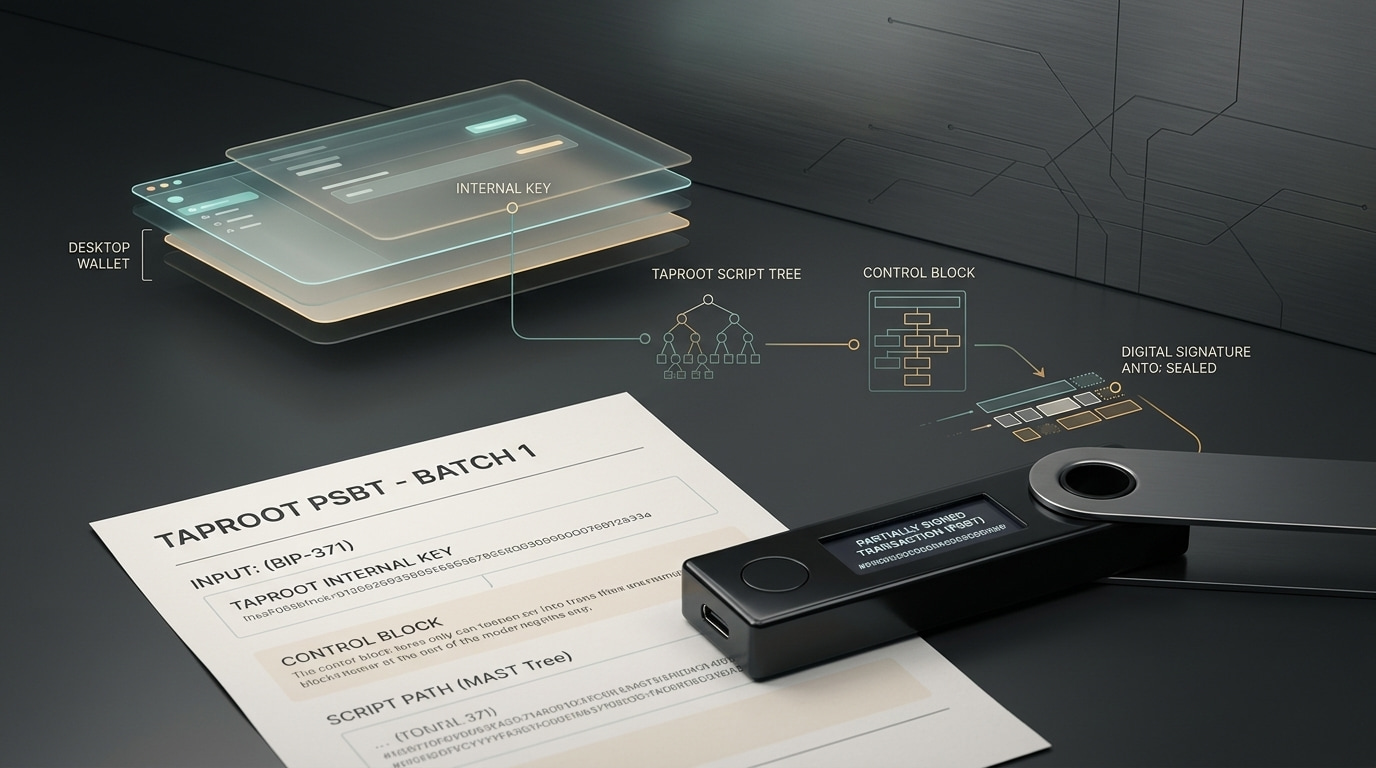
BIP-371, titled “Taproot Fields for PSBT,” defines additional fields that allow Taproot-related information to be carried inside a PSBT, or Partially Signed Bitcoin Transaction.
In simple terms, BIP-371 gives PSBTs the information they need to handle modern Taproot transactions.
Let’s break it down.
What Is BIP-371?
BIP-371 is a Bitcoin Improvement Proposal that adds Taproot-specific fields to the PSBT format.
It was authored by Ava Chow and assigned on June 21, 2021.
The specification is currently marked Deployed. It extends both PSBT version 0, defined by BIP-174, and PSBT version 2, defined by BIP-370.
The basic idea is straightforward:
Existing PSBT fields were not enough to represent all of the information required by Taproot.
So BIP-371 defines additional fields for things such as:
- Taproot Schnorr signatures
- Taproot scripts
- Taproot control blocks
- X-only public keys
- Taproot key derivation information
- Internal keys
- Taproot Merkle roots
- Taproot script trees
These fields allow wallet software and signing devices to exchange the information required to construct and sign Taproot inputs and outputs.
First, What Is a PSBT?
Before understanding BIP-371, you need to understand PSBT.
PSBT stands for Partially Signed Bitcoin Transaction.
A PSBT is a standardized way of moving a Bitcoin transaction between different pieces of software or different signing devices before the transaction is completely signed.
For example, imagine you want to spend Bitcoin using a hardware wallet.
Your computer could create the transaction first.
The transaction information could then be transferred to your hardware wallet.
The hardware wallet reviews the transaction and adds its signature.
The signed information can then return to the computer.
Finally, the completed transaction can be broadcast to the Bitcoin network.
The basic flow looks like this:
Create transaction
↓
Create PSBT
↓
Send PSBT to signer
↓
Signer adds signature
↓
Finalize transaction
↓
Broadcast transaction
PSBT provides a standardized container for this process.
Your existing article on What Is a PSBT? explains the general system in more detail.
BIP-371 builds on that foundation.
Why Did Taproot Need New PSBT Fields?
This is the key question.
When Bitcoin introduced Taproot, the way Bitcoin transactions could be constructed and spent changed.
Taproot uses:
- BIP-340 Schnorr signatures
- BIP-341 Taproot spending rules
- BIP-342 Tapscript
These technologies introduced information that older PSBT fields were not designed to represent.
The BIP-371 specification explains that existing PSBT fields could not adequately support Taproot because of the new signature algorithm and the way scripts are embedded within Taproot outputs.
Therefore, Bitcoin needed a standardized extension.
That extension became BIP-371.
How BIP-371 Fits Into the Bitcoin Upgrade Stack
BIP-371 makes more sense when you see how the different BIPs connect.
Think of the system as several layers.
BIP-340
Defines Schnorr signatures for secp256k1.
BIP-341
Defines Taproot spending rules.
BIP-342
Defines Tapscript validation rules.
BIP-174
Defines the original PSBT format.
BIP-370
Defines PSBT version 2.
BIP-371
Adds the Taproot-specific PSBT fields needed to work with these newer Bitcoin features.
So BIP-371 isn’t another consensus upgrade like Taproot itself.
Instead, it is an application-layer specification that helps wallet software exchange the information required to work with Taproot.
This distinction is important.
Does BIP-371 Change Bitcoin’s Consensus Rules?
No.
BIP-371 does not change the rules that Bitcoin miners and nodes use to determine whether a transaction is valid.
Instead, it extends the information that can be carried inside a PSBT.
Think of it like this:
Bitcoin consensus
determines whether a transaction is valid.
PSBT
helps wallets and signing devices coordinate the transaction.
BIP-371
makes that coordination work properly for Taproot.
This is why BIP-371 belongs to the Applications layer rather than the Consensus layer.
Why Are Taproot Transactions Different?
A traditional Bitcoin transaction can rely on public keys, signatures, scripts, and derivation information in ways that older PSBT fields already understood.
Taproot introduces a different structure.
A Taproot output can be spent in two major ways:
Key Path
The owner spends using the Taproot output key.
Script Path
The owner reveals a specific script and the information needed to prove that the script belongs to the Taproot tree.
These two spending methods require different information.
For example, a script-path spend may need:
- A Taproot leaf script
- A leaf version
- A control block
- A leaf hash
- A Schnorr signature
- Information about the relevant public key
BIP-371 provides standardized PSBT fields for carrying this information.
What Is a Taproot Key-Path Spend?
A key-path spend is the simpler Taproot spending route.
The spender proves control of the Taproot output through a Schnorr signature.
BIP-371 defines:
PSBT_IN_TAP_KEY_SIG
for carrying the Taproot key-path signature inside a PSBT.
The field can contain a 64-byte or 65-byte Schnorr signature, depending on the sighash form used.
The important idea is:
The PSBT needs somewhere to store the Taproot signature before the transaction is finalized.
BIP-371 provides that standardized location.
What Is a Taproot Script-Path Spend?
Taproot can also contain one or more scripts hidden inside a Merkle tree.
If the spender uses one of those scripts, they must reveal enough information for the network to verify that the script was part of the Taproot construction.
This is called a script-path spend.
A script-path PSBT therefore needs more information than a simple key-path spend.
BIP-371 defines fields for:
- The Taproot leaf script
- The control block
- The leaf version
- The public key involved in the script
- The leaf hash
- The corresponding Schnorr signature
This information allows different wallet components to understand which Taproot script is being used and how the signature relates to that script.
The Important BIP-371 Input Fields
BIP-371 defines several new per-input fields.
You don’t need to memorize the hexadecimal values yet.
Instead, understand what each field accomplishes.
1. Taproot Key Spend Signature
PSBT_IN_TAP_KEY_SIG
This stores the Schnorr signature used for a Taproot key-path spend.
The signature is associated directly with the Taproot output key, so BIP-371 does not require additional key data for this field.
2. Taproot Script Spend Signature
PSBT_IN_TAP_SCRIPT_SIG
This stores a Schnorr signature associated with:
- An X-only public key
- A particular Taproot leaf
The field therefore connects a signature to the specific script path where it is intended to be used.
3. Taproot Leaf Script
PSBT_IN_TAP_LEAF_SCRIPT
This stores information about a Taproot script leaf.
It includes:
- The control block
- The script
- The leaf version
The control block is especially important because it contains the Merkle-path information needed to prove the leaf belongs to the Taproot tree.
4. Taproot BIP32 Derivation
PSBT_IN_TAP_BIP32_DERIVATION
This provides key-derivation information for an X-only public key involved in the Taproot input.
It can identify whether the key is associated with:
- The Taproot output key
- The internal key
- A key used inside a Taproot leaf
It also carries the relevant leaf hashes and BIP32 derivation path information.
5. Taproot Internal Key
PSBT_IN_TAP_INTERNAL_KEY
This stores the X-only public key used as the internal key for the Taproot output.
Why does this matter?
Because the internal key isn’t necessarily identical to the final output key.
Taproot derives the output key using a tweak.
A signer may therefore need to know the original internal key when determining whether it can sign an input.
BIP-371 provides a dedicated field for this information.
6. Taproot Merkle Root
PSBT_IN_TAP_MERKLE_ROOT
This stores the 32-byte Merkle root associated with the Taproot tree.
Remember the basic Taproot structure:
Internal key
Taproot Merkle root
↓
Tweaked output key
The Merkle root therefore represents the script-tree component of the Taproot construction.
BIP-371 Also Adds Output Fields
BIP-371 isn’t limited to transaction inputs.
It also defines Taproot-specific information for outputs.
The main output fields include:
PSBT_OUT_TAP_INTERNAL_KEY
Stores the X-only internal key associated with the Taproot output.
PSBT_OUT_TAP_TREE
Stores information needed to reconstruct the Taproot script tree.
PSBT_OUT_TAP_BIP32_DERIVATION
Stores BIP32 derivation information for Taproot-related X-only public keys.
This distinction matters because a PSBT can carry information about both:
What you are spending
and
What you are creating.
Why Does the Taproot Tree Matter?
Taproot can contain multiple possible spending conditions.
For example, imagine a wallet has:
Key path
Normal cooperative spending
and
Script path
Emergency recovery after a timelock
The Taproot tree organizes those script paths.
The PSBT may need enough information to reconstruct that tree.
BIP-371’s:
PSBT_OUT_TAP_TREE
field provides the information required to reconstruct the Taproot tree.
The specification represents each leaf with information such as:
- Depth
- Leaf version
- Script length
- Script
The entries are arranged in depth-first-search order so the tree can be reconstructed correctly.
BIP-371 and Hardware Wallets
One of the most practical reasons BIP-371 matters is hardware-wallet signing.
Imagine your Bitcoin wallet software runs on your computer, but your private key remains inside a hardware wallet.
The computer needs to communicate enough information for the hardware wallet to understand:
What am I being asked to sign?
With a Taproot transaction, that can include much more than a simple public key and transaction.
The signing device may need to understand:
- The Taproot output
- The internal key
- The relevant script
- The leaf being spent
- The control block
- The derivation path
- The Schnorr signature information
BIP-371 provides standardized places for this information inside a PSBT.
That makes interoperability between different wallet components much easier.
Why Standardization Matters
Without a standardized format, every wallet developer could invent a different way to transport Taproot information.
That would create compatibility problems.
Imagine:
Wallet A
uses one proprietary format.
↓
Hardware Wallet B
expects another format.
↓
Wallet C
understands neither.
Standardized PSBT fields solve much of this problem.
BIP-371 gives developers a common specification for representing Taproot information.
This doesn’t mean every wallet supports every Taproot feature automatically.
It means software has a standardized framework to build that support around.
Does BIP-371 Work With PSBTv0 and PSBTv2?
Yes.
BIP-371 specifically defines Taproot fields that can be included in both BIP-174 PSBTv0 and BIP-370 PSBTv2.
This is useful because PSBT is designed to be extensible.
BIP-371 adds new fields without replacing the entire PSBT concept.
The Bitcoin Core documentation currently lists BIP-371 Taproot PSBT support as available from Bitcoin Core v24.0.
A Simple Example
Imagine Alice wants to spend Bitcoin from a Taproot wallet.
Her computer creates a transaction.
Instead of immediately producing the final transaction, it creates a PSBT.
The PSBT can carry information such as:
Taproot output
↓
Internal key
↓
Relevant Taproot tree information
↓
Signing key information
↓
Transaction data
Alice’s hardware wallet receives the PSBT.
The device can inspect the transaction and use the relevant Taproot information to produce a Schnorr signature.
The signature is added to the PSBT.
The wallet then finalizes the transaction.
Finally:
PSBT → Final transaction → Bitcoin network
This is the basic reason BIP-371 exists.
The Two Main Types of Taproot Spending
Before looking at individual fields, remember that Taproot has two major spending methods:
Key path
or
Script path
These paths require different information.
A key-path spend is relatively simple.
The spender proves control of the Taproot output with a Schnorr signature.
A script-path spend is more involved because the spender must reveal the selected script and provide a control block proving that the script belongs to the Taproot tree.
BIP-371 provides fields for both situations.
1. Taproot Key-Path Signature
The first important field is:
PSBT_IN_TAP_KEY_SIG
This field carries the Schnorr signature for a Taproot key-path spend.
Imagine Alice has a Taproot output controlled through its key path.
Her wallet creates a PSBT and sends it to her signing device.
The signing device produces a BIP-340 Schnorr signature.
That signature can then be placed into:
PSBT_IN_TAP_KEY_SIG
The field contains either:
- A 64-byte Schnorr signature using the default sighash
- A 65-byte signature when a non-default sighash type is included
The important point is that this field is specifically associated with a Taproot key-path spend.
2. Taproot Script-Path Signature
Now consider a script-path spend.
A Taproot tree might contain several possible scripts.
For example:
Leaf A → Normal recovery
Leaf B → Emergency recovery
The wallet chooses one of them.
The signature used with that script is stored using:
PSBT_IN_TAP_SCRIPT_SIG
This field associates a Schnorr signature with two pieces of information:
- An X-only public key
- A Taproot leaf hash
That connection matters.
The same public key could potentially appear in different Taproot scripts.
The leaf hash identifies the specific script path for which the signature is intended.
So instead of simply saying:
“Here is a signature.”
the PSBT can represent:
“Here is this signer’s signature for this particular Taproot leaf.”
What Is an X-Only Public Key?
If you have read the BIP-340 article on SatoshiDock, you’ll remember that Schnorr signatures in Bitcoin use 32-byte X-only public keys.
Traditional compressed Bitcoin public keys contain information about both:
- The X coordinate
- The parity of the Y coordinate
Taproot uses X-only public keys.
BIP-371 therefore uses X-only public keys when representing Taproot-related key information.
This keeps the PSBT representation consistent with the Taproot and Schnorr specifications.
3. Taproot Leaf Scripts
The next important field is:
PSBT_IN_TAP_LEAF_SCRIPT
To understand this field, we need to understand Taproot’s script tree.
A Taproot output can commit to multiple scripts.
Those scripts form a Merkle tree.
For example:
             Taproot Tree
                  |
          -----------------
          |               |
       Leaf A           Leaf B
          |               |
      Recovery       Emergency
The spender doesn’t necessarily reveal every possible script.
Instead, they reveal the script they actually use.
The PSBT therefore needs to know which leaf is being spent.
PSBT_IN_TAP_LEAF_SCRIPT carries information including:
- The control block
- The script
- The leaf version
This gives the signer the information needed to understand the selected script path.
4. What Is a Control Block?
The control block is one of the most important pieces of Taproot script-path spending.
Suppose a Taproot output commits to several scripts.
A blockchain observer needs a way to verify that the script being revealed really belongs to the Taproot tree.
The control block provides the information required for that proof.
Conceptually:
Internal key
Merkle path
Leaf information
↓
Taproot output commitment
The control block contains the internal key and the Merkle-path information needed to reconstruct the commitment.
This allows the network to verify that the revealed script was actually committed to when the Taproot output was created.
Why Does the PSBT Need the Control Block?
Because the signer needs to know exactly what script-path spend it is participating in.
Imagine a hardware wallet receives a PSBT.
It cannot simply receive:
“Sign this transaction.”
It needs enough information to understand the Taproot construction.
The PSBT can therefore provide:
Transaction
Taproot leaf
Control block
Key information
The hardware wallet can then determine the appropriate signing information.
BIP-371 standardizes where these pieces belong.
5. Taproot BIP32 Derivation Information
Another important field is:
PSBT_IN_TAP_BIP32_DERIVATION
This field provides information about how an X-only public key was derived.
Why does this matter?
Modern Bitcoin wallets often use hierarchical deterministic wallets.
Instead of generating completely unrelated keys, a wallet can derive many keys from a master key structure.
For example:
Master key
↓
Account
↓
Branch
↓
Address
When a hardware wallet receives a PSBT, it needs to know which key inside its wallet corresponds to the public key being used.
The BIP32 derivation field provides that information.
Taproot Derivation Is More Complicated
Taproot introduces an additional detail.
A public key can be involved in different parts of a Taproot construction.
For example, it could be:
- The internal key
- The output key
- A key used inside a Taproot script leaf
BIP-371 therefore allows Taproot derivation information to include the relevant leaf hashes.
This tells the signer which Taproot script paths are associated with the key.
The basic idea is:
Public key
BIP32 derivation path
Relevant Taproot leaf hashes
↓
Information needed by the signer
6. Taproot Internal Key
BIP-371 also defines:
PSBT_IN_TAP_INTERNAL_KEY
This field stores the 32-byte X-only public key used as the Taproot internal key.
The internal key is important because it isn’t necessarily the same as the final Taproot output key.
Taproot applies a tweak to the internal key.
Conceptually:
Internal key
Taproot tweak
↓
Output key
Therefore, wallet software may need the internal key to understand how the Taproot output was constructed.
7. Taproot Merkle Root
The field:
PSBT_IN_TAP_MERKLE_ROOT
stores the Taproot Merkle root.
The Merkle root represents the script-tree commitment.
A Taproot output can therefore conceptually be understood as combining two components:
Internal key
and
Script-tree commitment
These are combined through the Taproot tweaking process to produce the output key.
If there is no script tree, the Taproot construction can use the internal key without a script-tree commitment.
When a script tree exists, the Merkle root becomes part of the Taproot commitment.
Key Path vs Script Path in a PSBT
Let’s put everything together.
Key-Path Spend
A simplified PSBT flow could look like:
Taproot input
↓
Internal/output key information
↓
Signer identifies key
↓
Schnorr signature
↓
PSBT_IN_TAP_KEY_SIG
↓
Final transaction
The blockchain sees the final Taproot transaction.
Script-Path Spend
The process contains additional information:
Taproot input
↓
Taproot leaf
↓
Control block
↓
Leaf hash
↓
Relevant public key
↓
Schnorr signature
↓
PSBT_IN_TAP_SCRIPT_SIG
↓
Final transaction
The final transaction reveals the selected script path because that information is needed to validate the spend.
Taproot Output Fields
BIP-371 doesn’t only describe information about inputs.
It also defines fields for Taproot outputs.
These include:
PSBT_OUT_TAP_INTERNAL_KEY
PSBT_OUT_TAP_TREE
PSBT_OUT_TAP_BIP32_DERIVATION
These fields help software understand how a Taproot output was constructed.
This can be particularly useful when a wallet creates a transaction that sends Bitcoin to another Taproot output.
What Is PSBT_OUT_TAP_TREE?
This field is especially interesting.
A Taproot output can commit to a tree containing multiple scripts.
Wallet software needs a standardized way to represent that tree inside the PSBT.
PSBT_OUT_TAP_TREE provides this information.
The field represents Taproot leaves using information such as:
- Tree depth
- Leaf version
- Script
The information is arranged so software can reconstruct the tree.
For example:
                Root
                 |
        ----------------
        |              |
      Leaf A          Leaf B
        |              |
    Normal          Recovery
The PSBT can carry enough information for compatible software to understand this structure.
Why Would a Wallet Need the Taproot Tree?
Imagine a wallet creates a Taproot address with:
Key path
Normal spending
and:
Script path
Recovery after a long timelock.
The wallet needs to remember the relationship between those components.
If it loses the information describing the script tree, recovering and spending from the output can become much harder.
BIP-371 therefore provides a standardized representation of the Taproot tree within the PSBT ecosystem.
A Complete Taproot PSBT Workflow
Now let’s walk through the entire process.
Imagine Alice wants to spend a Taproot UTXO.
Step 1: Wallet Creates the Transaction
Alice’s wallet selects one or more UTXOs.
It creates:
- Inputs
- Outputs
- Amounts
- Fees
The transaction is not yet fully signed.
Step 2: Wallet Creates a PSBT
Instead of immediately producing the final transaction, the wallet packages the necessary information into a PSBT.
For a Taproot transaction, BIP-371 fields can carry Taproot-specific information.
Step 3: PSBT Is Sent to the Signer
The PSBT may be transferred to:
- A hardware wallet
- Another computer
- A multisigner
- Another wallet application
The important point is that the private key does not have to leave the secure signing environment.
Step 4: Signer Inspects the Information
The signing device determines:
Which key belongs to this input?
For Taproot, the PSBT can provide information such as:
- Internal key
- BIP32 derivation
- Taproot leaf hashes
- Script information
- Merkle-root information
The device can use this information to identify the appropriate signing key.
Step 5: Signer Creates a Schnorr Signature
For a key-path spend, the signer creates a BIP-340 Schnorr signature.
For a script-path spend, the signature commits to the appropriate Taproot spending information.
The signature is then added to the PSBT using the appropriate BIP-371 field.
Step 6: PSBT Returns to the Wallet
The signed PSBT can return to the wallet software.
The wallet now has the necessary signature information.
Step 7: Finalization
The wallet combines the required information and creates the final Bitcoin transaction.
The PSBT is no longer needed for broadcasting.
The final transaction contains the data required by Bitcoin’s consensus rules.
Step 8: Broadcast
The completed transaction is broadcast to the Bitcoin network.
Bitcoin nodes validate it according to the consensus rules defined by Bitcoin.
At this stage, BIP-371 has done its job.
It helped the different pieces of wallet software communicate the Taproot information required to produce the final transaction.
Why BIP-371 Matters for Hardware Wallets
Hardware wallets are one of the clearest examples of why standardized PSBT fields matter.
A hardware wallet usually tries to keep private keys isolated.
The computer can prepare the transaction.
The hardware wallet can receive the transaction information, display important details to the user, and create the signature.
With Taproot, the signing device may need more contextual information than older transaction types required.
BIP-371 gives software a standardized way to provide that context.
This helps different wallet applications and signing devices communicate without requiring every developer to invent a separate Taproot transaction format.
BIP-371 and Multisignature Wallets
BIP-371 becomes even more interesting when combined with advanced signing systems.
For example, Taproot can be used with:
- Traditional script-based policies
- MuSig2
- Miniscript
- Hardware wallets
- Multisigner custody systems
A PSBT can act as the communication container while the participants or devices perform their respective signing operations.
This is particularly relevant to the MuSig2 article we just covered.
MuSig2 requires participants to exchange information during a collaborative signing process.
Standardized PSBT support can help wallet software transport transaction and signing information between participants.
BIP-373 extends PSBT with MuSig2-specific fields, while BIP-371 handles Taproot-specific information.
Together, these standards help modern Bitcoin wallets build more sophisticated signing workflows.
BIP-371 and Privacy
BIP-371 itself does not make Bitcoin transactions private.
Its purpose is to standardize transaction-signing information.
However, Taproot can provide privacy benefits by allowing different spending conditions to share a common output structure.
For example, a Taproot output may contain:
Key path
and
Several script paths
If the key path is used, the alternative scripts do not appear in the blockchain.
BIP-371 helps wallet software manage the information needed to construct and sign these Taproot outputs.
Therefore, BIP-371 indirectly supports the practical use of Taproot’s privacy and efficiency features.
BIP-371 Does Not Mean Every PSBT Contains Every Field
This is important.
A PSBT doesn’t automatically contain every BIP-371 field.
The fields depend on what the transaction requires.
A simple Taproot key-path spend may need much less information than a complex script-path transaction.
For example:
Simple key-path spend
May mainly require key-path signing information.
Complex script-path spend
May require:
- Leaf script
- Control block
- Leaf hash
- Key derivation information
- Internal key
- Merkle-root information
So the PSBT contains the information relevant to the particular transaction.
Why BIP-371 Uses X-Only Keys
Taproot and BIP-340 use X-only public keys.
This means the public key is represented using only its 32-byte X coordinate.
The Y coordinate is not stored directly because Bitcoin uses a defined even-Y convention when lifting an X coordinate into a curve point.
BIP-371 follows this design.
As a result, many Taproot-related PSBT fields use 32-byte X-only public keys.
This keeps the PSBT representation consistent with Taproot’s cryptographic design.
The Bigger Picture
At first, BIP-371 may look like a collection of technical field definitions.
But the bigger idea is much simpler.
Modern Bitcoin has increasingly sophisticated transaction structures.
Taproot introduced:
- Schnorr signatures
- Key-path spending
- Script-path spending
- Taproot trees
- Control blocks
- Internal keys
- Tweaked output keys
Wallets and signing devices need to exchange information about all of these components.
BIP-371 provides the standardized PSBT vocabulary for doing that.
Think of it as a communication layer:
Bitcoin transaction
↓
PSBT
↓
BIP-371 Taproot information
↓
Wallet / hardware wallet / signer
↓
Schnorr signature
↓
Final Taproot transaction
BIP-371 in Simple Terms
If you want the entire BIP explained in one sentence:
BIP-371 extends PSBT so Bitcoin wallets and signing devices can exchange the information required to create, sign, and finalize Taproot transactions.
It doesn’t replace PSBT.
It doesn’t replace Taproot.
And it doesn’t change Bitcoin consensus.
Instead, it connects the two.
BIP-371 vs. Ordinary PSBT
A regular PSBT is a standardized container for partially signed Bitcoin transactions.
It allows different pieces of software to work together without requiring private keys to move between them.
For example:
Wallet → PSBT → Hardware Wallet → Signed PSBT → Wallet → Final Transaction
Taproot introduced new information that older PSBT fields could not represent.
BIP-371 extends PSBT with fields specifically designed for Taproot.
This includes:
- Schnorr signatures.
- Taproot scripts.
- Control blocks.
- Internal keys.
- Merkle roots.
- Taproot BIP32 derivation information.
- Taproot output trees.
Therefore, BIP-371 doesn’t replace PSBT.
It makes PSBT capable of handling Taproot transactions.
Why Hardware Wallets Benefit From BIP-371
Hardware wallets are designed to keep private keys inside a dedicated device.
A computer can prepare a transaction, while the hardware wallet performs the actual signing operation.
This separation is important because the computer doesn’t need access to the private key.
Taproot adds more information that a signer may need to understand.
For example, a hardware wallet may need to determine:
Which internal key is being used?
Which script leaf is relevant?
Which public key belongs to the wallet?
Which derivation path produced that key?
BIP-371 provides standardized fields for this information.
This allows wallet software and signing devices to communicate using a common format.
A Simple Hardware-Wallet Example
Imagine Alice has Bitcoin stored in a Taproot address.
She wants to spend it using a hardware wallet.
Her desktop wallet first creates a PSBT.
The PSBT can contain information such as:
Transaction data
UTXO information
Taproot internal key
Key derivation information
Taproot script information, if required
The PSBT is transferred to the hardware wallet.
The device identifies the appropriate key and creates the Schnorr signature.
The signed information returns to the desktop wallet.
The wallet finalizes the transaction and broadcasts it.
At no point does Alice need to export her private key to the computer.
Why PSBT_IN_WITNESS_UTXO Is Enough for Taproot
This is one of the more interesting technical details in BIP-371.
Traditional PSBT guidance recommends including the full previous transaction using:
PSBT_IN_NON_WITNESS_UTXO
This helps protect against certain situations where transaction information could be misrepresented.
Taproot changes an important part of this calculation.
A Taproot signature commits to the amounts and output scripts of the transaction’s inputs.
Therefore, if someone attempts to lie about the amount or output script associated with the input, the resulting signature will not be valid.
Because of this, BIP-371 allows Taproot inputs to use:
PSBT_IN_WITNESS_UTXO
without requiring the full previous transaction.
This can reduce the amount of information that needs to be carried in a Taproot PSBT.
What Happens When a PSBT Is Finalized?
A PSBT is called “partially signed” because it is not necessarily the final Bitcoin transaction.
It can contain temporary information needed during the signing process.
For Taproot, this can include fields such as:
PSBT_IN_TAP_KEY_SIGPSBT_IN_TAP_SCRIPT_SIGPSBT_IN_TAP_LEAF_SCRIPTPSBT_IN_TAP_BIP32_DERIVATIONPSBT_IN_TAP_INTERNAL_KEYPSBT_IN_TAP_MERKLE_ROOT
Once the transaction is finalized, these intermediate PSBT fields are no longer needed for broadcasting.
BIP-371 specifically says finalizers should remove the relevant Taproot fields after constructing PSBT_IN_FINAL_SCRIPTWITNESS.
The result is the final transaction that can be broadcast to the Bitcoin network.
Does BIP-371 Change Bitcoin’s Consensus Rules?
No.
This distinction is important.
BIP-371 operates at the application layer.
It defines how Taproot information is represented inside PSBTs.
The actual Taproot spending rules come from the relevant consensus specifications, including BIP-340, BIP-341, and BIP-342.
Therefore:
BIP-371 → PSBT communication
BIP-341 → Taproot spending rules
BIP-342 → Tapscript validation rules
BIP-340 → Schnorr signatures
These specifications work together, but they perform different jobs.
BIP-371 and Taproot Privacy
Taproot can provide useful privacy properties because different spending conditions can be committed to within the same output structure.
Suppose a wallet creates a Taproot output containing:
Key path
Normal spending
and:
Script path
Recovery condition
If the owner spends through the key path, the alternative script does not need to appear in the transaction.
This means an observer does not automatically see every possible spending condition.
However, BIP-371 itself is not a privacy protocol.
Its purpose is to transport the information needed by wallets and signers.
The privacy characteristics come from Taproot’s transaction design and how the wallet uses it.
BIP-371 and MuSig2
BIP-371 becomes particularly interesting when combined with MuSig2.
MuSig2 allows multiple participants to cooperate in producing a single BIP-340-compatible Schnorr signature.
From the blockchain’s perspective, the resulting Taproot output can look similar to a regular single-key Taproot output.
However, the signing process happens between multiple participants.
This creates more complicated wallet workflows.
BIP-371 provides Taproot-specific PSBT fields.
BIP-373 defines MuSig2-specific PSBT fields.
Together, these standards can support advanced multisigner workflows.
This is one reason the modern Bitcoin ecosystem uses a family of BIPs rather than relying on one specification for everything.
BIP-371 and Miniscript
Miniscript is another technology that can work alongside Taproot.
Miniscript provides a structured way to represent Bitcoin spending conditions.
For example, a policy might require:
- One signature from Alice.
- One signature from Bob.
- A recovery path after a delay.
That policy can be compiled into Bitcoin Script.
Taproot can then commit to the resulting script through its script tree.
BIP-371 gives PSBT-based wallet software a standardized way to carry the Taproot information associated with that construction.
This is especially useful for complex custody and recovery arrangements.
Common BIP-371 Mistakes
BIP-371 is a technical specification, so implementation mistakes can have serious consequences.
Here are several areas developers need to handle carefully.
Using the Wrong Key Format
Taproot-related public keys use X-only 32-byte representations.
A traditional compressed public key is not interchangeable with a Taproot X-only key.
Incorrect serialization can produce invalid PSBTs.
Confusing the Internal Key With the Output Key
The Taproot internal key and the final output key are related, but they are not necessarily identical.
Taproot applies a tweak to the internal key.
Therefore, wallet software must preserve the correct information about the internal key when it is needed.
Mixing Up Key-Path and Script-Path Signatures
A key-path signature and a script-path signature serve different purposes.
A key-path signature belongs in:
PSBT_IN_TAP_KEY_SIG
A signature associated with a particular script leaf belongs in:
PSBT_IN_TAP_SCRIPT_SIG
Confusing these structures can result in an invalid transaction or an incorrectly constructed PSBT.
Losing the Taproot Tree Information
A wallet creating a complex Taproot output needs to preserve the relevant script-tree information.
Without the required scripts, leaf information, or derivation details, recovering the spending conditions can become difficult.
Wallet backup procedures therefore need to account for more than simply one private key.
Ignoring Finalization Rules
PSBT fields exist to help software construct and sign transactions.
They are not all part of the final transaction.
Once the transaction has been finalized, temporary PSBT information should be handled appropriately.
Is BIP-371 Compatible With Older PSBT Software?
PSBT was designed to be extensible.
BIP-371 adds new fields rather than replacing the entire format.
The BIP states that older software will ignore unknown fields.
However, this does not mean old software can necessarily sign or construct Taproot transactions correctly.
There is an important difference between:
Ignoring an unknown field
and:
Understanding what that field means.
A wallet that doesn’t understand Taproot-specific information may not be able to complete the signing process.
Therefore, compatibility depends on whether the software actually supports the required Taproot functionality.
BIP-371 and PSBT Versions
BIP-371 supports both:
PSBTv0
and:
PSBTv2
PSBTv2 was introduced by BIP-370.
BIP-371 adds Taproot fields that can be used with either PSBT version.
This allows Taproot-aware software to exchange the required information without making Taproot dependent on one particular PSBT version.
A Real-World Custody Example
Consider a company that stores Bitcoin using a multi-person custody policy.
The company has three authorized signers:
Alice
Bob
Carol
The company wants a system where multiple people participate in transaction authorization.
A modern setup might use Taproot with a combination of:
- Hardware wallets.
- PSBTs.
- Taproot.
- Schnorr signatures.
- Miniscript.
- MuSig2 or script-based policies.
The transaction can begin as a PSBT.
Each signing device receives the information it needs.
Each participant performs the required signing operation.
The wallet software combines the signatures.
The completed transaction is finalized.
Finally, the transaction is broadcast.
BIP-371 is one part of the communication infrastructure that makes this workflow possible.
Does BIP-371 Make Bitcoin Transactions Faster?
Not directly.
BIP-371 itself is a PSBT specification.
It doesn’t make Bitcoin blocks larger or make transactions confirm faster.
However, it helps software work with Taproot transactions.
Taproot itself can improve transaction efficiency in certain spending situations.
For example, a key-path Taproot spend can use a 64-byte Schnorr signature.
But it is important not to confuse the roles of these technologies.
BIP-371 organizes Taproot information inside PSBTs.
It does not directly change Bitcoin transaction confirmation times.
Does BIP-371 Reduce Bitcoin Fees?
Not directly.
BIP-371 does not determine Bitcoin transaction fees.
Fees depend on factors such as:
- Transaction size.
- Fee rate.
- Network demand.
- Transaction structure.
- Input and output characteristics.
Taproot can make certain transactions more efficient, which can affect their size and therefore their fee requirements.
But BIP-371’s role is to support the wallet and signing workflow before the transaction reaches the blockchain.
Advantages of BIP-371
BIP-371 provides several practical benefits.
Standardized Taproot Information
Wallet developers don’t need to invent separate formats for Taproot PSBT data.
Hardware-Wallet Support
Signing devices can receive Taproot-specific information in standardized fields.
Better Interoperability
Different applications can exchange Taproot PSBTs using a common format.
Support for Complex Spending Conditions
The specification supports information required for Taproot script paths and trees.
Works With PSBTv0 and PSBTv2
Taproot data can be represented in either PSBT version.
Supports Modern Bitcoin Wallet Architecture
BIP-371 fits naturally into workflows involving hardware wallets, multisignature systems, Taproot, and advanced signing protocols.
Limitations of BIP-371
BIP-371 also has limits.
It Doesn’t Protect Private Keys by Itself
PSBT is a transaction communication format.
Wallets still need proper key management and secure signing procedures.
It Doesn’t Make Bitcoin Private
BIP-371 doesn’t hide transactions from the blockchain.
It Doesn’t Guarantee Wallet Compatibility
Software needs to implement Taproot and BIP-371 correctly.
It Doesn’t Replace Taproot
BIP-371 depends on the underlying Taproot and Schnorr specifications.
It Doesn’t Eliminate Human Error
A user can still approve the wrong transaction or interact with malicious software.
Security therefore depends on the entire wallet system, not one BIP.
Frequently Asked Questions
What is BIP-371?
BIP-371 is the Bitcoin Improvement Proposal titled “Taproot Fields for PSBT.” It defines additional PSBT fields for carrying BIP-340, BIP-341, and BIP-342 Taproot information.
Who wrote BIP-371?
BIP-371 was authored by Ava Chow.
Is BIP-371 active?
Yes. The specification is listed as Deployed.
Does BIP-371 change Bitcoin’s consensus rules?
No. It defines application-layer PSBT fields rather than new consensus rules.
What does PSBT_IN_TAP_KEY_SIG contain?
It contains the 64- or 65-byte Schnorr signature used for a Taproot key-path spend.
What does PSBT_IN_TAP_SCRIPT_SIG contain?
It associates a Schnorr signature with an X-only public key and a specific Taproot leaf hash.
What is PSBT_IN_TAP_LEAF_SCRIPT?
It carries a Taproot leaf script, its leaf version, and the control block needed for the script-path construction.
What is the Taproot internal key?
It is the X-only public key used as the internal key in a Taproot output before the Taproot tweaking process produces the output key.
What is a Taproot Merkle root?
It is the 32-byte hash representing the Taproot script tree.
Can Taproot PSBTs use PSBT_IN_WITNESS_UTXO?
Yes. BIP-371 explains that Taproot signatures commit to the input amounts and output scripts, allowing Taproot inputs to use PSBT_IN_WITNESS_UTXO.
Does BIP-371 support PSBTv2?
Yes. BIP-371 defines Taproot fields for both PSBTv0 and PSBTv2.
Can a hardware wallet use BIP-371?
Yes. BIP-371 provides standardized Taproot information that signing devices can use when processing PSBTs.
Is BIP-371 the same as Taproot?
No.
Taproot is the Bitcoin spending system.
BIP-371 is the PSBT extension that allows software to exchange Taproot-related information.
Is BIP-371 the same as BIP-340?
No.
BIP-340 defines Schnorr signatures for Bitcoin.
BIP-371 defines Taproot-specific PSBT fields.
Is BIP-371 the same as BIP-341?
No.
BIP-341 defines Taproot’s spending rules.
BIP-371 defines how Taproot information is represented in PSBTs.
BIP-371 Explained in One Example
Let’s reduce everything to one simple scenario.
Alice has a Taproot UTXO.
She wants to spend it using her hardware wallet.
Her desktop wallet creates a PSBT.
The PSBT contains the transaction information.
BIP-371 provides Taproot-specific information where necessary.
The hardware wallet identifies the correct key.
It creates a Schnorr signature.
The signature is added to the PSBT.
The desktop wallet receives the signed PSBT.
It finalizes the transaction.
The temporary signing information is no longer required for broadcasting.
The final transaction is sent to the Bitcoin network.
That’s the practical role of BIP-371.
It helps the different parts of the Bitcoin wallet ecosystem communicate the information required to spend Taproot outputs.
Final Thoughts
What is BIP-371?
BIP-371 is the specification that extends PSBT with the fields needed to work with Taproot.
Taproot introduced a new transaction structure based on Schnorr signatures, internal keys, script trees, and key-path and script-path spending.
Those features required additional information during transaction creation and signing.
BIP-371 provides that information in a standardized format.
The result is a cleaner workflow:
Create transaction
↓
Create PSBT
↓
Add Taproot information
↓
Send to signer
↓
Create Schnorr signature
↓
Return signed PSBT
↓
Finalize
↓
Broadcast
For ordinary Bitcoin users, you may never manually inspect a BIP-371 field.
Your wallet handles the technical details.
But understanding BIP-371 helps explain what happens behind the scenes when a modern Bitcoin wallet creates and signs a Taproot transaction.
It also shows why Bitcoin development is not limited to the blockchain’s consensus rules.
Wallet standards, signing protocols, hardware devices, descriptors, PSBTs, and Bitcoin Improvement Proposals all work together to create the infrastructure users interact with every day.
BIP-371 is one of the pieces connecting Taproot’s advanced transaction capabilities with the wallets and signing tools that actually use them.
Related posts:
 Bitcoin Silent Payments Explained: How to Send Bitcoin Privately Without Revealing Your Address
 Bitcoin Payment Links & QR Codes: What Is a Bitcoin Payment URI?
 Bitcoin Payments Are Getting a Human Friendly Upgrade: What Is BIP 353?
 BIP 47 Explained: The Bitcoin Privacy Feature You Probably Haven’t Heard Of