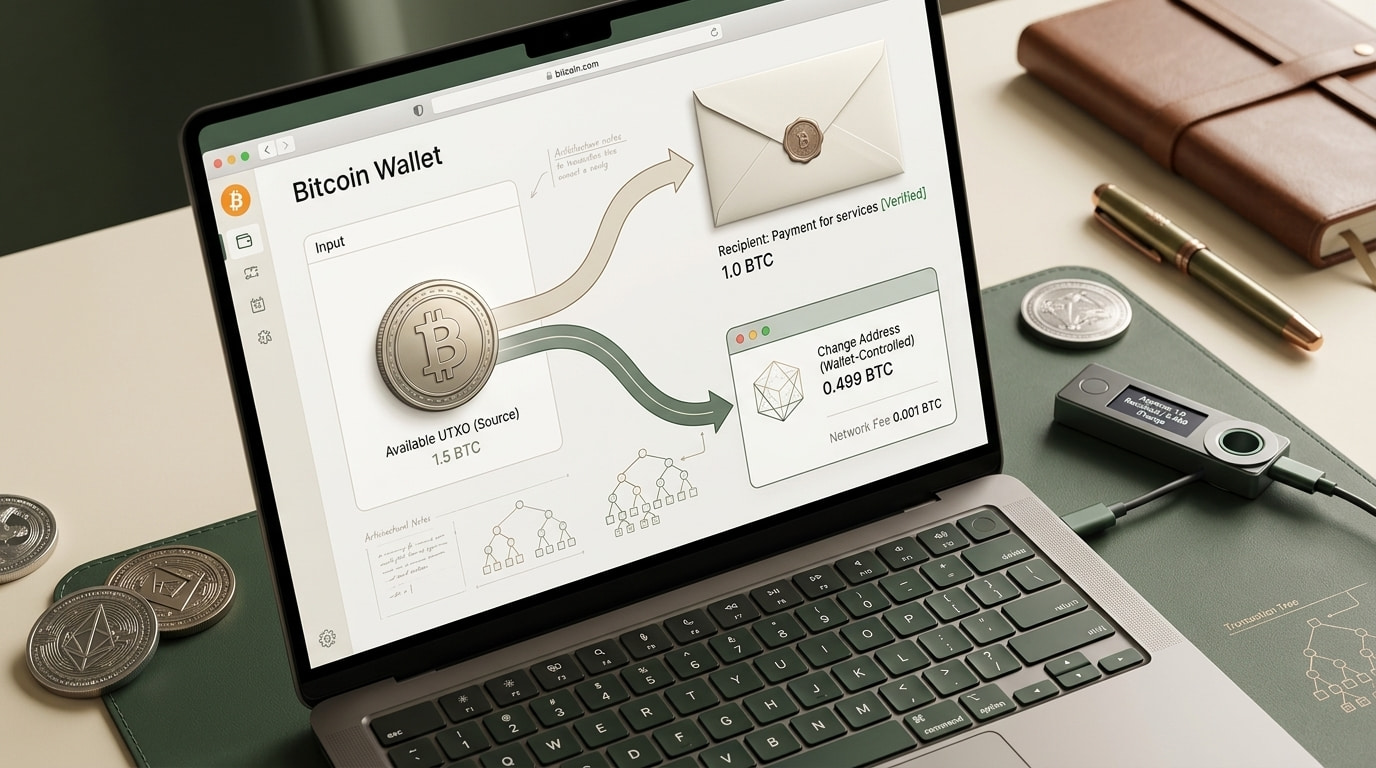
When you send Bitcoin, you might assume your wallet simply takes the exact amount you want to send and moves it to another person.
Bitcoin does not work quite that way.
Bitcoin transactions spend entire UTXOs. If the UTXO you use is worth more than the payment, the remaining Bitcoin has to go somewhere. Usually, your wallet sends that remaining amount back to you through a change output.
That destination is commonly called a Bitcoin change address.
Understanding change addresses makes Bitcoin transactions much easier to understand. It also helps explain why a transaction can have more than one output, why your wallet may show unfamiliar addresses, and why wallets often generate new addresses instead of sending change back to the address you originally used.
Bitcoin’s developer documentation defines a change output as an output that returns surplus satoshis to the spender.
What Is a Bitcoin Change Address?
A Bitcoin change address is an address controlled by the sender’s wallet that receives the leftover Bitcoin from a transaction.
The easiest way to understand it is with an example.
Imagine you have one Bitcoin UTXO worth:
0.01 BTC
You want to send:
0.003 BTC
to another person.
You also need to pay a transaction fee.
Your wallet cannot simply remove 0.003 BTC from the middle of your 0.01 BTC UTXO.
Instead, it spends the entire UTXO.
The transaction might look roughly like this:
Input:
0.010000 BTC

        ↓

Bitcoin Transaction

        ↓

Recipient: 0.003000 BTC
Change:    0.006900 BTC
Fee:       0.000100 BTC
The numbers above are only an example.
The important relationship is:
Inputs = Outputs + Transaction Fee
The remaining amount becomes a new output controlled by your wallet.
That output is your change.
Why Does Bitcoin Need Change?
Bitcoin uses a UTXO model.
A UTXO is an unspent transaction output created by an earlier transaction.
When you receive Bitcoin, you don’t receive a balance sitting inside your account in the same way money might appear in a traditional bank account.
Instead, your wallet controls one or more UTXOs.
Suppose your wallet controls:
0.004 BTC
0.007 BTC
and:
0.001 BTC
These are separate UTXOs.
If you want to make a payment of 0.005 BTC, your wallet may need to spend one or more of them.
It cannot take exactly 0.005 BTC from the 0.007 BTC UTXO while leaving the remaining 0.002 BTC inside that same UTXO.
Instead, the original UTXO is spent completely.
The transaction creates new outputs.
For example:
0.007 BTC UTXO

        ↓

   ┌───────────────┐
   │ Bitcoin Tx    │
   └───────────────┘
        ↓       ↓
       0.005   0.0019
       BTC     BTC
        ↓       ↓
   Recipient   Your
               change
The remaining 0.0001 BTC in this example becomes the transaction fee.
Bitcoin’s developer documentation explains that because each UTXO can only be spent once, the full value of the selected inputs must either be assigned to outputs or become a transaction fee.
A Change Address Is Not a Separate Type of Bitcoin
This is a common beginner misunderstanding.
There is no special kind of Bitcoin called “change Bitcoin.”
There is also no special blockchain object called a change address that works differently from every other Bitcoin address.
A change address is simply an address controlled by the sender’s wallet that receives an output.
In other words:
Change address = Your wallet’s destination for leftover transaction value
The Bitcoin sent there is just Bitcoin.
Once the transaction confirms, the change output becomes a new UTXO that your wallet can spend later.
Change Is an Output
This is another important concept.
Suppose you spend one UTXO to make a payment.
Your transaction might contain:
1 input
and:
2 outputs
The first output pays the recipient.
The second output returns the remaining value to you.
For example:
INPUT
0.01 BTC

      ↓

┌─────────────────────┐
│     Transaction     │
├─────────────────────┤
│ 0.003 BTC → Alice   │
│ 0.0069 BTC → You    │
└─────────────────────┘

Fee = 0.0001 BTC
Bitcoin transactions can have multiple outputs, and each output can later become a UTXO when it remains unspent.
This is why the Bitcoin balance displayed by your wallet can change in ways that seem confusing at first.
Your wallet may spend an old UTXO and receive a brand-new change UTXO in the same transaction.
Why Doesn’t My Wallet Just Send Change Back to My Original Address?
It could.
Bitcoin’s transaction rules don’t require a wallet to use a completely new address for change.
However, modern wallets often use a different address for change.
This can help reduce unnecessary address reuse and improve transaction privacy.
Bitcoin’s developer documentation specifically recommends sending change to a new address rather than reusing the same address when possible.
Imagine you previously received Bitcoin at:
Address A
You later spend some of that Bitcoin.
Instead of sending the remaining amount back to Address A, your wallet may generate:
Address B
The transaction then looks like:
Your old UTXO
     ↓
Transaction
   ↙     ↘
Alice   Address B
        (your change)
Both addresses can still belong to the same wallet.
The wallet may control the private keys behind both addresses even though they look completely different on the blockchain.
Change Addresses Can Look Unfamiliar
This is one reason beginners sometimes become concerned after looking at a blockchain explorer.
They send Bitcoin to someone.
Then they inspect the transaction and see another address receiving Bitcoin.
They might think:
“Who is that? Did my wallet send Bitcoin somewhere else?”
Often, that second output is simply your change.
For example:
Input:
Your previous UTXO

Outputs:

1. Recipient's address
2. Another address controlled by your wallet
The second address can look completely unrelated to the address you originally used.
That’s normal for wallets that generate fresh change addresses.
How Does the Wallet Know the Change Belongs to You?
Your wallet manages the keys needed to control its addresses.
When it creates a new change address, the wallet knows the corresponding private key or derivation information.
The blockchain does not know that the address belongs to you.
The network simply sees an output locked to a particular script or address representation.
Your wallet recognizes the output as belonging to it because it controls the necessary keys.
This is an important distinction:
The wallet knows ownership through its keys.
The blockchain records spendable outputs and their locking conditions.
What Happens to the Change Later?
The change output becomes part of your wallet’s UTXO set.
Suppose you received:
0.0069 BTC
as change.
Later, you want to send:
0.004 BTC
Your wallet might select that 0.0069 BTC change UTXO as one of the inputs.
It spends that UTXO completely.
The new transaction may then create:
0.004 BTC → Recipient
Remaining amount → New change output
So change can move through your wallet repeatedly.
The process looks like:
Receive Bitcoin
      ↓
UTXO
      ↓
Spend UTXO
      ↓
Change Output
      ↓
New UTXO
      ↓
Spend Again
      ↓
Another Change Output
This is one of the reasons Bitcoin transactions are better understood as movements between UTXOs rather than movements between simple account balances.
Is a Change Address the Same as a Receiving Address?
Not necessarily.
Both can be addresses controlled by your wallet, but they serve different purposes.
A receiving address is generally provided to someone who wants to send Bitcoin to you.
A change address is generated or selected by your wallet to receive the leftover amount from your own outgoing transaction.
For example:
Receiving
Someone → Your wallet
Change
Your wallet → Your wallet
The second transaction isn’t actually moving Bitcoin “from one wallet to another.”
It is creating a new output that your existing wallet controls.
Can You Spend Bitcoin From a Change Address?
Yes.
Once the change output exists and is spendable, it is simply another UTXO controlled by your wallet.
You can later use it to:
- Pay someone.
- Combine it with other UTXOs.
- Send it to an exchange.
- Move it to another wallet.
- Use it in another transaction.
The fact that an output was created as change doesn’t permanently label the Bitcoin.
It becomes part of your wallet’s spendable funds.
Why Change Addresses Matter
Change addresses might seem like a small technical detail, but they affect several important parts of Bitcoin.
They help explain:
- How Bitcoin transactions handle leftover value.
- Why transactions often have multiple outputs.
- Why wallet balances are built from UTXOs.
- Why your wallet may generate unfamiliar addresses.
- How wallets manage transaction privacy.
- Why address reuse can reveal relationships between transactions.
How Does a Bitcoin Wallet Choose UTXOs?
Suppose your wallet contains these UTXOs:
0.001 BTC
0.003 BTC
0.007 BTC
0.015 BTC
You want to send:
0.004 BTC
plus a transaction fee.
Your wallet has several possible choices.
It could use:
0.007 BTC
and return the remainder as change.
Or it could combine:
0.003 BTC + 0.001 BTC
to get exactly 0.004 BTC before considering the fee.
In reality, the wallet also has to consider the transaction fee.
So the problem becomes:
Which combination of UTXOs can fund the transaction efficiently?
This process is called coin selection.
What Is Coin Selection?
Coin selection is the process a Bitcoin wallet uses to choose which UTXOs will become inputs in a transaction.
The goal isn’t always simply to find the biggest or smallest UTXO.
A wallet may consider factors such as:
- Amount available.
- Number of inputs required.
- Estimated transaction fee.
- Whether change will be created.
- Existing UTXO structure.
- Privacy considerations.
- Future spending efficiency.
Different wallets can use different strategies.
There is no single universal coin-selection algorithm that every Bitcoin wallet must follow.
That’s why two wallets holding exactly the same UTXOs can potentially build different transactions.
The Perfect Match: No Change Required
The simplest situation happens when the wallet can find UTXOs that closely match the payment plus the required fee.
For example:
UTXO:
0.0051 BTC

Payment:
0.0050 BTC

Fee:
0.0001 BTC

Change:
0 BTC
In this case, the entire UTXO is consumed.
There is no separate change output.
This can be useful because every additional output adds transaction data.
However, finding an exact match isn’t always possible.
When the Wallet Needs to Create Change
Now suppose the wallet has:
0.01 BTC
and wants to pay:
0.003 BTC
with a:
0.0001 BTC
fee.
The transaction could look like:
Input:
0.0100 BTC

        ↓

Payment:
0.0030 BTC

Change:
0.0069 BTC

Fee:
0.0001 BTC
The 0.0069 BTC becomes a new output controlled by the wallet.
That output becomes another UTXO after the transaction confirms.
Why Not Always Use One UTXO?
Sometimes the wallet can fund the transaction with one UTXO.
Sometimes it cannot.
Imagine you want to send:
0.010 BTC
but your wallet has:
0.004 BTC
0.003 BTC
0.006 BTC
No individual UTXO is large enough.
The wallet may therefore combine:
0.004 BTC + 0.006 BTC
and use both as inputs.
The transaction then creates the recipient’s output, and any remaining value after the fee may become change.
This demonstrates why a wallet balance is not just one number.
Underneath that balance may be many separate UTXOs.
More Inputs Can Mean Higher Fees
Every input adds data to a transaction.
Therefore, spending five UTXOs can generally require more transaction data than spending one UTXO.
That can increase the fee required for the same payment, depending on the transaction type and fee rate.
Because of this, wallets may try to avoid unnecessary inputs.
This creates an interesting trade-off.
A wallet may want to:
Minimize inputs now
while also:
Avoid creating awkward UTXOs for the future.
Coin selection therefore isn’t simply about today’s transaction.
It can also affect future transactions.
What Is UTXO Consolidation?
Imagine your wallet receives many small payments:
0.0008 BTC
0.0011 BTC
0.0006 BTC
0.0013 BTC
0.0009 BTC
You technically control all of these funds.
But spending them individually later can require many inputs.
A wallet may sometimes combine several UTXOs into a larger one during periods when transaction fees are relatively favorable.
This process is called UTXO consolidation.
It is different from ordinary change creation.
The goal of consolidation is to reorganize multiple smaller UTXOs into fewer larger UTXOs.
Some wallet software includes specific logic for deciding when using additional inputs for consolidation makes sense.
How Does a Wallet Generate a Change Address?
Modern deterministic wallets can derive large numbers of addresses from a seed.
That means the wallet doesn’t need to generate each address from a completely unrelated random key.
Instead, it can derive addresses in a structured hierarchy.
BIP-44 defines the following general structure:
m / purpose’ / coin_type’ / account’ / change / address_index
For Bitcoin, the change level distinguishes between:
0 = external chain
and:
1 = internal chain
The internal chain is described as the chain used for change addresses.
So, under a BIP-44-style structure, a wallet might derive addresses such as:
Receiving:
m/44'/0'/0'/0/0
m/44'/0'/0'/0/1

Change:
m/44'/0'/0'/1/0
m/44'/0'/0'/1/1
The exact derivation path depends on the wallet and address type.
Not every modern wallet uses this exact scheme.
Descriptor-based wallets and other wallet designs can organize keys differently.
The important concept is that change keys can be managed separately from public receiving keys.
What Is the Internal Chain?
The term internal chain can sound complicated.
It simply refers to addresses intended for the wallet’s own internal use, including change.
The external chain is generally used for addresses the wallet presents to other people.
The internal chain is used for destinations controlled by the wallet itself.
Conceptually:
                 HD Wallet
                     |
             ┌───────┴───────┐
             ↓               ↓
        External          Internal
        Addresses         Addresses
             ↓               ↓
        Receive BTC       Change BTC
BIP-44 explicitly describes the internal chain as the chain for change addresses.
Does Every Wallet Use a New Change Address?
Not necessarily.
Wallet behavior differs.
However, privacy-conscious wallet designs commonly avoid repeatedly sending change back to the same address.
Using a fresh change destination can make it harder for outside observers to connect multiple transactions simply because the same address keeps receiving change.
Current Bitcoin wallet guidance also treats using a new change address as an important privacy practice.
That doesn’t make your transactions anonymous.
Bitcoin’s blockchain remains public.
It simply avoids unnecessarily exposing the same address relationship over and over.
Change Addresses and Address Reuse
Consider this example.
You receive Bitcoin at:
Address A
You later spend some of it.
Your wallet sends the change to:
Address A
An observer can see that Address A received Bitcoin before and later received the change.
Now imagine your wallet instead uses:
Address B
The relationship is less obvious from that particular address reuse pattern.
The observer may still be able to connect the addresses using transaction history and other clues.
So a fresh change address is not a magic privacy shield.
It is simply one useful privacy technique.
Why Change Amounts Can Reveal Information
The change output itself can sometimes provide clues.
Suppose a transaction has:
Input:
1.000000 BTC

Output 1:
0.700000 BTC

Output 2:
0.299800 BTC

Fee:
0.000200 BTC
Someone examining the transaction may try to determine which output belongs to the recipient and which is change.
Blockchain analysis companies use various heuristics to make these kinds of guesses.
Wallet design therefore matters for privacy.
The goal isn’t necessarily to make every transaction look identical.
Instead, good wallet design can avoid unnecessary patterns that make ownership easier to infer.
What Happens If the Change Is Very Small?
Creating a tiny change output is not always useful.
Suppose you spend a UTXO and only a very small amount remains after paying the recipient and fee.
Creating a new output has a cost.
That output will also need to be spent later.
If the value is so small that spending it later would cost more than its value, the output may be uneconomical.
This situation is related to what Bitcoin users commonly call dust.
Wallet software can therefore decide that a tiny remainder should not become a separate change output.
Instead, the remainder can effectively become part of the transaction fee.
Bitcoin Core includes configuration around the fee threshold used for discarding change that would be uneconomical to create.
Change Output vs Transaction Fee
This distinction is important.
Suppose:
Inputs = 0.010000 BTC
Recipient = 0.009900 BTC
There might not be enough economically useful value left to create a separate change output.
The wallet can allow some remainder to become part of the fee instead.
So not every transaction that spends more input value than the recipient amount creates a visible change output.
The practical question is:
Is the remaining amount worth creating another UTXO?
Why Some Wallets Group UTXOs
Wallets can also make privacy-related decisions when selecting multiple UTXOs.
Bitcoin Core has an avoidpartialspends feature that can group outputs associated with an address when selecting coins, which can improve privacy in some situations but may require more inputs and therefore increase fees.
This illustrates an important principle:
Privacy and efficiency can sometimes pull in different directions.
Using fewer inputs may save fees.
Using a particular group of UTXOs may produce a cleaner ownership pattern.
The wallet has to balance these considerations.
Can You Identify Change on a Blockchain Explorer?
Sometimes you can make an educated guess.
But you cannot always know with certainty.
Suppose a transaction has two outputs:
Output 1 → 0.002 BTC
Output 2 → 0.007 BTC
You might suspect one is the payment and the other is change.
But the blockchain does not include a simple label saying:
“Output 2 belongs to the sender.”
Blockchain analysis relies on transaction patterns, wallet behavior, address reuse, script types, amounts, timing, and other heuristics.
That means identifying change is often an inference rather than a direct piece of blockchain metadata.
Why Wallets Hide Change Details From Beginners
Most wallets don’t ask you to manually choose a change address every time you send Bitcoin.
That would make everyday Bitcoin payments unnecessarily complicated.
Instead, the wallet usually handles:
UTXO selection
Fee calculation
Change calculation
Change-address selection
automatically.
The user normally sees something much simpler:
Send 0.003 BTC
The wallet handles the underlying transaction construction.
Advanced users can inspect the resulting transaction using a block explorer or wallet’s transaction details.
A Full Example
Imagine your wallet contains:
UTXO 1 = 0.002 BTC
UTXO 2 = 0.004 BTC
UTXO 3 = 0.010 BTC
You want to send:
0.006 BTC
Your wallet decides to use:
UTXO 2 = 0.004 BTC
and:
UTXO 1 = 0.002 BTC
Now the wallet has exactly 0.006 BTC in inputs before accounting for the fee.
Because the fee still has to be paid, the wallet needs additional input value.
It might instead select:
UTXO 3 = 0.010 BTC
Then the transaction could look roughly like:
Input:
0.010 BTC

        ↓

Recipient:
0.006 BTC

Change:
0.0039 BTC

Fee:
0.0001 BTC
The 0.0039 BTC change becomes a new UTXO controlled by the wallet.
Later, that UTXO can be selected for another payment.
Why Change Is Important for Understanding Bitcoin
Once you understand change, many Bitcoin wallet behaviors become easier to understand.
You can see why:
A wallet can have many UTXOs.
A transaction can have multiple outputs.
Your balance can come from many different transactions.
A wallet can generate addresses you never manually requested.
A payment can create a new output that still belongs to you.
This is one of the most important steps toward understanding Bitcoin at the transaction level.
The Big Picture
A Bitcoin wallet isn’t simply keeping a pile of coins behind one address.
It manages a collection of cryptographic keys and spendable outputs.
When you make a payment, the wallet:
Selects UTXOs
↓
Builds transaction inputs
↓
Calculates the payment and fee
↓
Determines whether change is needed
↓
Creates a change output when appropriate
↓
Uses a wallet-controlled change destination
↓
Signs the transaction
↓
Broadcasts it
The change output then becomes part of the wallet’s future UTXO pool.
That cycle repeats every time you spend Bitcoin.
Why Change Addresses Matter for Privacy
Bitcoin’s blockchain is public.
Anyone can inspect transactions and see:
- Inputs
- Outputs
- Amounts
- Transaction history
- Addresses or scripts involved
However, the blockchain generally does not contain a simple label saying:
“This output belongs to the sender.”
Observers often use transaction patterns to make educated guesses.
Change addresses are one part of that analysis.
Bitcoin’s developer documentation recommends avoiding unnecessary address reuse because unique addresses can improve privacy and reduce certain risks.
Address Reuse Can Reveal Connections
Imagine you receive Bitcoin at:
Address A
Later, you spend some of that Bitcoin.
Your wallet sends the remaining amount back to:
Address A
Now the blockchain shows Address A appearing again.
This creates an obvious connection between the earlier receiving transaction and the later change transaction.
A wallet that instead uses:
Address B
for change avoids that particular form of address reuse.
That does not make the transaction anonymous.
Blockchain observers can still use many other clues.
But avoiding unnecessary reuse removes one easy source of information.
Fresh Change Addresses Are Not a Privacy Guarantee
It is important not to exaggerate what change addresses accomplish.
Suppose a wallet sends change to a fresh address.
A blockchain analyst may still connect that address to the sender using:
- Common-input patterns
- Transaction amounts
- Script types
- Spending behavior
- Timing
- Previous transaction history
- Other wallet-related patterns
Therefore:
New change address ≠ anonymous transaction
It is better to think of fresh change addresses as one privacy-preserving design choice within a much larger system.
Can Someone Tell Which Output Is the Change?
Sometimes.
But there is no universal rule that says:
“The second output is always change.”
A transaction can have several outputs.
For example:
Input
1.000 BTC

        ↓

Output 1
0.300 BTC

Output 2
0.699 BTC

Fee
0.001 BTC
An observer might try to determine which output is the payment and which belongs to the sender.
They can use heuristics.
However, the blockchain itself does not attach a “change” label to the output.
The wallet knows which output belongs to it because the wallet controls the associated key or script information.
What Happens When You Restore a Bitcoin Wallet?
This is where change addresses become especially important.
Suppose your wallet is lost.
You reinstall the wallet on another device.
You enter your recovery seed.
You expect your Bitcoin to reappear.
In a properly designed deterministic wallet, the wallet can derive its keys and addresses from the seed according to the wallet’s derivation rules.
However, the seed alone is not the entire story.
The wallet also needs to know how those keys were derived and which wallet structure was used.
This is why wallet compatibility matters.
Two wallets can start with the same seed but use different derivation paths or wallet structures.
If the second wallet looks in the wrong place, it may not find the addresses containing your Bitcoin.
BIP-44 and Change Addresses
BIP-44 introduced a widely used hierarchical deterministic wallet structure.
Its general path is:
m / purpose’ / coin_type’ / account’ / change / address_index
BIP-44 defines:
0 = external chain
and:
1 = internal chain
The internal chain is specifically described as the chain used for change addresses.
Conceptually:
Bitcoin Wallet
     |
     ├── External Chain
     │      ├── Address 0
     │      ├── Address 1
     │      └── Address 2
     │
     └── Internal Chain
            ├── Change 0
            ├── Change 1
            └── Change 2
This allows a deterministic wallet to generate receiving and change addresses from the same underlying wallet structure while keeping their purposes separate.
What Is the Address Gap Limit?
BIP-44 also introduced the concept of an address gap limit.
The BIP specifies a gap limit of 20: if software encounters 20 consecutive unused addresses, its discovery algorithm assumes there are no used addresses beyond that point and stops scanning that chain.
This matters during wallet restoration.
Imagine a wallet has used:
Address 0
Address 1
Then generated many unused addresses.
If the wallet restoration process follows a gap-limit-based discovery procedure, it may stop searching after the defined run of unused addresses.
This is one reason wallets shouldn’t casually generate large numbers of unused addresses without considering how the wallet’s recovery process discovers them.
Does the Gap Limit Apply the Same Way to Change?
The exact discovery behavior depends on the wallet design.
BIP-44 says its discovery procedure scans the external chain and notes that internal chains receive coins from the associated external chains.
Modern wallets can use more advanced wallet structures.
For example, Bitcoin Core’s descriptor wallets represent collections of output scripts using descriptors rather than relying on the older implicit key-based model. Bitcoin Core’s documentation also supports descriptors that explicitly distinguish receiving and change derivation paths.
So you should not assume that every modern wallet recovers addresses in exactly the same way as a basic BIP-44 wallet.
The important lesson is:
Know your wallet’s backup and derivation system.
What Are Output Descriptors?
Modern Bitcoin wallet software increasingly uses output descriptors.
An output descriptor describes the scripts or addresses that belong to a wallet.
Bitcoin Core’s documentation explains that descriptor wallets use descriptors internally to reason about collections of wallet outputs. Descriptors can also specify separate derivation paths for receiving and change addresses.
A simplified descriptor might contain:
Extended public key + derivation path
For example, a wallet can represent:
.../0/* → Receiving addresses

.../1/* → Change addresses
The exact descriptor depends on the wallet and address type.
This makes the wallet’s structure explicit.
Why Descriptors Matter for Wallet Recovery
Consider a watch-only wallet.
It doesn’t need private keys to monitor Bitcoin.
Instead, it can use public key information or descriptors to determine which outputs belong to the wallet.
Bitcoin Core’s descriptor documentation demonstrates descriptors that include separate receiving and change branches.
This is useful because a wallet can describe not only:
“Here is one Bitcoin address.”
but:
“Here is the entire family of addresses that this wallet controls.”
That is a much more powerful concept.
Change Addresses and Hardware Wallets
Hardware wallets often generate many addresses from keys derived from a master seed.
The hardware device keeps the private keys protected.
The connected wallet software may receive public key information and derivation details needed to construct transactions.
In a Bitcoin Core/HWI example, receiving and change descriptor paths are represented separately, with /0/* used for receiving and /1/* for change in the demonstrated BIP84 setup.
This allows the computer to construct a transaction while the hardware wallet protects the private signing keys.
Do You Need to Back Up Every Change Address?
Normally, you do not manually write down every change address.
With a properly designed deterministic wallet, the keys for future addresses can be derived from the wallet’s underlying backup information.
However, that doesn’t mean every seed phrase works with every wallet automatically.
You may also need to preserve information such as:
- Wallet type
- Derivation path
- Account number
- Address format
- Descriptor information
- Additional passphrase, if used
This is why documenting how your wallet was created can be valuable.
A seed phrase without the correct wallet context can sometimes make recovery much harder.
What Happens if You Import a Seed Into the Wrong Wallet?
Imagine you originally used a wallet that derived addresses according to one standard.
You import the same seed into a wallet using a different derivation path.
The second wallet may generate completely different addresses.
You might see:
0 BTC
even though the original wallet contained Bitcoin.
That does not necessarily mean the Bitcoin disappeared.
The wallet may simply be looking at a different branch of the key hierarchy.
This is one reason experienced Bitcoin users pay attention to derivation paths and wallet standards when recovering funds.
Change Addresses and Watch-Only Wallets
A watch-only wallet can monitor addresses without holding the private keys needed to spend from them.
For an advanced Bitcoin setup, a watch-only wallet can use public information describing both:
Receiving addresses
and:
Change addresses
This allows it to track the wallet’s transaction history and balances without possessing the signing keys.
Output descriptors are particularly useful for describing these collections of wallet outputs.
Can a Change Address Be Used as a Normal Receiving Address?
Technically, an internal or change address is still a valid Bitcoin destination.
But wallet software often treats internal and external addresses differently.
The distinction is about purpose, not whether Bitcoin can technically be sent there.
An internal address is intended for wallet-controlled outputs such as change.
An external address is generally intended to be given to another person or service for receiving payments.
The difference helps wallets organize their address pools and transaction behavior.
Should You Manually Send Bitcoin to Your Own Change Address?
Usually, there is no reason to do this manually.
Your wallet already knows how to create change.
Manually moving Bitcoin between addresses in the same wallet can create another transaction and therefore another fee.
It can also create additional blockchain history without accomplishing anything useful.
Let the wallet’s transaction construction system handle normal change.
Common Change-Address Mistakes
Mistake 1: Thinking the Change Address Belongs to Someone Else
Seeing an unfamiliar output in your transaction does not automatically mean someone took your Bitcoin.
It may be a change address controlled by your own wallet.
Mistake 2: Assuming Every Second Output Is Change
There is no universal rule that says the second output belongs to the sender.
Output ordering isn’t a reliable ownership label.
Mistake 3: Reusing One Address Forever
Repeated address reuse can reveal relationships between transactions and reduce privacy.
Bitcoin’s developer documentation recommends avoiding address reuse when possible.
Mistake 4: Using the Wrong Derivation Path During Recovery
A seed imported into the wrong wallet configuration may generate addresses that do not match the original wallet.
Always identify the wallet standard and derivation structure used when the wallet was created.
Mistake 5: Assuming Seed Backup Solves Everything
A seed is extremely important, but wallet recovery can also depend on additional information.
Examples include:
- BIP39 passphrase
- Derivation path
- Descriptor
- Wallet type
- Account structure
Losing relevant recovery information can make restoration difficult.
Mistake 6: Manually Tracking Every Generated Address
You normally don’t need a spreadsheet containing hundreds of change addresses.
Deterministic wallets are specifically designed to derive addresses systematically.
The important thing is preserving the wallet’s underlying recovery information and understanding its derivation structure.
Frequently Asked Questions
What is a Bitcoin change address?
A Bitcoin change address is a wallet-controlled destination used to receive leftover value when selected UTXOs are worth more than the payment and transaction fee.
Is a change address a special type of Bitcoin address?
No. “Change address” describes how the wallet uses the address. It is not a separate Bitcoin asset or a special consensus-level address type.
Are change addresses new addresses?
Often, yes. Many wallets generate fresh internal addresses for change to reduce unnecessary address reuse.
Can someone see my change address?
Yes. If the change output appears in a confirmed Bitcoin transaction, anyone can see its address or underlying locking script on the public blockchain.
Can someone tell that an output is change?
They may make an educated guess using blockchain-analysis heuristics, but the blockchain does not simply label outputs as “change.”
Do change addresses improve privacy?
Fresh change addresses can reduce some forms of address reuse, but they do not make transactions anonymous.
Why does my wallet show an address I never gave anyone?
It may be a change address generated by your wallet for internal use.
Can I spend Bitcoin received at a change address?
Yes. Once the change output is confirmed and spendable, it becomes another UTXO controlled by your wallet.
What is the difference between an external and internal address?
In the BIP-44 model, the external chain is used for receiving addresses, while the internal chain is used for change addresses.
What is the BIP-44 change path?
BIP-44 uses 0 for the external chain and 1 for the internal change chain.
What is an address gap limit?
In BIP-44, the address gap limit is 20 unused addresses in a row during address discovery.
Do modern wallets all use BIP-44?
No. Modern wallets can use different standards, derivation structures, descriptors, or wallet architectures.
Can I recover my change addresses from a seed phrase?
A properly designed deterministic wallet can derive its addresses from its underlying backup information, but recovery also depends on the wallet’s derivation scheme and any additional recovery information it requires.
What are output descriptors?
Output descriptors are structured descriptions of wallet-controlled output scripts and keys. Bitcoin Core uses descriptors internally in descriptor wallets and can represent separate receiving and change derivation paths.
Bitcoin Change Address vs Receiving Address
The difference can be summarized simply.
| Feature | Receiving Address | Change Address |
|---|---|---|
| Main purpose | Receive a payment | Receive leftover transaction value |
| Typical chain | External | Internal |
| Controlled by | Recipient’s wallet | Sender’s wallet |
| Usually given to others? | Yes | Usually no |
| Can receive Bitcoin? | Yes | Yes |
| Can later be spent? | Yes | Yes |
| Often freshly generated? | Frequently | Frequently |
The “internal” and “external” terminology comes from the HD-wallet structure defined by BIP-44.
The Complete Picture
Now we can put the entire process together.
Suppose you have several UTXOs.
You want to send Bitcoin.
Your wallet:
1. Looks at your available UTXOs
↓
2. Selects suitable inputs
↓
3. Calculates the required fee
↓
4. Determines the payment amount
↓
5. Calculates the remainder
↓
6. Decides whether useful change should be created
↓
7. Derives or selects an internal change destination
↓
8. Creates the transaction
↓
9. Signs the transaction
↓
10. Broadcasts it
After confirmation, the change becomes a new UTXO.
Later, that UTXO can become an input in another transaction.
And the cycle continues.
Why Understanding Change Addresses Matters
Bitcoin may look like a simple system:
Send coins from A to B.
Underneath the surface, it is more accurately:
Select UTXOs → Create inputs → Create outputs → Pay the fee → Return change when necessary → Sign → Confirm
Once you understand change addresses, several Bitcoin concepts become much clearer.
You start seeing why:
- Wallet balances aren’t simple account balances.
- Transactions can have multiple outputs.
- Wallets generate many addresses.
- Address reuse can affect privacy.
- UTXO management matters.
- Wallet recovery depends on derivation rules.
- Hardware wallets can manage large address families without exposing private keys.
A change address is therefore a small feature with a surprisingly important role in Bitcoin’s transaction model.
Final Thoughts
What is a Bitcoin change address?
It is a wallet-controlled destination that receives the leftover value from a Bitcoin transaction after the wallet spends selected UTXOs, pays the recipient, and accounts for the transaction fee.
Modern wallets often generate separate internal addresses for change.
This helps organize wallet funds and can reduce unnecessary address reuse.
But change addresses are about more than privacy.
They are connected to:
UTXOs
Coin selection
HD wallets
BIP-44
Descriptors
Hardware wallets
and:
Wallet recovery
The key idea to remember is this:
Your Bitcoin wallet isn’t simply moving a balance from one address to another. It is selecting spendable outputs and creating new outputs.
One of those new outputs may be the payment.
Another may be your change.
That change becomes a new UTXO, which your wallet can later spend again.
Once you understand that cycle, Bitcoin transactions become much easier to read and understand.