







Most people use money every day without thinking much about it.
You receive a salary, buy groceries, pay bills, and transfer money through banks or mobile apps. It feels normal because traditional money has been part of our lives for generations.
Then along comes Bitcoin.
Suddenly, people start talking about digital currencies, decentralization, blockchain technology, and a future where money might work very differently than it does today.
This naturally raises an important question:
If traditional money already works, why was Bitcoin created?
The answer lies in understanding the key differences between these two financial systems. While both can be used to store value and make payments, they operate in fundamentally different ways.
In this guide, we’ll compare Bitcoin and traditional money, explore their advantages and disadvantages, and examine why millions of people believe Bitcoin could play a major role in the future of finance.
What Is Traditional Money?
Traditional money, often called fiat currency, is money issued and controlled by governments.
Examples include:
- US Dollar (USD)
- Euro (EUR)
- British Pound (GBP)
- Japanese Yen (JPY)
- Pakistani Rupee (PKR)
Fiat currencies have value because governments declare them legal tender and people trust them as a medium of exchange.
When you deposit money in a bank, use a debit card, or transfer funds online, you’re participating in the traditional financial system.
This system has served the world for decades, but it also has limitations.
What Is Bitcoin?
Bitcoin is a digital currency that operates independently of governments and central banks.
Created in 2009, Bitcoin allows users to send and receive value through a decentralized network.
Unlike traditional money, Bitcoin is not printed or controlled by any authority.
Instead, it relies on blockchain technology to verify and record transactions.
This makes Bitcoin one of the first successful forms of decentralized digital money.
You can learn more about it here What Is Bitcoin and How Does It Work?
Centralized vs Decentralized
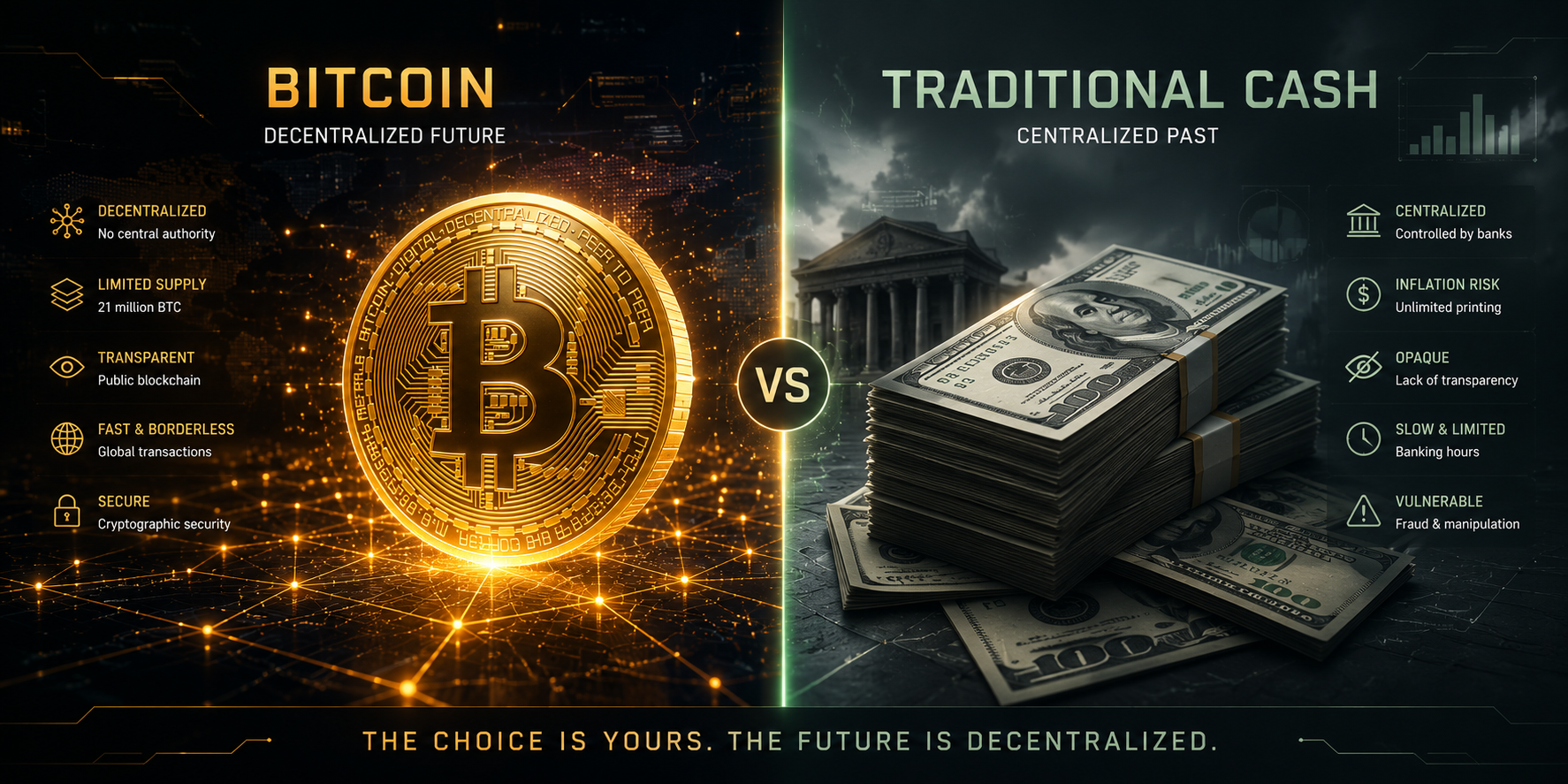
The biggest difference between Bitcoin and traditional money is control.
Traditional Money
Traditional currencies are centralized.
Central banks and governments manage the money supply, influence interest rates, and oversee the financial system.
Examples include:
- The Federal Reserve
- The European Central Bank
- The Bank of England
These institutions play an important role in economic stability.
Bitcoin
Bitcoin is decentralized.
No government, company, or individual controls the network.
Instead, thousands of computers around the world maintain the system collectively.
This decentralized structure is one of Bitcoin’s most distinctive features.
Supply and Scarcity
Another major difference is how supply is managed.
Traditional Money Supply
Governments and central banks can create additional currency when necessary.
This flexibility can help during economic crises but may also contribute to inflation.
As more money enters circulation, purchasing power can decline over time.
Bitcoin Supply
Bitcoin has a fixed maximum supply of 21 million coins.
No additional Bitcoin can be created beyond this limit.
Supporters argue that this scarcity makes Bitcoin similar to precious metals like gold.
Speed of Transactions
Modern banking systems have become much faster than they once were.
However, international transfers can still involve delays.
Traditional Money
Domestic payments are often quick.
International transfers may take several days due to intermediary banks and regulatory processes.
Bitcoin
Bitcoin transactions can be sent directly across borders without requiring traditional banking infrastructure.
This makes Bitcoin particularly attractive for global transfers.
Accessibility
Access to financial services varies around the world.
Traditional Banking
Opening a bank account often requires:
- Identification documents
- Verification procedures
- Approval from financial institutions
In some regions, access remains limited.
Bitcoin
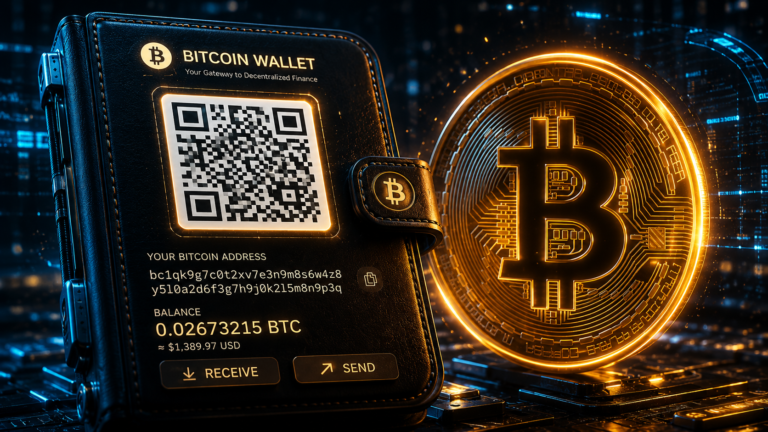
Anyone with internet access can create a Bitcoin wallet and participate in the network.
This opens financial opportunities for people who lack traditional banking services.
Transparency
Transparency is another area where the two systems differ.
Traditional Finance
Bank records are private.
Transactions are generally visible only to account holders and authorized institutions.
Bitcoin
Bitcoin transactions are recorded on a public blockchain.
Anyone can verify transaction activity on the network.
While wallet owners remain relatively anonymous, transaction records are transparent.
Security
Security is essential for any financial system.
Traditional Money
Banks invest heavily in fraud prevention and cybersecurity.
Customers often benefit from protections such as chargebacks and fraud monitoring.
Bitcoin
Bitcoin uses advanced cryptographic security.
The network itself has proven highly resilient.
However, users bear greater responsibility for protecting their wallets and private keys.
This added responsibility can be both an advantage and a challenge.
Inflation and Purchasing Power
Inflation affects nearly every economy.
Traditional Money
Most fiat currencies experience inflation over time.
As prices rise, the purchasing power of money can decrease.
This is one reason many people seek alternative stores of value.
Bitcoin
Bitcoin’s fixed supply prevents unlimited creation of new coins.
Many investors view Bitcoin as a potential hedge against inflation, although its market value remains volatile.
Privacy
Financial privacy is an increasingly important topic.
Traditional Financial Systems
Banks typically collect significant personal information.
Transactions may be monitored for regulatory compliance.
Bitcoin
Bitcoin transactions do not require sharing extensive personal information directly on the network.
However, many cryptocurrency exchanges implement identity verification requirements.
Volatility
This is one area where traditional money currently holds a significant advantage.
Traditional Money
Most major currencies experience relatively stable price movements.
This stability makes them practical for everyday transactions.
Bitcoin
Bitcoin is known for significant price fluctuations.
Its value can rise or fall dramatically over short periods.
While some investors view this as an opportunity, others see it as a risk.
Advantages of Traditional Money
Traditional money offers several strengths:
- Stable value
- Widespread acceptance
- Consumer protections
- Government backing
- Familiarity
These factors make fiat currencies highly practical for daily use.
Advantages of Bitcoin
Bitcoin also offers unique benefits:
- Decentralization
- Fixed supply
- Borderless transfers
- Financial accessibility
- Transparency
- User control
These characteristics have attracted millions of users worldwide.
Can Bitcoin Replace Traditional Money?
This question continues to spark debate.
Some believe Bitcoin could eventually become a global financial standard.
Others believe traditional currencies will remain dominant.
A more realistic possibility is that both systems will coexist.
Traditional money may continue serving everyday economic needs while Bitcoin functions as:
- A store of value
- An investment asset
- A hedge against inflation
- A decentralized payment option
The future may involve a combination of both approaches.
Which Is Better?
The answer depends on your goals.
If you need stability and widespread acceptance, traditional money remains highly effective.
If you value decentralization, scarcity, and financial independence, Bitcoin offers unique advantages.
Rather than viewing them as competitors, many people use both.
Traditional money handles daily expenses, while Bitcoin serves as a long-term asset or alternative financial tool.
The Future of Money
Technology continues to reshape finance.
Digital payments, online banking, blockchain technology, and cryptocurrencies are changing how people interact with money.
Bitcoin has challenged long-standing assumptions about financial systems and introduced new possibilities for transferring value globally.
Whether it ultimately becomes a dominant financial asset or remains a complementary system, Bitcoin has already influenced the future of money.
Conclusion
Bitcoin and traditional money share the same basic purpose: enabling people to store and exchange value.
However, they achieve this goal in very different ways.
Traditional money relies on centralized institutions, government oversight, and established financial infrastructure. Bitcoin relies on decentralization, blockchain technology, and a fixed supply.
Each system has strengths and weaknesses.
For many people, the future is not about choosing one over the other. Instead, it’s about understanding both and using them where they provide the greatest benefit.
As digital finance continues to evolve, understanding these differences will become increasingly important for anyone interested in the future of money.