Bitcoin is often described as a transparent financial network because its blockchain is public.
But there is another part of Bitcoin that most beginners rarely think about:
How do Bitcoin computers actually communicate with each other?
Before BIP 324, Bitcoin’s peer-to-peer network mainly communicated using an unencrypted protocol known as P2P protocol version 1, or V1.
The blockchain data being exchanged was already public. However, the communication itself could reveal useful metadata, could be tampered with more easily, and could be identified by network monitoring systems.
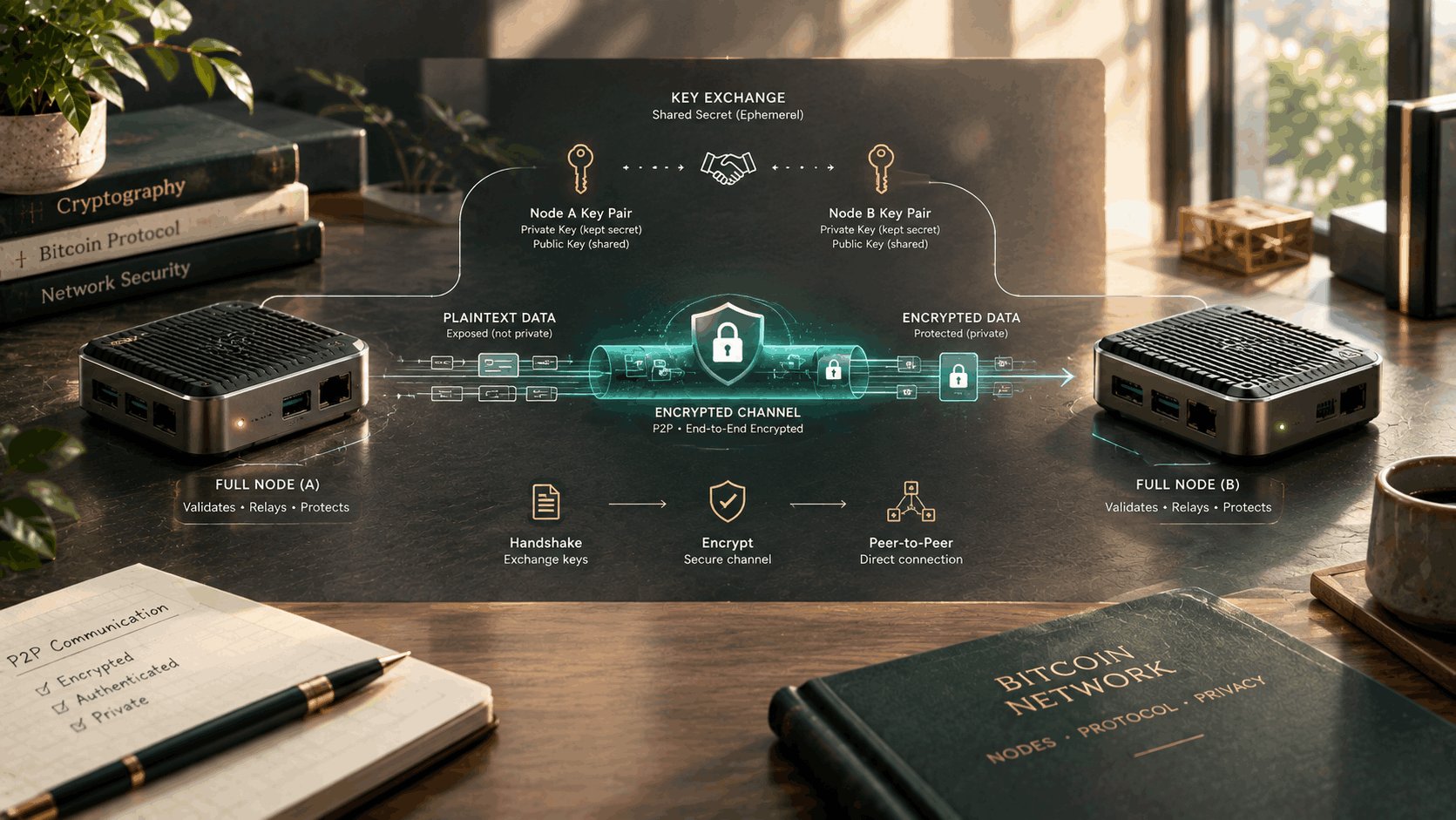
BIP 324 introduces an encrypted version of Bitcoin’s peer-to-peer transport protocol.
It is called the Version 2 P2P Encrypted Transport Protocol, or simply BIP 324.
In this beginner’s guide, we’ll explain what BIP 324 is, why Bitcoin needed it, what it protects, and why encrypting Bitcoin’s network traffic matters.
What Is BIP 324?
BIP 324 is a Bitcoin protocol specification that introduces encrypted communication between Bitcoin nodes.
It creates a new version of Bitcoin’s peer-to-peer transport protocol called V2.
The proposal uses opportunistic encryption, meaning compatible nodes can establish an encrypted connection without requiring users to manually configure certificates, passwords, or VPNs.
The current BIP documentation lists BIP 324 as Deployed. It is a specification at Bitcoin’s Peer Services layer and was assigned in 2019.
In simple terms:
BIP 324 helps Bitcoin nodes communicate privately over the internet instead of sending their P2P traffic in plain text.
What Is Bitcoin’s Peer-to-Peer Network?
To understand BIP 324, you first need to understand what a Bitcoin node does.
A Bitcoin node is a computer running Bitcoin software that communicates with other nodes.
These nodes form Bitcoin’s peer-to-peer network.
They exchange information such as:
- New transactions
- Blocks
- Blockchain data
- Network information
- Peer-related messages
For example, when someone broadcasts a Bitcoin transaction, their node can relay that transaction to other nodes.
Those nodes relay it again.
Eventually, the transaction can spread throughout the network.
The same general communication system helps Bitcoin nodes discover peers and distribute blockchain data.
This is one of the foundations that allows Bitcoin to operate without a central server.
What Was Wrong With the Old Bitcoin P2P Protocol?
Bitcoin’s original P2P communication protocol was designed to exchange public blockchain information.
That makes sense.
After all, Bitcoin transactions and blocks are supposed to be publicly verifiable.
However, there is an important difference between:
Public information
and:
Publicly observable network communication.
The transaction itself may be public.
But information about how and when that transaction moved through the network can reveal additional clues.
That is where the privacy problem begins.
Public Blockchain Doesn’t Mean Private Network Traffic
Imagine Alice broadcasts a Bitcoin transaction.
The transaction itself eventually appears on the public blockchain.
But before confirmation, it has to travel through the Bitcoin network.
If someone monitors Alice’s network connection, they may be able to observe that her node communicated certain information at a particular time.
That can potentially provide clues about:
- Transaction origin
- Timing
- Network relationships
- IP addresses
- Node behavior
BIP 324 is designed to make this type of passive observation more difficult.
What Is P2P Encryption?
P2P encryption means encrypting the communication channel between two Bitcoin nodes.
Instead of sending readable protocol messages across the network, the nodes establish encryption keys and then exchange encrypted data.
Conceptually:
Node A
↓
Encrypted connection
↓
Node B
An outside observer can still see that data is moving.
But they shouldn’t be able to simply read the encrypted contents of the communication.
This is similar to the difference between sending a postcard and sending a sealed package.
The network can see that something was sent.
It becomes much harder to see the contents.
Why Does Bitcoin Need Encryption If the Blockchain Is Public?
This is one of the most important questions.
Bitcoin doesn’t need encryption to hide the blockchain.
The blockchain is intentionally public.
Instead, encryption helps protect the communication layer surrounding that public data.
Think of it this way:
Blockchain
Public
Anyone can inspect confirmed transactions and blocks.
P2P communication
Transport communication
This is how nodes exchange information before and while it reaches the wider network.
BIP 324 focuses on improving the privacy and security of this communication layer.
What Problems Does BIP 324 Address?
The BIP 324 specification identifies several weaknesses in the older plaintext P2P protocol.
The major ones include:
1. Eavesdropping
A passive attacker can monitor network traffic.
2. Metadata exposure
Network information can reveal clues about transaction sources and timing.
3. Traffic identification
Bitcoin’s old protocol has recognizable patterns that can make Bitcoin traffic easier to identify.
4. Tampering
An attacker positioned between two peers can interfere with an unencrypted connection.
5. Censorship
If network traffic can easily be identified, a censoring system can attempt to block or disrupt it.
BIP 324 attempts to raise the cost of these attacks.
What Is an Eavesdropping Attack?
An eavesdropper is an attacker who observes communication without necessarily changing it.
Imagine someone monitoring internet traffic between two Bitcoin nodes.
With an unencrypted protocol, the attacker may be able to inspect the data being exchanged.
With encrypted communication, the attacker can still observe that communication is happening, but the contents become much harder to interpret.
This is called protection against a passive attacker.
BIP 324 specifically aims to provide confidentiality against passive attacks.
What Is Metadata?
Metadata is information about communication rather than necessarily the contents themselves.
For Bitcoin networking, potentially useful metadata can include:
- IP addresses
- Timing
- Connection relationships
- Packet sizes
- Communication patterns
This information can matter even when the underlying blockchain data is public.
For example, suppose an observer notices that a transaction appears on a particular node’s connection shortly before it spreads through the wider network.
That timing could potentially provide a clue about where the transaction originated.
Encryption doesn’t automatically eliminate this problem, but it can make some forms of observation more difficult.
BIP 324 Doesn’t Hide Bitcoin Transactions
This distinction is extremely important.
BIP 324 does not encrypt the Bitcoin blockchain.
It does not hide:
- Confirmed transactions
- Transaction amounts
- Block contents
- Bitcoin addresses
- UTXOs
Anyone can still inspect Bitcoin’s public blockchain.
Instead, BIP 324 protects the transport communication between peers.
So:
Bitcoin blockchain → Public
Bitcoin P2P communication → Encrypted when using V2
That is the key concept.
What Is Bitcoin P2P Protocol V1?
The original Bitcoin peer-to-peer transport protocol is commonly referred to as V1 in BIP 324.
V1 communication is not encrypted.
It uses recognizable protocol structures, including Bitcoin’s network magic and message formats.
This makes it possible for network observers to identify Bitcoin traffic relatively easily.
BIP 324 introduces V2 as an encrypted alternative.
What Is Bitcoin P2P Protocol V2?
V2 is the encrypted transport protocol introduced by BIP 324.
When two compatible nodes establish a V2 connection, they perform a cryptographic handshake.
They then derive shared encryption keys.
After that, their Bitcoin P2P messages travel through an encrypted channel.
The BIP also aims to make the resulting byte stream appear pseudorandom to passive observers, making simple pattern matching much less effective.
V1 vs V2: The Basic Difference
| Feature | P2P V1 | P2P V2 |
|---|---|---|
| Encryption | No | Yes |
| Readable traffic contents | More exposed | Encrypted |
| Easy protocol fingerprinting | Yes | Much harder |
| Passive eavesdropping | Easier | More difficult |
| Traffic tampering | Lower barrier | More difficult |
| P2P privacy | Limited | Improved |
| Automatic encryption | No | Designed for opportunistic use |
| Bitcoin blockchain itself | Public | Public |
The important point is that V2 doesn’t make Bitcoin’s blockchain private.
It improves the security and privacy of the network transport layer.
What Does “Opportunistic Encryption” Mean?
The phrase can sound complicated.
The basic idea is simple.
Bitcoin nodes should be able to encrypt their communication without requiring a centralized certificate authority or manual configuration.
If both peers support V2, they can establish an encrypted connection.
This makes encryption practical for Bitcoin’s decentralized network, where nodes constantly connect to different peers.
The BIP deliberately separates encryption from authentication because Bitcoin is a permissionless network and there isn’t one central authority that can authenticate every peer.
Does BIP 324 Authenticate Bitcoin Nodes?
No—not by itself.
This is a subtle but very important distinction.
Encryption and authentication are different things.
Encryption
Protects the communication from being read by passive observers.
Authentication
Proves who you’re communicating with.
BIP 324 primarily focuses on encryption.
It does not provide a general system that proves:
“This is definitely the Bitcoin node operated by Alice.”
Instead, it creates an encrypted channel without requiring identity authentication.
The specification deliberately treats authentication as a separate problem that could be added through future mechanisms.
Why Not Just Use HTTPS or TLS?
You might wonder:
“Why didn’t Bitcoin developers simply use TLS?”
It’s a reasonable question.
Bitcoin’s P2P network has requirements that don’t map perfectly onto ordinary web encryption.
BIP 324 was designed specifically around Bitcoin’s networking environment.
Among other things, it aims for:
- A pseudorandom bytestream
- Low overhead
- Compatibility with Bitcoin’s existing networking model
- Support for Bitcoin’s secp256k1 ecosystem
- Packet-based communication
- Opportunistic encryption
- Future upgradeability
The BIP’s authors therefore designed a Bitcoin-specific transport protocol rather than simply wrapping the P2P network in a general-purpose protocol.
Why Not Just Use a VPN?
A VPN can encrypt network traffic.
So why does Bitcoin need BIP 324?
The problem is scale and automation.
Bitcoin nodes automatically establish connections with peers across the network.
A VPN usually requires configuration.
BIP 324 is designed to work directly at the Bitcoin P2P transport layer.
That means compatible nodes can use encryption without requiring every operator to manually configure a private network.
The BIP specifically discusses VPNs and proxy networks such as Tor as different solutions with different trade-offs.
Does BIP 324 Replace Tor?
No.
BIP 324 and Tor solve different problems.
BIP 324
Encrypts the Bitcoin P2P communication between compatible peers.
Tor
Can hide the user’s normal IP address by routing traffic through the Tor network.
Therefore, BIP 324 should not be thought of as a replacement for Tor.
A Bitcoin node using BIP 324 can still have an ordinary internet connection and a publicly observable IP address.
Encryption does not automatically provide IP anonymity.
Does BIP 324 Hide Your IP Address?
No.
This is one of the biggest misconceptions to avoid.
BIP 324 encrypts the communication channel.
It does not magically hide the network endpoints.
If you connect directly to Bitcoin peers over your normal internet connection, your IP address can still be visible to those peers.
If you need stronger network-layer privacy, technologies such as Tor address a different part of the problem.
BIP 324 and network anonymity should therefore be treated as separate concepts.
Does BIP 324 Prevent All Bitcoin Network Attacks?
No.
BIP 324 improves the security of the communication channel, but it doesn’t eliminate every possible attack against Bitcoin’s P2P network.
For example, it does not automatically prevent:
- Eclipse attacks
- Sybil attacks
- Traffic analysis
- Malicious peers
- IP-level surveillance
- All man-in-the-middle attacks
- Blockchain analysis
Instead, it raises the cost of certain attacks and makes some forms of passive observation and protocol identification more difficult.
How Does BIP 324 Help Against Censorship?
Bitcoin traffic has historically been relatively easy to identify because the older P2P protocol has recognizable patterns.
A network operator or firewall can potentially use those patterns to identify and block Bitcoin traffic.
BIP 324 changes this.
The V2 connection is designed to produce a pseudorandom bytestream that is much harder to identify through simple pattern matching.
That means a censoring system may need to use more expensive or aggressive techniques to identify and block Bitcoin communication.
This doesn’t make censorship impossible.
It simply makes simple protocol fingerprinting less effective.
Why Is a Pseudorandom Bytestream Useful?
Imagine a firewall looking for a specific pattern.
If every Bitcoin connection begins with a recognizable sequence of bytes, the firewall can search for that sequence.
It’s similar to recognizing a vehicle because it always has a distinctive shape.
BIP 324 attempts to remove that easy fingerprint.
The encrypted traffic should instead resemble random data.
This makes basic pattern matching much less useful.
The protocol can also include additional techniques that make the traffic more difficult to distinguish.
What Is Forward Secrecy?
BIP 324 also includes forward secrecy within a session.
The basic idea is that compromising current session encryption material should not automatically reveal previously encrypted traffic from that same session.
The protocol achieves this by periodically changing encryption keys during a session.
This is an important security property for long-lived Bitcoin connections.
The official specification states that the encryption keys are cycled after a large number of messages to provide forward security within the session.
Is BIP 324 a New Bitcoin Blockchain Upgrade?
No.
This is another important distinction.
BIP 324 doesn’t create:
- A new cryptocurrency
- A new blockchain
- A new consensus rule
- A new mining algorithm
Instead, it changes how Bitcoin nodes communicate.
It operates at the Peer Services layer.
The blockchain itself remains Bitcoin.
Is BIP 324 Part of Bitcoin’s Consensus Rules?
No.
Consensus rules determine what Bitcoin nodes consider valid blocks and transactions.
BIP 324 doesn’t change those rules.
Instead, it defines how peers can securely transport Bitcoin P2P messages.
That’s why you can think of BIP 324 as a networking upgrade rather than a monetary or consensus upgrade.
Is BIP 324 Already Deployed?
Yes.
This is important because BIP 324 isn’t merely an experimental proposal.
The current Bitcoin BIP documentation lists it as:
Status: Deployed
Type: Specification
Layer: Peer Services
The current specification is version 1.0.2. The BIP was marked final in its 1.0.0 release in July 2024, with subsequent revisions published afterward.
What Does “Deployed” Mean?
It means the protocol has moved beyond the proposal-only stage and has been implemented for use in the Bitcoin ecosystem.
However, that doesn’t mean:
Every Bitcoin node on Earth is using V2.
Bitcoin’s network contains nodes running different software versions and configurations.
BIP 324 therefore includes compatibility mechanisms so that V2-capable software can still communicate with older V1 peers.
What Happens If a Node Doesn’t Support BIP 324?
Bitcoin needs backward compatibility.
Otherwise, introducing a new transport protocol could split the network into incompatible groups.
BIP 324 addresses this by allowing V2-capable clients to accept inbound V1 connections.
V2 support is also signaled through the Bitcoin P2P service mechanism.
If a connection attempt using V2 fails because the other side doesn’t support it, implementations can retry using V1.
This allows the network to transition gradually.
Why Is This Important for Bitcoin?
Bitcoin doesn’t have a central administrator who can force every node to upgrade at the same time.
There is no central switch that says:
“Everyone must use V2 tomorrow.”
Instead, Bitcoin improvements often need to coexist with older software during a transition period.
BIP 324 was designed with that reality in mind.
That makes gradual deployment possible without requiring the entire network to upgrade simultaneously.
BIP 324 in One Simple Example
Imagine two Bitcoin nodes:
Node A → Node B
With the older V1 protocol, their communication is essentially sent without transport encryption.
With BIP 324:
Node A
↓
Cryptographic handshake
↓
Shared encryption keys
↓
Encrypted P2P communication
↓
Node B
The blockchain information remains public.
But the communication channel between the nodes becomes much harder for passive observers to inspect.
Why BIP 324 Matters for Bitcoin Privacy
Bitcoin privacy isn’t only about hiding addresses.
It also involves understanding what information leaks through the network itself.
A transaction can reveal information through its blockchain history.
But the network layer can provide another category of information:
Who communicated what, when, and through which network connection?
BIP 324 doesn’t solve every privacy problem.
But it strengthens one important layer of Bitcoin’s architecture.
It makes the communication between peers more private and harder to identify through simple network fingerprints.
The Big Picture
Think of Bitcoin as having several layers.
Layer 1: Your Wallet
Creates and signs transactions.
Layer 2: Bitcoin P2P Network
Relays transactions and blocks between nodes.
Layer 3: Blockchain
Stores the public transaction history.
BIP 324 focuses on Layer 2.
It doesn’t make Layer 3 private.
Instead, it improves the security of the network that carries information toward the blockchain.
How Does BIP324 Actually Encrypt Bitcoin Network Traffic?
In Part 1, we looked at why Bitcoin needed a more private and harder-to-identify way for nodes to communicate.
Now let’s look at what happens when two Bitcoin nodes establish a BIP324 connection.
You don’t need advanced mathematics to understand the basic process.
At a high level, BIP324 does this:
Exchange temporary keys → Create a shared secret → Derive encryption keys → Negotiate the protocol → Encrypt Bitcoin messages
Let’s break that process down.
1. Two Bitcoin Nodes Establish a Connection
Imagine two Bitcoin nodes:
- Node A — the initiator
- Node B — the responder
Node A connects to Node B using the Bitcoin P2P network.
With BIP324, the nodes don’t immediately start exchanging normal Bitcoin messages.
Instead, they first establish an encrypted transport connection.
This initial process is called the handshake.
The handshake has two major jobs:
- Establish shared cryptographic secrets.
- Determine that both sides can communicate using the version 2 transport protocol.
BIP324 divides the connection into three phases:
Key exchange → Version negotiation → Encrypted application messages
The first two together form the handshake.
2. Temporary Keys Are Created
Each node generates a temporary cryptographic key pair.
BIP324 uses the secp256k1 elliptic curve—the same curve used extensively throughout Bitcoin’s cryptography.
However, these aren’t the node’s Bitcoin wallet keys.
They are temporary keys created specifically for the network connection.
This distinction is important.
Your Bitcoin wallet private key controls your Bitcoin.
A BIP324 transport key instead helps protect communication between two Bitcoin nodes.
Because the keys are temporary, BIP324 can provide forward secrecy.
That means compromising session-related secrets later should not allow an attacker to decrypt previously protected traffic, apart from a limited amount of the most recent traffic.
3. Enter ElligatorSwift
This is where BIP324 gets particularly interesting.
The temporary public keys aren’t simply sent using a conventional, easily recognizable public-key format.
BIP324 uses a technique called ElligatorSwift.
Its purpose is to encode elliptic-curve public keys in a way that makes the resulting bytes look much more like random data.
Why does that matter?
Remember one of BIP324’s goals:
Make Bitcoin’s encrypted network traffic difficult to identify by simple fingerprinting.
If the beginning of every encrypted Bitcoin connection had an obvious recognizable pattern, an observer could potentially identify it.
ElligatorSwift helps make the handshake itself look less distinctive.
4. The Nodes Perform ECDH
After exchanging their temporary public-key information, the two nodes perform an elliptic-curve Diffie-Hellman operation, commonly called ECDH.
The important idea is simple.
Both nodes independently calculate a shared secret.
An observer watching the connection can see the public information exchanged during the handshake, but shouldn’t be able to calculate that same secret without the corresponding private information.
Conceptually:
Node A private key + Node B public key → Shared secret
and:
Node B private key + Node A public key → Same shared secret
Both sides therefore arrive at the same secret without sending that secret directly across the network.
BIP324 uses X-only ECDH as part of this process.
5. The Shared Secret Creates Multiple Keys
BIP324 doesn’t simply take the shared secret and use it directly to encrypt everything.
Instead, it derives additional key material using HKDF-SHA256.
This allows the protocol to create separate keys for different purposes.
The resulting key material includes:
- Encryption keys for each direction.
- Keys for encrypting packet lengths.
- Garbage terminators used during the handshake.
- A session ID.
This separation helps keep the transport protocol organized and secure.
It also means that communication from Node A to Node B can use different cryptographic material from communication going in the opposite direction.
6. What Is the Session ID?
BIP324 also derives a session ID for the encrypted connection.
Think of it as an identifier for that particular encrypted channel.
The session ID doesn’t replace authentication.
In fact, BIP324 deliberately separates encryption from identity.
The protocol can encrypt communication without proving that the other node belongs to a particular person or organization.
Future transport versions could potentially use the session ID as part of stronger authentication mechanisms.
7. The Nodes Negotiate Version 2
Once the encryption setup is ready, the nodes negotiate the transport version.
A node supporting BIP324 can signal that it supports the version 2 P2P transport protocol.
This design also leaves room for future transport upgrades.
For example, future protocol versions could introduce additional authentication methods or newer cryptographic techniques.
This is one reason BIP324 isn’t simply a one-off encryption feature.
It establishes a framework that can evolve over time.
8. Bitcoin Messages Are Then Encrypted
After the handshake, normal Bitcoin P2P communication can continue.
The difference is that the data travelling across the network is now carried inside encrypted packets.
BIP324 uses ChaCha20-Poly1305 for authenticated encryption of packet contents.
It also encrypts the packet length separately.
Why hide the length?
Because packet sizes can sometimes reveal useful information about what is happening on a network connection.
BIP324 therefore attempts to make both the content and packet boundaries less obvious to passive observers.
9. What Does an Encrypted Packet Look Like?
You don’t need to understand every byte to understand the concept.
A simplified representation looks like this:
Encrypted length + Encrypted Bitcoin message
The packet contains a small encrypted length field followed by authenticated encrypted data.
The encrypted plaintext includes a header and the actual contents.
BIP324 also includes an ignore bit, which can be used for decoy packets.
A decoy packet can be ignored by the receiving node after it verifies that the packet decrypts correctly.
This contributes to BIP324’s broader goal of making traffic more difficult to fingerprint.
10. What Are Decoy Packets?
Decoy packets are one of the more unusual features of BIP324.
A node can send packets that don’t contain an ordinary Bitcoin application message.
Instead, they can act as additional encrypted traffic.
The receiving node can recognize that such a packet should be ignored after verifying it.
This gives implementations another way to shape the appearance of network traffic.
Importantly, BIP324 doesn’t prescribe exactly how implementations should use this feature.
It provides the mechanism while leaving traffic-shaping strategies outside the core specification.
11. BIP324 Uses Forward Secrecy
BIP324 also periodically changes its encryption keys.
The specification defines rekeying every 224 packets.
This helps limit how much traffic is protected by any single encryption key.
The goal is to improve forward-security properties while keeping the transport efficient.
For a beginner, the easiest way to think about this is:
Don’t use one key forever.
Instead, the protocol regularly derives fresh key material during an active connection.
How Long Does the BIP324 Handshake Take?
The handshake is designed to remain relatively lightweight.
BIP324 combines key exchange and version negotiation into a process that takes approximately 1.5 round trips.
The basic flow is:
Node A → public key + optional data
Node B → public key + optional data + encrypted version information
Node A → encrypted version information
After that, the connection can proceed with encrypted packets.
This matters because Bitcoin nodes establish many network connections.
A security improvement that created excessive overhead would be less practical for a decentralized network.
BIP324 therefore aims to improve privacy and security without imposing a major bandwidth or computational burden.
Does BIP324 Hide Bitcoin Transactions?
No.
This distinction is extremely important.
BIP324 encrypts the communication between Bitcoin nodes.
It does not encrypt the Bitcoin blockchain itself.
Bitcoin’s blockchain remains public.
Transactions confirmed on the blockchain can still be viewed using a block explorer.
Likewise, BIP324 does not make a Bitcoin transaction anonymous simply because the transaction travelled through an encrypted P2P connection.
Instead, it protects the transport layer between nodes.
Think of it this way:
Bitcoin blockchain = public
Communication between BIP324 nodes = encrypted
These are two different things.
Does BIP324 Hide Your IP Address?
No.
BIP324 provides encryption for the P2P connection, but it isn’t an IP-hiding system.
An observer may still obtain network-level information such as the IP addresses involved in a connection.
That is why technologies such as Tor can still play a separate role.
A Bitcoin node could use encrypted P2P communication while also using a network privacy system such as Tor.
The two technologies solve different problems.
BIP324 vs Tor
It is easy to confuse BIP324 with Tor because both can improve privacy.
However, they work at different layers.
BIP324
Encrypts communication between Bitcoin P2P peers.
Tor
Can route network connections through multiple relays, helping conceal the user’s direct IP address from the destination.
Therefore, BIP324 and Tor aren’t necessarily competitors.
They can complement each other.
You can think of BIP324 as protecting the conversation between Bitcoin nodes, while Tor can help protect the network path and IP address.
What Are the Benefits of BIP324?
By now, you know how BIP324 creates an encrypted connection between Bitcoin nodes.
But why does this matter?
Bitcoin’s blockchain is designed around public information. Anyone can inspect confirmed transactions and blocks.
However, the network communication surrounding that public data can reveal additional information.
BIP324 helps protect that layer.
Here are its biggest benefits.
1. Protection Against Passive Eavesdropping
Before BIP324, Bitcoin’s original P2P protocol transmitted network communication without encryption.
An observer could monitor connections and analyze the information moving between nodes.
BIP324 encrypts the contents of the communication.
This makes passive surveillance significantly more difficult because an observer who records the encrypted traffic should not be able to recover the plaintext simply by listening to the connection.
2. Makes Bitcoin Traffic Harder to Fingerprint
Bitcoin’s older P2P protocol had recognizable characteristics.
For example, its connections began with fixed protocol information that made Bitcoin traffic relatively easy to identify.
BIP324 instead aims to make the encrypted bytestream pseudorandom.
In simple terms, it should look much more like random data instead of immediately announcing:
“This is Bitcoin traffic.”
That makes simple pattern-matching and protocol fingerprinting more difficult.
3. Makes Network Tampering More Expensive
Encryption doesn’t make active attacks impossible.
However, it can make them more difficult.
An attacker attempting to modify an encrypted connection has to deal with the cryptographic state of the connection rather than simply changing visible plaintext bytes.
BIP324 therefore raises the cost of certain active attacks.
This doesn’t create perfect protection, but it improves the security of the communication channel.
4. Helps Resist Some Forms of Censorship
Because BIP324 traffic is designed to be pseudorandom, identifying Bitcoin connections through simple packet-pattern matching becomes more difficult.
That can raise the cost for systems attempting to block Bitcoin traffic based purely on recognizable network signatures.
However, BIP324 isn’t a complete censorship-avoidance system.
More advanced traffic analysis can still identify patterns.
5. Forward Secrecy
BIP324 uses temporary cryptographic keys and periodically changes encryption key material.
This provides forward-security properties.
If session secrets are compromised later, an attacker should not automatically be able to decrypt older traffic from previous sessions, aside from the limited recent traffic covered by the protocol’s key-rotation design.
What Doesn’t BIP324 Protect You From?
This is just as important as understanding its benefits.
BIP324 improves Bitcoin’s transport security.
It does not solve every Bitcoin privacy problem.
1. It Doesn’t Hide the Blockchain
Bitcoin’s blockchain remains public.
Anyone can inspect confirmed transactions, addresses, inputs, outputs, blocks, and other on-chain information.
BIP324 does not change this.
It protects communication between nodes rather than making blockchain data private.
2. It Doesn’t Automatically Hide Your IP Address
BIP324 encrypts the connection between Bitcoin peers.
It does not function like Tor or a VPN.
Therefore, network-level information such as the IP addresses involved in a connection can still matter.
If hiding your network location is part of your privacy strategy, BIP324 alone isn’t enough.
3. It Doesn’t Provide Peer Authentication
This is one of BIP324’s most important limitations.
Encryption and authentication are different things.
BIP324 establishes an encrypted channel, but it doesn’t prove that the remote peer is a particular person, organization, or trusted node.
This is intentional.
Bitcoin is a permissionless network, so there isn’t always a useful identity that every peer needs to prove.
The BIP therefore leaves authentication as a separate problem that future protocols can address when needed.
4. Traffic Analysis Is Still Possible
Encryption hides the contents of communication.
It doesn’t necessarily hide every characteristic of communication.
An observer may still analyze things such as:
- Timing.
- Packet sizes.
- Connection behavior.
- Network relationships.
- Traffic patterns.
BIP324’s pseudorandom bytestream makes basic fingerprinting harder, but it doesn’t make traffic analysis impossible.
BIP324 vs. Tor
BIP324 and Tor are often mentioned together, but they solve different problems.
| Feature | BIP324 | Tor |
|---|---|---|
| Encrypts Bitcoin P2P communication | Yes | Yes, through Tor’s routing |
| Hides Bitcoin P2P message contents | Yes | Yes, from intermediate network observers |
| Hides your IP from the destination | No | Yes, generally |
| Changes Bitcoin’s blockchain | No | No |
| Designed specifically for Bitcoin P2P | Yes | No |
| Requires a separate routing network | No | Yes |
BIP324 works directly at Bitcoin’s P2P transport layer.
Tor operates as a privacy-oriented network-routing system.
Therefore, they aren’t necessarily substitutes.
They can provide different layers of protection.
The BIP324 specification itself explains that Tor and similar proxy networks aren’t a replacement for ubiquitous opportunistic encryption because they introduce different network and operational trade-offs.
BIP324 vs. a VPN
A VPN creates an encrypted connection between your device and a VPN server.
BIP324 works differently.
It encrypts the Bitcoin P2P communication itself between Bitcoin peers.
A VPN therefore protects a broader network path, while BIP324 is specifically designed around Bitcoin’s P2P requirements.
Another important difference is configuration.
BIP324 is intended to work automatically as part of supported Bitcoin software.
A VPN normally requires the user to select and configure a provider.
The BIP was designed specifically to provide encryption without requiring every Bitcoin node to manually configure a separate secure tunnel.
BIP324 vs. Bitcoin’s Original P2P Protocol
The easiest way to understand the improvement is to compare the two transport approaches.
Older V1 Transport
- Plaintext communication.
- Recognizable protocol patterns.
- Easier passive monitoring.
- Easier protocol fingerprinting.
- Limited protection against traffic manipulation.
BIP324 V2 Transport
- Encrypted communication.
- Pseudorandom wire data.
- Encrypted packet contents.
- Encrypted packet lengths.
- Forward-security properties.
- Transport version negotiation.
- Support for future upgrades.
BIP324 doesn’t replace Bitcoin’s consensus rules.
Instead, it improves the communication layer underneath them.
Does BIP324 Change Bitcoin Transactions?
No.
This is another important distinction.
Suppose Alice sends Bitcoin to Bob.
The transaction itself still follows Bitcoin’s normal transaction rules.
Nodes still validate it.
The transaction still enters the network’s relay system.
Eventually, it can be included in a block.
BIP324 doesn’t change how the transaction is constructed or validated.
It changes how Bitcoin nodes transport information between one another.
That’s why BIP324 belongs to Bitcoin’s Peer Services layer rather than the consensus layer.
Is BIP324 a Bitcoin Privacy Upgrade?
Yes, but with an important qualification.
BIP324 improves network-level privacy.
It can make it harder for passive observers to read Bitcoin P2P traffic and identify connections through simple fingerprints.
However, it doesn’t provide complete financial privacy.
Your on-chain activity remains public.
For example, BIP324 doesn’t prevent someone from analyzing Bitcoin transactions on the blockchain.
Other privacy technologies solve different problems.
These include:
- CoinJoin.
- Silent Payments.
- BIP47.
- BIP351.
- Tor.
- Other network and transaction privacy techniques.
Each operates at a different layer.
BIP324 is therefore best understood as encrypted transport privacy, not anonymous Bitcoin.
Why Is BIP324 Important for Bitcoin Nodes?
Bitcoin depends on thousands of independent computers communicating with one another.
Those nodes exchange:
- Transactions.
- Blocks.
- Network information.
- Peer messages.
- Consensus-related data.
If network communication is easy to monitor, identify, or manipulate, attackers can gain additional opportunities.
BIP324 strengthens this communication layer.
It also does so without requiring Bitcoin to become a centralized service.
Nodes can continue communicating directly over the Bitcoin P2P network while gaining encrypted transport.
That fits Bitcoin’s decentralized design particularly well.
Is BIP324 Already Deployed?
Yes.
The current BIP324 specification lists its status as Deployed and its current version as 1.0.2.
Version 1.0.0 was marked Final in July 2024, while versions 1.0.1 and 1.0.2 introduced subsequent specification updates.
BIP324 also appears in the current list of deployed Bitcoin Improvement Proposals.
This means BIP324 isn’t merely a theoretical proposal sitting on a research document.
It represents an implemented Bitcoin P2P transport protocol.
What Happens If a Node Doesn’t Support BIP324?
Bitcoin’s network needs backward compatibility.
A network upgrade that immediately prevented older nodes from communicating could create serious problems.
BIP324 therefore includes compatibility considerations.
V2-capable clients can still allow inbound V1 connections, reducing the risk of network fragmentation.
A V2-capable node can also fall back to V1 in certain situations.
This helps the network transition without requiring every node to upgrade simultaneously.
What Is the Future of BIP324?
BIP324 was designed with future upgrades in mind.
The version-negotiation mechanism can potentially support additional features.
The BIP specifically identifies possibilities such as:
- Optional authentication.
- Post-quantum cryptography upgrades.
- Additional transport capabilities.
- Improved traffic shaping.
The important point is that BIP324 doesn’t attempt to solve every future problem today.
Instead, it establishes a transport architecture that can evolve.
Frequently Asked Questions
What is BIP324?
BIP324 is Bitcoin’s Version 2 P2P Encrypted Transport Protocol.
It provides opportunistic encryption for communication between Bitcoin nodes.
Is BIP324 active?
Yes. The current specification lists BIP324 as Deployed.
Does BIP324 encrypt Bitcoin transactions?
It encrypts Bitcoin’s P2P network communication while the data travels between supporting nodes.
It does not make transactions permanently private on the blockchain.
Does BIP324 hide my IP address?
No.
BIP324 provides encrypted P2P transport but isn’t an IP-hiding network such as Tor.
Does BIP324 make Bitcoin anonymous?
No.
It improves network-level privacy but doesn’t provide complete anonymity.
Does BIP324 replace Tor?
No.
BIP324 and Tor operate at different layers and can address different privacy concerns.
Does BIP324 replace VPNs?
No.
A VPN protects a broader network connection, while BIP324 specifically protects Bitcoin P2P transport.
Does BIP324 change Bitcoin’s consensus rules?
No.
It is a peer-services transport protocol rather than a consensus-rule change.
What encryption does BIP324 use?
BIP324 uses ChaCha20-Poly1305 for authenticated encryption of packet contents and uses additional cryptographic mechanisms for the transport handshake and encrypted packet lengths.
What is ElligatorSwift?
ElligatorSwift is used to encode elliptic-curve public-key information so that the resulting data can appear pseudorandom.
This helps BIP324 make its handshake less recognizable to simple traffic fingerprinting.
What is forward secrecy in BIP324?
Forward secrecy means that compromising certain session secrets later should not automatically allow an attacker to decrypt older protected sessions.
Does BIP324 protect against every network attack?
No.
It improves protection against passive observation and raises the cost of some active attacks, but it doesn’t eliminate traffic analysis, malicious peers, IP-level observation, or every possible network attack.
Why BIP324 Matters
Bitcoin is often described as a transparent financial network.
That’s true.
But there is an important difference between public blockchain data and private network communication.
The blockchain needs to remain publicly verifiable.
The communication used to distribute that information doesn’t necessarily need to remain readable to everyone watching the network.
That’s the problem BIP324 addresses.
It adds encrypted transport between Bitcoin peers, makes the wire data harder to fingerprint, introduces forward-security properties, and creates an upgrade path for future transport features.
At the same time, it doesn’t pretend to solve every privacy problem.
It doesn’t hide the blockchain.
It doesn’t automatically hide IP addresses.
It doesn’t authenticate every peer.
And it doesn’t make Bitcoin anonymous.
Instead, BIP324 strengthens one specific layer of Bitcoin’s architecture:
the communication layer between nodes.
That may sound less exciting than a new Bitcoin feature users can see in their wallet.
However, infrastructure improvements like this are important because Bitcoin depends on its network remaining resilient, decentralized, and difficult to monitor or manipulate at scale.
BIP324 is therefore an important step toward making Bitcoin’s underlying peer-to-peer network more secure and private.
Final Verdict
BIP324 is Bitcoin’s move toward encrypted, harder-to-fingerprint P2P communication.
Its biggest contribution isn’t changing how Bitcoin works on the blockchain.
Instead, it changes how Bitcoin nodes communicate while preserving the network’s decentralized architecture.
For beginners, remember these five points:
- BIP324 encrypts Bitcoin P2P communication.
- It makes network traffic harder to fingerprint.
- It provides forward-security properties through ephemeral keys and rekeying.
- It does not hide Bitcoin’s public blockchain or automatically hide IP addresses.
- It is deployed and designed to support future transport upgrades.
So when someone says Bitcoin is a public network, remember that there are two different things involved:
Public blockchain data and private communication between network participants.
BIP324 doesn’t make Bitcoin’s blockchain private.
It makes the road used to transport that information more secure.
Related posts:
 Bitcoin Silent Payments Explained: How to Send Bitcoin Privately Without Revealing Your Address
 Bitcoin Payment Links & QR Codes: What Is a Bitcoin Payment URI?
 Bitcoin Payments Are Getting a Human Friendly Upgrade: What Is BIP 353?
 BIP 47 Explained: The Bitcoin Privacy Feature You Probably Haven’t Heard Of